
11.02.26
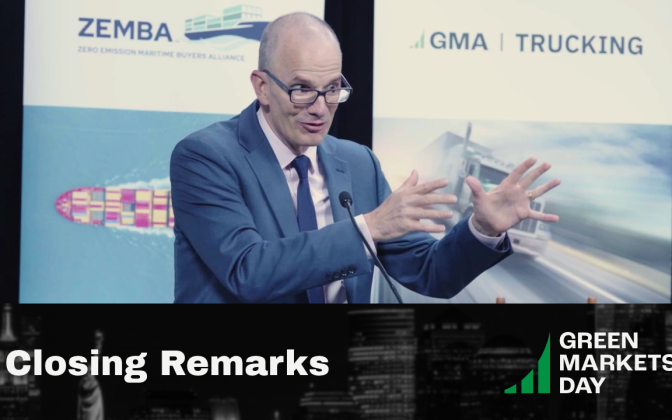
Green Markets Day 2026 | Closing Remarks
Jon Creyts, CEO of RMI, closed the third annual Green Markets Day by reflecting on the day’s announcements as evidence of a functioning ecosystem for new green markets, from new buyers alliances and members to expansion into new regions and new book and claim frameworks. He highlighted the umbrella registry system being developed to connect heavy industry and transport, and challenged attendees to take one concrete action after Climate Week to help move these markets faster.
See below for a full transcript.
TRANSCRIPT
JON CREYTS:
Terrific. Good afternoon. Hello, everyone. For those of you who don’t know me, I’m Jon Creyts. I’m the CEO of RMI. You’ve already heard from some of my colleagues today about our work transforming global energy systems through market-driven solutions like the ones that you’ve explored here today. And I’m honored to be here with you for the closeout of Green Markets Day.
First, a huge, huge thank you to our host, Amazon, who has been a partner accelerating the market for green fuels and materials since day one, right? And I think we all know that not only do they help bring us together, but they help provide the confidence to make some of those early deals happen through their decarbonization support and through their commitments. Today simply wouldn’t have been possible without them, without you, so thank you to all the Amazon folks here.
An immense gratitude as well to our convening partners in GMA and to the Smart Freight Centre for making the third annual, and this is amazing, it’s the third year we’ve done this, the third annual Green Markets Day a reality. So thank you as well to all the speakers and to you all as attendees, because there are no shortage of things and places you could be right now, and we are just grateful that you’re here at this moment.
Now I wasn’t able to be with you all for the full afternoon, but I did get a chance to debrief with my team here, and what strikes me today, based on their feedback, is that this wasn’t a collection of isolated announcements. We’re starting to develop a functioning, thriving ecosystem, right, to drive these new markets together. You know, today’s theme was about turning progress to scale, and I think it’s clear from what you’ve heard today that we’re well on our way.
We’re seeing buyers initiatives grow, from launching in new sectors like the Green Ammonia Buyers Alliance, and for those involved with that, it’s amazing. Congratulations on that. We’re welcoming new members to longer-term stalwarts like ZEMBA, as well as expanding into new regions through the GMA’s partnership with Green Fuel Forward. So there’s lots of opportunity here, lots of expansion, growth, and we’re seeing increasingly this global opportunity.
We’re also seeing demand for members to drive changes in commodity production and transportation, whether it’s fulfilling the need for lower emissions concrete and cement, while cutting 70% of emissions compared to conventional cement through SCoBA, by helping a next-generation sustainable aviation fuel facility reach FID through SABA, or putting new fully electric trucks on our roads through GMA trucking.
So lots of reasons for us to feel good about the progress we’re making, and we’re building the systems that help make sure all this progress can be tracked and verified, which is super important by companies so that the claims that we all make through the new book and claim framework that’s been established for steel, that really complements existing frameworks and gives us the confidence that we need to move forward with investability here.
So there’s a clear arc that we’ve heard across all these different activities today that standards and market infrastructure create trust, that aggregated demand creates a credible signal, that contracts turn that signal into momentum and into investment, and investment brings new supply into the market. And once we know that all that machinery works, we can adapt it across sectors and geographies. And that’s how a market goes from promising to self-reinforcing. And we’re all part of that cycle right now.
So with that, it’s worth zooming out for a moment here, because we all are in the nuts and bolts on a day-to-day basis. And just to recognize that the clean energy transition has crossed a significant threshold here. Last year, we had nearly 700 gigawatts of renewable capacity that were added globally, more than any other year, accounting for more than 85% of new power capacity, right? This year, the world’s on track to invest over $2.2 trillion in the energy transition. Again, a full trillion more than is going into the old energy economy. So this is no longer a story about whether an energy transition will happen. It is happening, right?
The challenge now is extending that momentum into the harder parts of the economy, the next parts of the economy, the fuels, the materials, freight, industrial systems that are really represented in this room here.
So we’ve moved beyond theory, right, at this point. A little over five years ago, when we launched the Sustainable Aviation Buyers Alliance, we had a theory, right, about how we could drive investment into the leading-edge technologies in one of the hardest sectors to abate. What started as committed action in a group of about 10 buyers, right, has grown by leaps and bounds in the past five years and is now embodied and represented in this room.
The most exciting part is it’s not any longer just a story about SABA. We’re seeing the model become repeatable, right? Again, we see it in shipping and trucking and cement and concrete and steel and chemicals and fertilizer now. That’s amazing, right, and that’s part of how we’re all working together through our institutions to drive broader change. Think. Do. Scale. Right? That’s our mantra here.
So, the demand that we’re demonstrating across sectors gives suppliers something enormously valuable, the confidence to invest, to modernize a plant, to scale a new product or to build that next facility, and today’s conversations have all really demonstrated once again that demand aggregation, collective procurement, book and claim systems, and other market-based approaches are really increasingly the way to produce tangible results.
So, the next step really is about how do we make this repeatable, how do we make this easier for you all, right? And as these demand initiatives have grown, we’ve really got to work on that standards, on the accounting, on the registries, on the other market, making infrastructure that can provide you all with greater clarity on, and really the confidence to act.
So we’ve seen great success in things like the SAFc Registry, and I will say we are on the brink of a million tons here right now. Literally during happy hour today, somebody could seal a million tons, so make that a motive here. What’s that? World Energy is in the room. You could do it, Adam and team. You could do it.
And the Katalist Registry for Shipping, which is helping companies address the emissions associated with maritime. This is a sector that moves 80% of the world’s freight. Again, we’re seeing opportunities there.
The challenge ahead isn’t simply developing more models, but it’s taking what is working and making it easier and making it replicable. So, that’s about how we expand it to multiple sectors, and in particular, we’re excited about the umbrella registry system right now that you’ve heard mentioned today. It’s designed to help build connectivity and confidence and create simplicity and help drive to scale. And so, think about that and let’s all feed in and make sure that it’s a success in itself. It’s really a next generation nonprofit platform. And it’s going to bring together heavy industry and the transport sectors into one ecosystem that allows, again, that ease and that replicability that’s so essential.
So instead of spending time keeping track of holdings or figuring out, you know, kind of requirements, you’re going to, through what is arguably heroic efforts by many of you, we’re going to make that easier and take your time and put it where higher value can be used in finding those next transactions rather than authenticating what you’ve already done. I hope everyone in this room can be a part of the journey as we build that to scale.
So with that, I know I stand between you and happy hour. You’re just going to literally go out those doors and go downstairs and there will be drinks and you’ll be able to continue the ecosystem formation in a informal environment that’s so essential to all the work that we’re doing to accelerate at scale.
But I do want to leave you with a final thought, right? And that’s for each of us, we’re going to be in a lot of meetings here this week. We’re going to have a lot of opportunities, but I want you to take one, one action here post, post-climate week that proves that this is all worthwhile in the end.
And if you’re, if you’re a buyer, right, where can your demand become more powerful by joining with others? Maybe SABA, right? We can get over a million, but maybe other places. If you’re a supplier, what signal would you, would give you the confidence to invest, right? And if you’re an investor or market builder, what friction can you remove that’s going to make that next transaction easier? Take that as a request, as an obligation, right, of having been here and invested your time. Let’s all take that forth into action.
The momentum is real. The machinery is in place. We now just need to get it moving faster. Thank you for all the amazing work you do. In this amazing community, let’s all continue to spin that machinery faster, do more deals, and drive more change at scale. Thank you all.
Related News & Resources

11.02.26
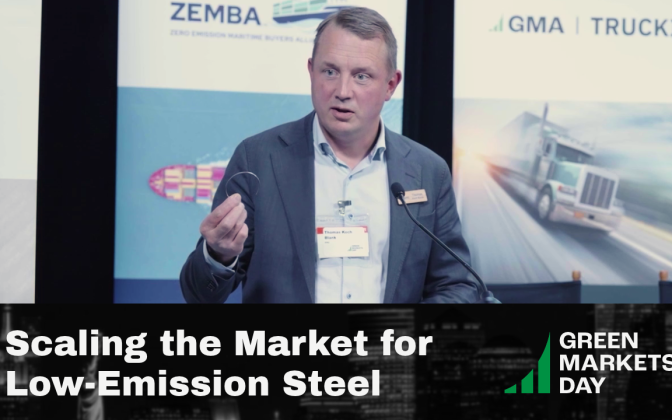
Green Markets Day 2026 | Scaling the Market for Low Emission Steel
Thomas Koch Blank, Managing Director at RMI, discussed the state of the low-emission steel market and announced the release of a new book and claim framework for steel. Developed with more than 20 organizations and based on real market transactions, the framework is designed to build the systemic trust that buyers and producers need to transact at scale, since the emissions benefit of low-carbon steel can’t be seen or tested in the product itself.
See below for a full transcript.
TRANSCRIPT
THOMAS KOCH BLANK:
Good afternoon. We’re running towards the end of a busy day, so I will try to keep this fairly short. Thanks for joining us here this whole afternoon together with this amazing set of partners that were here to really work on activating supply chains and reducing emissions in our Scope 3 footprint.
We have heard throughout the day the value and the need for standards and market infrastructure and early transactions to lead the way in shaping these transitions. I’m going to talk a little bit about the steel sector where we can really see examples of all of these imperatives.
The industry is indeed moving. There are some real strong evidence of availability of supply and demand connecting, but we still need a stronger demand signal and we need credible market mechanism to support the supply chain. We even have representatives in this room that are building the next generation steel plants that will allow us to actually make a significant reduction in the steel supply chain footprint.
So there’s no longer really a technology question in the steel sector. Of course, there is a question of whether, you know, which technology will capture market share in the end, but there is not a question of whether or not there is a technology available.
So what we need now are conditions to finance and conditions to deploy and scale these technologies. Connecting demand with supply is critical, as critical for the steel sector as for any sector that we engage with. And to facilitate this, we, as an organization, together with many of you in this room, work across multiple enablers here to create transparency, financing, procurement practices through a number of different platforms.
I think, in an essence, part of the problem here is that we can’t — we’re trying to facilitate transactions of a value that you want to pay for that you can’t really see in the product that you’re buying. So I’m wearing this bracelet which is made out of fossil-free steel to remind myself that the technology is available, but I’m also claiming that right now and there is no way for you to prove whether that’s right or wrong. You can’t sample it, you can’t test it, you can’t bend it to see whether it’s fossil-free or not. You’re going to have to take my word for it.
Now, that’s one problem that we are trying to address with the market mechanism we’re putting in place. There’s another problem with dilution of demand signals. There’s a problem of cost and logistics of a bulky product. All of these barriers are addressed with what we all know and are familiar with as a book and claim framework. And while it’s not a sort of a silver bullet for market conditions, it’s actually quite helpful for early transactions.
But in the end, going back to my bracelet, the foundation of the market is trust. So you can choose to trust me when I claim that it’s a hydrogen-reduced piece of steel. But it’s better for all if it’s a systemic and institutionalized trust base that allows everyone to transact at scale.
So questions like what qualifies as low carbon? What emission reductions are verifiable? How do you make sure you have integrity in the transactions are really, really critical. And it might sound like basic fundamentals, but we need to create that trust in the market because it’s not automatically there.
So what we have done to contribute here is to… if this works. No, it did not work. There we go. Maybe it was up already.
We have released today a book and claim framework for steel that is bringing what we consider to be a well already tested framework. We’ve based this on real transactions in the market with again with multiple participants in this room. But we’ve also done it in a collaborative effort with more than 20 organizations involved. We have facilitated this in our independent nonprofit position of getting both buyers and producers, tech suppliers and academics involved in creating this standard or this framework. So this collaboration is important because that’s how we move the trust in the solution from a single organization into a more systemic and established trust base.
We’ve gotten some positive response already from this framework. We see that it’s being used already in some real market transactions. I think it’s worth noting that as these frameworks are developed not only in steel but in other sectors as well, we’re all involved in moving these forward. For each sector, we dig into the details of the transaction mechanisms. We learn something that we can bring with us to the next sector we work with.
We are addressing at this point a number of sectors. I do not remember the exact number that we’re working on here together with GMA and others, but we’re knocking on double digit, which is really exciting. And across all these sectors, of course, the goal is to convert demand into investment so that we see new technology deploy. And we see real impact on the supply chains. Right.
So I’ll close out here because I realize that I’m almost the last thing between everyone here and drinks by inviting you all to continue collaborating with us as we move this work forward across more sectors and more transactions. Thank you very much.
Related News & Resources
11.02.26
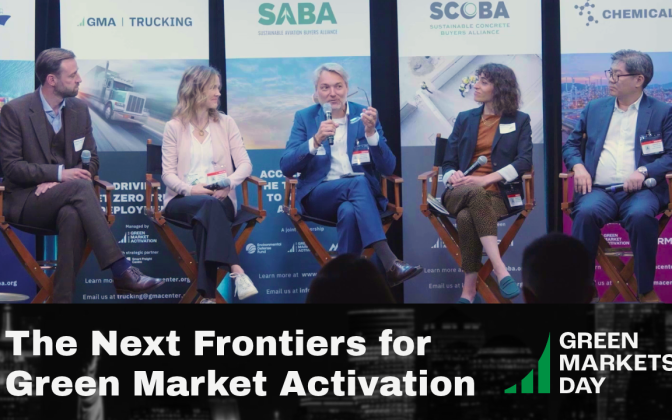
Green Markets Day 2026 | Panel: The Next Frontiers for Green Market Activation: New Technologies, New Sectors, New Regions
Moderated by Andrew Alcorta, Senior Director at GMA, this panel featured Philippe Vedrenne, CEO of 3Degrees; Frederick Teo, CEO of GenZero; Rachel Lichte, Interim CEO of the Good Food Institute; and Devon Lake, Head of Net Zero Strategy at Meta. The panelists explored where demand aggregation and market mechanisms should go next, from new sectors such as metals, plastics, low-carbon fertilizer, green ammonia and alternative proteins to new regions, especially the Asia Pacific. They also discussed the standards and market infrastructure needed to work across geographies, and shared what success could look like five years from now.
See below for a full transcript.
TRANSCRIPT
ANDREW ALCORTA:
So, first of all, thank you to the panelists and we’ll do introductions in just a moment. But I just want to start with some reflections and perhaps some framing for this conversation about new frontiers for demand aggregation and market mechanisms.
Every Green Markets Day, I find myself kind of looking around the room and seeing all the various folks that I know from past lives and that I know from some of the work that we’re doing within various GMA initiatives. And it is hard not to be blown away by the amount of good work that is happening in this space, even in spite of some real headwinds that I know many of us are feeling at the moment.
And so I think it’s important to start by recognizing that there is real progress happening here and that deploying things like demand aggregation, deploying market mechanisms and book and claim is allowing us to really create wins in a number of sectors that have been very challenging to move forward for quite some time.
And if I think back to the deals that move markets panel earlier in the day, I think it is a reflection of the fact that we are seeing real projects move forward that either would have taken much longer or might not have been able to move forward absent these mechanisms.
And it’s a good opportunity to step back and really take stock of the fact that we have something that is working, right? And we need more of it and we need more of it faster, but we have found something that really is moving the needle and not only allowing projects to move forward to FID, but ultimately is going to put steel in the ground for low-carbon projects that we can point to as a demonstration that this is possible.
And so I think it’s against that backdrop that it’s important to really ask the question, where else can and should we be applying these mechanisms? And that’s what we’re going to explore on the panel today and we want to take that from two lenses.
The first is what other sectors might be ripe for demand aggregation, for market mechanisms to really be applied and to accelerate progress beyond what we’re seeing? And the second is what new geographies can we bring these mechanisms to or scale these mechanisms in more aggressively and how can we do that effectively?
On the first one, as we think about additional sectors, there are two places that I just want to pause on and frame out. I think it’s important to step back and look at the entire emissions stack that we’re trying to solve for.
25% of emissions come from industrial production. Cement and concrete, steel, copper, aluminum, a lot of things that we take for granted and don’t think about, but that are responsible for this structure that we’re in today, are responsible for the phones and laptops that we are doing business on every day. And it is a sector where, despite the fact that we all know there is a huge impact and a huge challenge that we need to tackle, very little progress has been made to date in many of these sectors. And we have seen some announcements here and there about low-carbon production, but they are still the exception and not the norm. And I think understanding how we can be applying some of these mechanisms to industrial commodities and to industrial production is a question that we really need to seriously ask here, particularly when a lot of the market failures that we have successfully addressed in some of the transportation sectors are also present in industrial commodities. And I think we could bring some of the same solutions to bear.
Another sector that we need to look at here is agriculture, which is another 20 to 25 percent of emissions and is another place where there are some really challenging problems. And we are beginning to move forward and get traction on some of those, but we have a very long way to go. And so thinking about how can we accelerate some of that progress is really, really critical.
If I switch and think about the geographic side for a moment, many of us live in this world and we’re trying to figure out how to get these projects across the line. But I think it’s really important to step back and remember that while many of the interactions we may be having on a day-to-day basis or with colleagues in the U.S. or North America or sometimes Europe, the projects that can really deliver here can happen all over the world. And particularly when you look at the global south, some of the energy cost fundamentals are incredibly compelling in terms of being able to bring new technologies to the market at effective costs if we can solve for the capital stack.
And at the same time, there is demand all over the world. I was looking up some stats as I was preparing for this, and it is remarkable to think, I think for many of us, that only 10% of the validated SBTi targets come from companies headquartered in North America. 35% of the targets come from companies headquartered in Asia. And so there is an enormous amount of opportunity. And if we are going to make the voluntary markets drive the change that we need to see and live up to their potential, we need not just the first wave of demand that some of the folks, including people here on the stage, are delivering, but we need to figure out who is going to follow that demand. And part of that is recruiting the next set of buyers in the markets that we’re operating in today, but part of that is also expanding the aperture and looking at new markets. And so that’s what we get to explore over the next 35 minutes or so, and I’m really excited to get into the conversation. And we’ll talk about the sector element of this, the geographic element of this, and– and I want us to really pause and talk for a few minutes about, okay, well, if we execute on that and if we do it right, what does the world look like? I think it’s easy for many of us to get caught up in the day-to-day of the work, and it’s important to step back and say, what is the vision here and what can we actually achieve if we are effective in rolling these mechanisms out? So with that, I will pause.
I would love to turn to the panel here and ask everyone on the panel to provide a very quick introduction, name, organization, perhaps a little bit of context. And I can start here briefly. My name is Andrew Alcorta. I’m a senior director at the Center for Green Market Activation. I lead our low-emissions materials work, which includes both cement and concrete, ammonia, and other high-value chemicals. And I’m very excited to be here with you all today. Devon.
DEVON LAKE:
Hi. Devon Lake. I’m the head of net zero strategy at Meta. And I think this is my third Green Markets Day. And it’s just a thrill to be here and see how many different sectors are represented. I’m really excited to talk about the new sectors that are coming. And my team leads basically all of our work, investing in market mechanisms across many of the commodities and technologies that we’re talking about here.
PHILIPPE VEDRENNE:
Hi, everyone. I’m Philippe Vedrenne, CEO of 3Degrees. 3Degrees is a global climate solutions provider. We help companies to reduce emissions on Scope 1, 2 and 3. We have been in the business now for more than 20 years. We are a B Corp. We’ve just reached the $1 billion turnover. Joined this company one year ago. I spent 25 years before in the energy space. Still new in this space, but very excited about what we try to do all together. Thank you for having me here.
RACHEL LICHTE:
Hello. Wonderful. Hi, I’m Rachel Lichte. I’m the interim CEO of the Good Food Institute, or GFI. We are a nonprofit think tank, and we focus on unlocking the resources and the knowledge to change how meat is made in order to create our vision of a thriving world fed sustainably. We just celebrated our 10-year anniversary. We have a presence here in the United States, and we have affiliates around the globe, so we’re a global network. And I’m absolutely thrilled to be talking about new opportunities for aggregating market demand.
FREDERICK TEO:
Very good. Hi, my name is Fred again. I’m CEO of GenZero. I think GenZero is probably the baby on the block here. So we are just slightly over four years old. We are a climate investment company headquartered in Singapore, wholly owned by Temasek Holdings. We invest into nature, technology, as well as climate ecosystem solutions. And we have been focusing on delivering both sustainable financial returns from our investments, as well as to deliver climate impact from our investments. Thank you.
ANDREW ALCORTA:
Wonderful. And thank you all for joining us today. Devon, I want to start with you. And, you know, as I think about the challenge that Meta is tackling here with the net zero goal, the supply chain that you all have to manage is incredibly complex, right? And it spans power, cement and concrete, steel, all sorts of metals, from products to data centers, and even food, right? And so as you are thinking about the next set of opportunities, what are you all focused on as the sectors that you really want to try to deploy market activation techniques in and move the needle in?
DEVON LAKE:
Yeah, no, that’s a great question, and it’s one that my team really loves kind of digging into. So the sectors that you mentioned, cement and concrete, steel, iron, we’re now on our third, fourth, fifth transactions in each of those sectors. And it gets easier. The AIM Platform is our bible. I say this all the time. We now have guidance, which we didn’t three years ago, in terms of what makes a quality investment of this kind. The book and claim systems are out there. We’re getting the sector guidance that docs in. So the whole process from an investment point of view is really becoming much easier. And the counterparties, the folks bringing us the projects, whether it’s through buyers alliances or directly, are also much more mature. So all that to say, you know, I have a lot of hope for where this can get to.
It’s been interesting to start to work, for example, on the trucking sector. That was one of the things that I have to do is to get my leadership excited about every new sector we go to. It’s not enough to say that deep in the bowels of my Scope 3 EEIO factors, like this emissions is there. That doesn’t, you know, that doesn’t, it’s not going to get the money moving. So instead, what we do is we really help communicate what are the sectors that we drive through our business and that our suppliers operate in, what are the solutions that those sectors need to decarbonize, how can we do investments now so that in five or ten years our suppliers can be using these solutions directly, or we can be using these solutions directly.
So one of the sectors that we’ve been spending more time in is plastics, which is what we’ve named chemicals, because chemicals didn’t capture the imagination, but plastics people can touch and feel from a data center perspective. So we actually just did our first plastics project, which was announced today with Macrocycle this morning, and we’re learning in that sector. And so I think another sector that we’re really interested in continuing to explore is, what are the other metals that we can be doing work in? Copper, aluminum, we know that these metals are relevant to us and our suppliers, and we’re still very early in terms of figuring that out.
ANDREW ALCORTA:
Wonderful. Thank you, Devon. Philippe, I want to turn to you. And I would ask that maybe you share a little bit about what 3Degrees is currently doing in regards to low-emissions fertilizer, low-emissions ammonia. And if you can say a little bit about why book and claim might be particularly important in this sector, it would be wonderful.
PHILIPPE VEDRENNE:
Yeah, this is actually one of our core topics. I mean, when we are talking about low-carbon fertilizers or fertilizers, generally speaking, what are we talking about in terms of emissions? This is a really hard spot. I mean, fertilizer industry emits roughly 1.3 gigaton of emissions on a yearly basis. I think it’s nearly a quarter of total U.S. emissions on a yearly basis, or equivalent of 300 million of vehicles powered with gasoline. So it’s really a very, very important sector in terms of emissions. And 40% of these emissions resides in the production of these fertilizers.
So end of 2023, 2024, 2025, we decided to launch the Low-Carbon Fertilizer Alliance, bringing together actually consumer brands, forward-looking companies who wanted to accelerate the decarbonization of this space. And technologies exist, actually. You can use catalytic technologies to abate nitrous oxides in nitric acid plants. You can install CCS, carbon capture and storage when you produce ammonia. And you can in the future even produce green ammonia with green power, water and air.
Now, you need investments to deploy these technologies. And these emissions happen very upstream in the value chains of these big brands. And so there is a huge and very complex supply chain that sits in between. I mean, these potential investments and this ultimate consumer brands company.
Now, that’s where actually collective action and market-based instrument comes into play. With market-based instrument, as long as you can associate your intervention or investment to, let’s say, a geographic boundary which makes sense towards your value chain, then you can overcome this problem of not being able to do direct procurement from your fertilizer industry. And so you can deploy market-based instruments collectively. And that was the other element which was important.
When you need to invest in these assets, and we mentioned that earlier in the day, I mean, no one can afford investing in a single asset. So having a collective approach, a pool of investors that can fill their actual capital through these technologies, make these technologies accessible, lower the initial ticket for each of them, and building a coalition of buyers as well, resolve a risk management issue, which is, in general, these budgets are only yearly budgets, and you want to have a steady flow of money over the years to finance not only the capex but the opex of these technologies.
So one of our first interventions was with CF Industries, which is a large fertilizer producer in the United States. We finance a catalytic-based technology to reduce emissions by 600,000 tons per annum, so that’s a significant one. We have currently 25 members in this LCFA alliance. We are going to add new projects, and the next step now is what you see on the left side, the Green Ammonia Buyers Alliance. We want to replicate what we have done with the Low-Carbon Fertilizer Alliance in the green ammonia sector. We will have exactly the same concept.
Coming from the renewable energy certificate business, actually we experienced today what we experienced 20-25 years ago, when actually through RECs we were allowing end consumers to have access to renewable power without having to manage the complexity of the supply chain and the logistics of power. So that’s where we are today, and we are still at the beginning with a lot to come, but with a good start.
ANDREW ALCORTA:
Wonderful. Thank you, Philippe. And we have been incredibly excited about the collaboration and the ability to move the Green Ammonia Buyers Alliance forward here. Rachel, let me go down to you, and I mentioned briefly in my opening that as we think about new sectors, industrial commodities is one space we need to think about, the agricultural sector is another. And there are some real tricky challenges when you start breaking down emissions from food and beverage and the agricultural supply chain more broadly, and animal proteins are at the heart of a lot of that. And so we’d love for you to share a little bit about, maybe just some context on the challenge as you see it, but also the solutions that you all are working on at the Good Food Institute.
RACHEL LICHTE:
Absolutely. So, you did speak to the overall global emissions of agriculture, but if we look at animal agriculture in particular, it’s 12% of global greenhouse gas emissions. So there is a huge percentage that we can focus on, just from animal agriculture. Animal agriculture is also incredibly inefficient. 80% of farmland is used for just 17% of the calories that are produced. And the demand is increasing. Right now, the projection is that it’s going to increase 50% by 2050. And animal agriculture is connected to some of the biggest issues that we face as a globe. So in addition to greenhouse gas emissions, we’re also looking at biodiversity loss, land use issues, water pollution, a whole slew of human health issues as well, zoonotic disease, antibiotic use resistance. There are a lot of issues that are connected to livestock and to animal agriculture.
So at GFI, we really focus on not trying to get people to change what they eat, but rather to look at how meat is made, how our protein is developed. And if we can produce those foods differently, then we have an opportunity to drastically reduce some of the negative side effects of it.
So at GFI, we focus primarily on three different types of proteins. So one of them is plant-based. Perhaps you have had it before down the street. You can get products like a Beyond Burger or Impossible that is primarily a plant-based protein. So meats that are made from plants. But we consume them, and they perform, and we experience them just like a conventional animal product. Another technology is fermentation-derived. So those are foods that are made. If you were to, you could walk in, at industrial scale, you could walk in and see huge tanks. They’re like three floors tall. They even go multiple floors through, and it looks like a big brewery. But rather than producing beer or yogurt, they’re producing proteins. And these proteins are used in really small amounts, but they provide critical functionality or performance or taste benefits to products. And then the third technology that we use or that we focus on is called cultivated meat. So these are meats made from animal cells rather than whole animals.
And across the board, we see that there is the emissions reductions are absolutely incredible. So through this and as we think about a buyer’s alliance here, we’re really focused on precision fermentation and in particular whey, so a dairy protein and eggs. And the emissions reductions potential there is significant. So with whey, we’d be reducing emissions by 77% land use. It’s less than 99% more efficient from a land use standpoint. And with egg, it’s 55%. And it continues on as we look at plant-based and cultivated as well. So huge, huge potential as far as more environmental benefits and in addition to others.
Over the past 10 years that GFI has been around, we’ve seen incredible development in this space. So 10 years ago, alternative proteins and protein diversification wasn’t really talked about a whole lot. But we have seen tremendous scientific advancement around the globe. There are three countries that have already approved cultivated meats. So in the United States, there are different restaurants and states you can go into and purchase cultivated meat right now. We have seen precision fermentation products, plant-based products make tremendous strides.
And we’ve also seen some headwinds. Over the past few years, we have seen that products were too expensive. Products did not meet the performance expectations. They didn’t taste quite right. They didn’t feel quite right. So we did not see them perform as businesses would have expected. But there is a whole set of technology that has continued to develop but is now really kind of caught in this middle where they have, there is technology that is ready to scale. There are businesses that see, that have invested in these technologies that have seen some benefit but there is a real need to scale them up more. So we’re in this kind of stalemate situation with technology that is ready to scale. Businesses that see some benefit, that see a value proposition primarily around the sustainability benefits or the price stability benefits, particularly as there is price volatility with dairy and eggs. But there is a big risk in investing.
And so as we think about opportunities to support and address this market failure, we’re very excited about what we’ve learned with GMA about the opportunity for something like a Buyers Alliance that would allow us to aggregate some of that demand and really signal that there is demand for these products in order to unlock that financing that can help scale up these technologies. So there is demand for these technologies. We’ve seen some from some of the large companies around the world, like JBS and Novonesis. There is technology that is ready to scale. There is tremendous greenhouse gas emission savings. And so we’re really excited about the potential for precision fermentation technology in particular.
ANDREW ALCORTA:
Wonderful. So, I mean, it’s really exciting to hear both the appetite to look up in upstream and supply chain and really understand what are those remaining hotspots. And a lot of what I’m hearing here is industrial commodities, right? Metals, materials, as well as ammonia into fertilizer is key opportunities in places where action is already taking place. And then, Rachel, I am hearing, you know, perhaps kind of the new frontier here as being how can we start applying demand aggregation to some of the other big problems that we know we have ahead of us in the transition.
I want to switch gears here and start moving to the second lens that we teed up at the beginning of geography. And Fred, I will start with you. And, you know, I think it’s important to start with the incredible work that GenZero is already doing on applying this model. And at least part of how I think about it is, you know, ultimately so much of what needs to happen to deploy these models is building understanding and building trust. And I think having folks that are operating in market and know the key players and can do that translation work is critical as we think about building those things. And so would love to hear how you are thinking about opportunities to apply demand aggregation and market mechanisms within the Asian context more broadly, both on the supply side, but also looking at the demand generation side of this.
FREDERICK TEO:
Sure. I think when we think about market activation, and that’s true in Asia, that will be true anywhere else. I think that I’ve got a couple of things that you probably need, especially when we’re talking about green solutions. The first is that you’ve got to be very clear about the policy and regulatory framework and environment. Whether it is about standards on what kind of new foods you will need to have, and Singapore went through that process as well, right? Or setting a sufficiently ambitious carbon price to be able to incentivize change and transformation. You’ve got to have the enabling regulatory and policy environment. Otherwise, it is also going to be very difficult for many corporates to make the case to often pay more, right, for some of these solutions. That’s one.
Two, given the current macro environment especially, it is important for us, when we’re talking about activation, to be able to connect to the audience. In other words, can we speak the language that people will understand? For many of us in this space, right, I mean, we are sometimes lost in our own alphabet soups and our own technical jargons, which only we understand. But the point of it is that when you are talking to others, you’ve got to be able to relate to them and explain things to them and have these solutions become appealing.
So, for example, all the good stuff that Rachel is talking about will not work if it doesn’t taste great, right, because food is experiential. We’ve got to find a way to tell people, look, you know, all of us love to travel, we want to see new cultures, new places, we’ve got to fly. Now, how do we do this in a way that doesn’t also make you feel bad about the impact that you are, you know, having on the planet, right? So, we’ve got to think about changing the narrative. So, both of these things actually require us to develop a little bit of an innovative framework and I will relate to some examples out in Asia on what we are trying to do.
Let’s talk about the narrative around climate and maybe shifting it from clean energy to a question around energy security and resilience. This issue around biofuels that we spoke about has actually come to the fore more recently, not because we all want to have like SAF for aviation but because you don’t want to be vulnerable to a single choke point somewhere in the Middle East. And that means that you’ve got to diversify your feedstock, you’ve got to diversify the way that you have access to fuels and that means in the near term biofuels or renewables or many other kinds of things. So, where we see an intersection between climate impact and energy resilience, that is a good place to activate.
Now, even on the food question, we work on carbon projects that are nature-based around the world. One very interesting project is in India where we talk about sustainable rice farming and that involves teaching some of the smallholder farmers practices around alternate wetting and drying. Now, why do we do it? When I visited some of the farmers in India, I asked them, you know, this practice has been around for a long, long time, why are you doing it now? And they said that that’s because over the past few years, the average rainfall in that part of India dropped by 50%. And as you know, rice farming involves continuous flooding of the rice fields. And so if you don’t have enough water, you’re going to have a real problem. So teaching them how to save water is important for their ability to continue to grow rice. But for us, it results in lower anaerobic decomposition, less methane emissions, and we can then credit it, right, and draw additional revenues. Now, so there is actually an adaptation concern here as well, right, because you are teaching them how to deal with agriculture in a much more water-constrained environment. And then there is a food resilience component to it.
But I belatedly also realized that there’s something else happening. With climate change, farmers need to adapt to very new conditions. So that means that they are sometimes switching out from food crops to cash crops. Take, for example, oil palm that uses about a third of the amount of water to produce the same amount of product. And each ton of that product, crude palm oil versus rice, is probably three times more valuable. If you are the smallholder farmer facing some of these challenges, it’s kind of like a no-brainer. But carbon revenues, for example, can then channel additional economics to the smallholder farmers to perhaps alleviate some of these negative disincentives. So this is important for us.
So in other words, change the narrative. We don’t need to always talk about climate impact. We don’t always have to talk about doing clean energy, low-impact food. Sometimes it’s about food resilience, energy resilience. We can talk about it in a language that others can understand. Secondly, we’ve got to corral each other or support each other to be able to get the correct policy frameworks to encourage action. And finally, I will also say that we’ve got to find the correct economic incentives because we have got to make sustainability sustainable. Great. Thanks.
ANDREW ALCORTA:
Thank you, Fred. Philippe, I want to turn back to you. And I know 3Degrees has operated across a range of markets and has sold market mechanisms ranging from RECs to other EACs in a number of markets. And, you know, I think as we are thinking about applying and scaling this model in new places, one of the questions is how do we need to adjust this model? Or to what extent should we be prioritizing consistency and standardization? So I’d be curious what lessons you have learned about, you know, where and how these models might need to be flexed in different policy or infrastructure or demand environments as you have operated in various geographies.
PHILIPPE VEDRENNE:
Yeah, I will share, I mean, our experience more on the REC side. I mean, we are operating nearly in 65 different EAC markets globally. And some of them are very mature. REC markets are very greeny markets. Here are very, I mean, standard liquid. Some others are much less. So we face a huge diversity in terms of market infrastructures. And when we look at these market infrastructures, four dimensions are important for us. The registries, I think we mentioned that in a previous session. The chain of custody, how we track actually the commodity. The local regulation. And I put that last, but I think it’s the most important, the accounting standard and target setting standard. And I will come back to that.
Of course, when we are talking about registries, there’s a question of cost to trade. There’s a question. I mean, registries are super important to, I mean, validate the eligible environmental assets that are registered. The claim and the environmental certificates you can issue from them and avoiding the double counting. So that’s super important. It’s important as well to make sure that, I mean, you have easy access to them. You can lower your cost to operate with them. And we’re not necessarily at the same level of, I would say, sophistication across the world. So that’s something that might be an impediment to development of a market-based mechanism.
Chain of custody. In the renewable energy certificates, we talk about book and claim, where you can completely separate the flow of the environmental certificates with a physical power. In other commodities, you talk about mass balance, which is probably a more precise system to track the environmental attributes across the value chain within blended systems. I mean, both of them are valid. I mean, one is probably easier to manage and create more fungibility. So it helps. So the book and claim system helps actually to create more scale in terms of tradability. Mass balance is probably a more challenge from that perspective. That’s the one we have typically in the biomethane sector globally. But nothing that you can’t overcome.
Then you come with the regulation. I mean, the regulation has two sides of the coin. Positive signals in terms of price and value that actually give incentives to the demand to be there and to actually buy for these environmental attributes. The other side of the coin is a regulatory uncertainty. As long as we can complain about voluntary markets because actually the demand is difficult to trigger and that’s come back to what is the correct narrative to have company making actions. We like sometimes having more regulatory, I mean, strong frameworks to incentivize these interventions. But actually on the other side, you take the risk of change of regulation and that might be as well a difficulty.
Last point I think which is important is accounting and target setting framework. I think we had a great discussion earlier with David from SBTi. Where are the markets we operate? I mean, we’re going to manage the structures of this market differently. The storytelling might be different depending on the commodity we are addressing. But we need to be consistent across geographies in terms of the way we measure and we report our interventions. And because we are still in this flux of evolving guidance, evolving regulatory frameworks in some areas in the world, it’s an impediment actually to scale up what we currently try to do.
For example, the fertilizer industry. We expect to expand that in many other geographies. In Asia, it’s probably the right place where we could have a lot of demand and a lot of projects. But applying what we did on Scope 2 and Scope 3 is not necessarily easy. And we need to take care about issues we face as well on Scope 2. I mean, it was mentioned earlier today. Additionality. When we are discussing about GO markets in Europe, there is no more additionality. The question of double counting emission factors that take into account the market-based instruments which are traded or not. The question of regional matching. I mean, how close you are between your operations and the source of your EACs. That are issues we’re going to face in the Scope 3 market developments.
We are at the beginning where we actually want to trigger these markets. So we want this investment coming from actually these high-end firms that are committed. But moving forward, we’ll see some challenges we will have to address in terms of precision, in terms of accounting, precision in terms of locationality. That we need to address with wide open eyes.
ANDREW ALCORTA:
No, it’s very helpful. And I think we want to make sure that we are learning lessons from prior market experiences and the reactions that have come there. And perhaps you can file this one under shameless plug. But I think this is where the AIM standard work can be really helpful to navigate some of those tradeoffs in the early days. And what we’re seeing is more convergence and ensuring that these nascent markets we are helping to get off the ground. But we’re doing it with a glide path that addresses all of these things is the balance that we have to strike here. Devon, I want to go to you and understand from the buyer’s perspective, what does it take to engage across markets? And what do you need to see in terms of rules and standards or from a project perspective to be able to really take a meaningful position in projects across a range of geographies?
DEVON LAKE:
Yeah, it’s a great question. And just to confirm, we’ve got three minutes. Yeah, we’re going to shorten the next bit of this. All right, I’m going to be real fast. So I would say at the highest level, it is certainly easier for us to transact in the U.S. And we’re going after solutions that don’t all exist in the U.S., right? Either because the emissions aren’t happening here, right? This is not where the copper smelting, as far as I understand it, is happening. I’m learning a lot about where the processes are and thus where the technologies are going to need to be deployed. So that’s one.
Two, this is Scope 3. We’ve got a huge portion of our Scope 3 that is based out of this country, mostly in APAC, right? So there are a number of different reasons to go beyond the U.S. market, and it gets progressively trickier because it gets less familiar, right? And so the more that we have the book and claim frameworks, the registries, the more we’re able to say, yeah, this looks familiar. We know how to go and transact here because a lot of the other pieces, to your point on the standards, we’ve got those parts, you know, figured out. We’ve got a playbook to follow.
So I would just say standardization, whether that’s the contracts, the, you know, systems that we’re using, is going to help our team because my guess is our team at Meta is probably larger than most of the teams that people in these buyers alliances is maybe paying attention to, maybe working on, and our team will struggle to go internationally if there isn’t some replicability and familiarity in the way that the markets work.
ANDREW ALCORTA:
Incredibly helpful. So being conscious of time, I want to maybe condense this last section and just go down the line and ask each of you, you know, if we were sitting here five years from now and your wildest dreams have been realized for kind of your priority in the sector, what does the world look like? And Fred, perhaps I’ll start with you.
FREDERICK TEO:
Oh, I usually think that if I’m extremely successful with my work, I don’t need to exist. So if we are highly successful at what we are doing, you won’t need to have a dedicated market activation capability because it would just be the norm. I think that it would take a lot to be able to get there. Clearly, there will need to be political will. We will need to be able to bring some of the costs down. But if I can just summarize in one thing, I think we do need to work with each other a lot more closely and be a lot more open-minded about the kind of coordination, understanding of what is actually happening out here. You know, America is a continental country. It is a big, huge country. But it is extremely important, like just what Devon was saying, to be aware of what is actually happening outside the US, what is happening in Europe, innovation that is happening in APAC, developments that are happening in Africa and South America because, you know, really a lot of the action and what needs to take place to be able to get us to net zero will be happening outside this country.
ANDREW ALCORTA:
Thank you, Fred. Rachel?
RACHEL LICHTE:
Yeah, so in thinking about the near-term future, I’m kind of wondering where we would have room on this stage for a buyer’s alliance that speaks to the precision fermentation opportunities. So another shameless plug there. And if there are any people interested, please do come and speak with us.
But I think that it’s very much aligned with what you shared, Fred, that ideally there wouldn’t be a need for an organization that is going out of its way, that we have greater protein diversification, that this is fairly unremarkable, that the way that we source proteins, the way that we are eating is much more sustainable, so is not emitting and is far more efficient. That is a longer-term future, so we are doing what we can along the way.
Near-term, looking at a buyers alliance opportunity to help aggregate that demand and scale up supply. Medium-term, diversifying even the types of proteins that can fit within that sort of aggregated demand. And then longer-term, just an unremarkable commodity market that is much more sustainable.
ANDREW ALCORTA:
Thank you. Philippe?
PHILIPPE VEDRENNE:
Yeah, I hope in five years we will be here with GMA and RMI to celebrate what we have done on the low-carbon fertilizer industry and ammonia industry. Hope that we will have more than 200 members by then, that we will have a lot of demand, not only coming from the U.S., but from Europe and from Asia, with a lot of projects everywhere in the world, meaning that will become brighter and better.
And hope as well that we will be able to stimulate demand over 10 years and 15 years, long-term commitments. Really the things which are critical. And that they will consider some as normal things to do when you want to manage your supply chain risk, when you use it as a hedge. Because actually, as you mentioned, at the end it’s a question of resilience and forward-looking. So I hope that we will be there in five years’ time.
ANDREW ALCORTA:
Wonderful. And Devon?
DEVON LAKE:
I’m going to go back to, I think someone mentioned shovel-ready projects and ribbon cuttings. I would love to see just a huge map of all of the ribbon cuttings from the plants that are actually built from these transactions because I’m learning a lot about what it takes to move from idea in the lab or startup concept, you know, shopping an idea around to investors to actually getting the project built. And I’m hopeful that the demand that we and others represent accelerates that process. And I really just am excited to see actual materials that we can consider putting in our own data centers, that we can say we help those get deployed in this other facility. That to me is where, you know, I can’t touch the carbon, so I want to touch the concrete and the cement and just know that this is actually changing things in the real world.
ANDREW ALCORTA:
Incredible. So we will check back in five years. We’ll probably do one-year checks between now and then. But thank you all so much for the time, for sharing your thoughts here. And this is where we’ll break and actually hand over to our colleagues at RMI to share some of the work that they are doing on one of the industrial commodities that we started the session talking about. So thank you all.
Related News & Resources
11.02.26
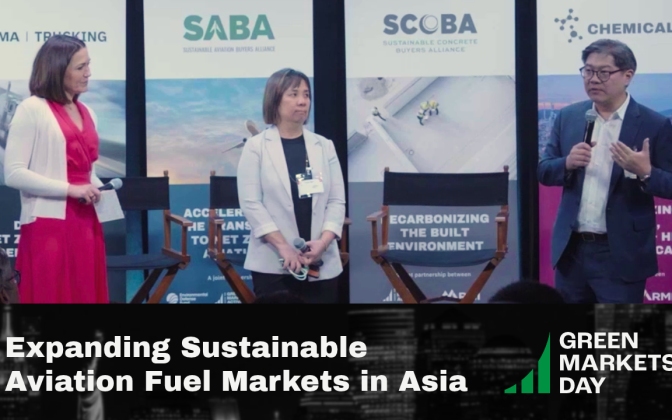
Green Markets Day 2026 | Expanding Sustainable Aviation Fuel Markets in Asia
Kim Carnahan, CEO of GMA, was joined by Frederick Teo, CEO of GenZero, and Seow Hui Tan, CEO of SAFCo, to announce the next phase of Green Fuel Forward, an initiative launched by GenZero with the World Economic Forum to accelerate the deployment of sustainable aviation fuel (SAF). GMA and SAFCo are joining the initiative’s steering committee, bringing GMA’s buyers alliance experience to the Asia Pacific region, where much of aviation’s future growth will happen, and moving Green Fuel Forward from raising awareness to getting companies to sign contracts.
See below for a full transcript.
TRANSCRIPT
KIM CARNAHAN:
We are here, I am here again, and we are here together to talk about decarbonizing aviation. Decarbonizing aviation is, in fact, a global challenge. It is something that requires us to be working on the creation of credible SAF markets all over the world. And although, of course, the Sustainable Aviation Buyers Alliance is in many ways my baby, and we are incredibly proud of the work that SABA has done, we have to be honest that SABA, to date, has had its membership primarily focused in the United States and Europe. And we can’t wait to grow demand all across the world.
And so we’ve been talking with our partners on the stage about how we can take advantage of the incredible opportunity that the APAC region is when it comes to growing aviation and sustainable aviation fuel. And we’re here today to talk about, you know, how we’re going to together take advantage of that incredible frontier for aviation growth. And expanding on the progress we’ve made through SABA, staying very well coordinated with SABA, but reacting to and reflecting on the regional specificities of the APAC region. That’s why we’re here today.
I’m here with Frederick Teo from GenZero, the CEO of GenZero, and Seow Hui Tan from SAFCo. And I’m going to hand it over to Fred to actually tell us, tell you about our news today.
FREDERICK TEO:
Thanks a lot, Kim. Good afternoon, everyone, and thanks for having us. So, Green Fuel Forward. The Green Fuel Forward was an initiative that we launched a year ago together with the World Economic Forum. The entire idea here really was thinking about how we could accelerate the deployment of SAF to help with the decarbonization of aviation.
Now, we know that SAF today is expensive, right? It’s gotten more expensive with what’s happening in the Middle East. Now, but with this green premium, we’ve got to be able to address it for a couple of reasons. One, we’ve got to make it simply much more economically affordable for the airline industry. Two, we have got to also encourage governments to be able to mandate for the use of SAF. If it becomes extremely expensive and is economically difficult and challenging, then governments are somewhat deterred from imposing an ambitious mandate and to push through much more ambitious policy.
So how do we address this? So we thought that it might be useful to be able to get corporates to pay a little bit, right, and defray the cost of SAF by buying things like SAF certificates. Now, it started as an idea within GenZero because for us, we address about 5% of our aviation emissions by purchasing SAF credits. Now, as a small company, could you do 10%, 20%, 30%? You could do a lot more. But that’s not the point. We can’t scale that way. So we’ve got to encourage corporates to be able to do whatever they can.
Now, that leads us to then think about how to get WEF to convene a grouping in one year of about nearly 50 organizations that encompasses not just the aviation industry and corporates, but also the fuel providers. We have to move on to the next phase. And the next phase is going beyond just telling people about SAF, how do you purchase SAF certs, but now about getting action, getting people to actually purchase, spend money, get things done.
And as I was sitting down on the floor just now, on the audience, I noticed that there are lots of alliances that GMA has been responsible for. And everything ends with ZEMBA, SABA, SCoBA, GABA. GABA. GABA. Is that GABA? Right. So it’s a buyer’s alliance.
But I think it is important to then think, okay, how do we contribute out of Asia? And why is that important? To 2045, Asia is likely to purchase something like 19 over thousand planes. And that is because about 40 over percent of aviation growth is going to come from the Asia Pacific. There is no sustainable global aviation without decarbonizing aviation in the Asia Pac.
So building on the capabilities of GMA, right, in doing a lot of all these buyer’s alliances, and being able to activate buyers to actually do something, we are delighted to be able to partner with GMA in the first instance to bring some of their capabilities to Asia. And to activate that market as well.
And on top of that, we are also welcoming SAFCo to the SteerCo for GFF. Because SAFCo is going to be responsible for purchasing lots of SAF out of Changi Airport. And on the back of that purchase, if we are able to drive more corporate spending in, then it will end up catalyzing even more demand for SAF out of Changi Airport. And that is, I guess, the flywheel and the theory of change.
And so we are very delighted, now as we move to the second phase of GFF, to welcome GMA and SAFCo to the SteerCo. And maybe I pass now to Seow Hui to explain a little bit more.
SEOW HUI TAN:
Good afternoon, everyone. Thanks, Fred, for the introduction. Like what Fred has actually shared, SAFCo was actually set up a year ago to operationalize the Singapore SAF policy. Some of you on the floor may have heard that Singapore is actually implementing the SAF policy starting from January 1st, 2027. So we are set up to help deliver the Singapore national SAF ambition. But all the infrastructure, the process, the system, the governance that we are going to be built for the Singapore government can be leveraged to scale a credible voluntary demand market.
And we are very excited to be partnering with GMA, given all the experience and expertise that GMA has in setting up all the different buyer alliances across hard-to-abate sectors. And of course, SABA being the first one in aviation, and of course, GenZero. Thank you for the pivotal role that you have actually done to start up the Green Fuel Forward initiative that actually given the stage for us today to move to the next phase. SAFCo is very proud and I’m actually very happy to actually participate in the next phase of GFF to really making this a reality.
Like what Fred has actually mentioned, we can’t just do this alone. We need to do this in partnership. All the expertise and all the experience that is actually done in U.S. and done in Europe can be replicated in Asia Pacific. And we know that similar to what Fred has also described, without decarbonizing Asia Pacific in terms of aviation, there is no decarbonization of aviation globally. So hopefully we look towards the next step together with the two partners here to really enabling the decarbonization of aviation. Thank you.
KIM CARNAHAN:
And I’ll just say one more thing before we pass to our next panel. We are very excited to take what we’ve learned through SABA and work with our partners. I just wanted to add my excitement specifically to have these two partners in this region.
In particular, GFF has already done a lot of work with GenZero and WEF to capacity build in the region to get a lot of companies involved and interested in SAF. And the next step is really getting them to sign contracts. And that’s what we’ve had so much experience doing through SABA. SABA is and will remain a global initiative, but in this region in particular, you know, diving deep into the regional specifics and finding a way to engage with companies in the region that we have not had access to before and get them interested in growing that demand and working together to grow the SAF market in Asia is something that is very exciting to us and what we’re so grateful to have the opportunity to work with our partners going forward.
Related News & Resources
11.02.26
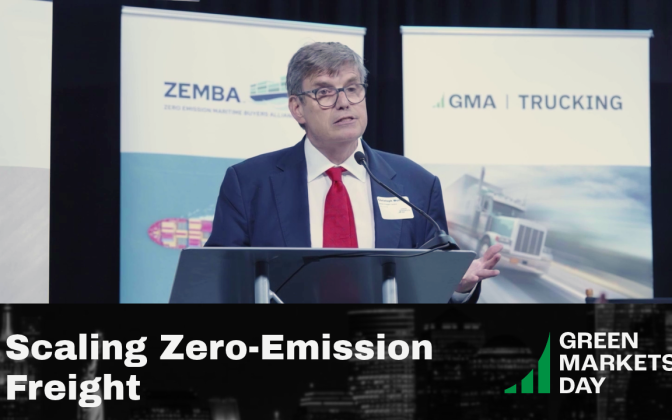
Green Markets Day 2026 | From Demand to Deployment, Scaling Zero-Emission Freight
Christoph Wolff, CEO of Smart Freight Centre, announced the largest electric truck order in US history: 2,500 battery electric Class 8 trucks, ordered through ZET SCALE together with Catalyst Mobility. He explained how pooling shippers’ freight demand, concentrating deployments in high-density freight hubs, and giving carriers demand certainty broke the chicken-and-egg problem holding electric trucking back, and how the next wave, in partnership with GMA, will combine physical procurement with book and claim.
See below for a full transcript.
TRANSCRIPT
CHRISTOPH WOLFF:
Good afternoon. Thanks for Kari, Kim, Andre and the GMA team for inviting us. Exciting things happening today.
I’m going to start with the headline because it’s a big headline. Today, and that meant 9 o’clock this morning, we, and this is Catalyst Mobility and Smart Freight Centre, announced the largest electric truck order in US history. 2,500 battery electric Class 8 trucks. A single order large enough on its own to nearly double the entire electric Class 8 fleet on American roads today. Thank you. A single order large enough on its own to nearly double the entire electric Class 8 fleet – I said that.
And here’s the part that matters most. This did not happen because a truck got cheaper by accident or because one company placed a big bet. It happened because some of the world’s largest shippers did something none of them could have done alone. They pooled their freight demand and they built a market that didn’t exist before.
That’s what I want to talk to you about for the next few minutes, not just what we accomplished but how it became possible and where it goes from here.
Let me set up why this is hard because it explains why it hasn’t happened until now. An electric truck today costs roughly three times what a diesel truck costs. Now, the technology works, the trucks are real and they’re on the road. But you can have the best technology in the world and still not have a market. And that price gap is exactly why electric trucking has been stuck in small-scale pilot for years.
Think about the position that everybody is in. A carrier can’t invest in trucks that cost three times as much without knowing the freight will be there to pay for them. A truck maker can’t bring the price down without volume. And they can’t get volume until the price comes down. And a single shipper, no matter how committed, can’t pay a high green premium on a lot of its freight. Multiple chicken and egg problems all around. So everybody waits for somebody else to go first. The technology is ready. The ambition is there. Nothing moves.
That’s what ZET SCALE was built to break. And this is how we did it. We went to the shippers, the companies whose products move on these trucks, and we aggregated their demand. Not vague interest. Real freight on real lanes. And they were willing to put behind this. In total, the demand we’ve aggregated is equivalent to more than 20,000 trucks. We took fragmented interest, scattered around dozens of companies and turned it into one credible, actionable signal.
And that signal changes economics in three specific ways. First, it pools volume so manufacturers can finally price at scale. When you show a truck maker thousands of trucks instead of a handful, you give them a reason to sharpen their pencil. And as you’ll see, they did. Second, we concentrate the deployments in about ten high-density freight hubs, places where the routes are strong and the economics already work best. That concentration drives up utilization of both the trucks and the charging, which pulls the total cost of ownership down further.
Third, it gives carriers demand certainty. A carrier can invest with confidence when they can see the freight is committed on the lanes they have run, they are running. That certainty is what turns a good intention into an order.
Put those three things together, and you’ve done something important. You’ve taken a desired goal and turned it into a calculated business case. And the scale of that opportunity is real. For the price reductions we achieved, more than half of the demand we aggregated could reach cost parity with diesel. That’s the whole game. And that’s how trucks leave the pilot phase and scale.
This has been the work of the past 18 months, with shippers, carriers, and manufacturers, and our finance partner. It was not fast, and it wasn’t simple. First-of-a-kind coalitions never are. But the result is not a pledge or a press release. It is a committed firm order.
Let me be clear about the ambition first, because it frames everything. Our goal with ZET SCALE is 10,000 trucks over the next few years. That’s a level we believe creates a self-sustaining market. The point where electric trucking no longer needs a coalition to organize it, because the economics carry it on their own. So this first round is the first 2,000 trucks toward that goal.
And to place that order, we ran a competitive RFP, open to every manufacturer offering– offering a battery electric Class 8 truck in the United States. We evaluated on price, performance, production capability and maintenance support. Here’s the most single, most important result. Every bidder lowered its price in response to the scaled demand. That’s the proof the model works. The process didn’t just get us one good deal. It moved the whole market at once.
From that process, we selected Tesla as a primary OEM for the first 2,500 trucks. Chosen on price, performance, production capability and maintenance support. And for carriers who want other options, additional qualified manufacturers are available to them as well. This was never about picking one OEM and closing the door. It’s about giving carriers real competitive choice.
Now a truck order is only half the puzzle. The other half is who pays for it. So we brought in a dedicated finance partner, ZET Financial, who will purchase the trucks and lease them to carriers and critically absorb the residual value risk. That’s the fear of what the truck is worth at the end of the lease and that it’s kept a lot of carriers on the sidelines. Taking that off their books is a big part of what makes this bankable.
Step back for a second because I don’t want the numbers to obscure the point. What we have really done is align an entire ecosystem and lower the risk for every part in it. The shipper, the carrier, the manufacturer, the financier, the charging provider. Each of them was waiting on the others. Aggregated demand gave all of them a reason to move at the same time.
And that’s the insight I ask you to take away. When you aggregate demand, you turn a desired goal into a calculated business case. And that’s how costs actually move. Not with a subsidy, though they help us move faster. Not with a press release or press conference. With a real organized signal that the market can price against. And that’s how electric trucks leave the pilot phase and scale.
So where do we go from here? This is round one. The opening chapter, the overture, not the ceiling. Remember the ambition is 10,000 and beyond. And we get there on two reinforcing tracks. The first is more physical procurement, more waves like this one. Every wave adds volume to the pool, which pushes prices down further, adds routes that lift truck and charger utilization and strengthens the demand signal. For the next round, it compounds. It creates a flywheel.
The second track is newer and I’m excited about it, book and claim. Book and claim lets the shipper fund electric trucking and claim the environmental benefit even when they can’t yet route their own physical freight onto an electric lane. In the next wave, in partnership with GMA, we’ll combine physical procurement with book and claim. So a shipper whose freight does not yet run through one of our hubs can still put demand into the system, fund real emission reductions and strengthen the business case for carriers.
Why does that matter? Because it widens the pool of shippers who can participate far beyond those who can physically deploy today. And the physical deployments stay the anchor. Real trucks on real routes doing real work. Book and claim doesn’t replace that. It extends it. It expands it.
Together, physical and book and claim create a positive feedback loop. More physical demand lets carriers offer competitive rates, which pulls in more book and claim buyers, which funds more trucks and pushes utilization even higher. That loop is how we scale faster than either lever could get us there alone.
I want to leave you with that. The math only gets better from here. Every shipper who joins adds volume. More volume improves utilization. Better utilization strengthens the signal. And a stronger signal brings the next round of trucks down in price again.
So if your freight moves through these corridors, or you want it to, there’s a seat for you at this table. This is the moment the market for electric trucking stopped being something we simply hoped for, and it started being something we are building together. Thank you very much.
Related News & Resources
11.02.26
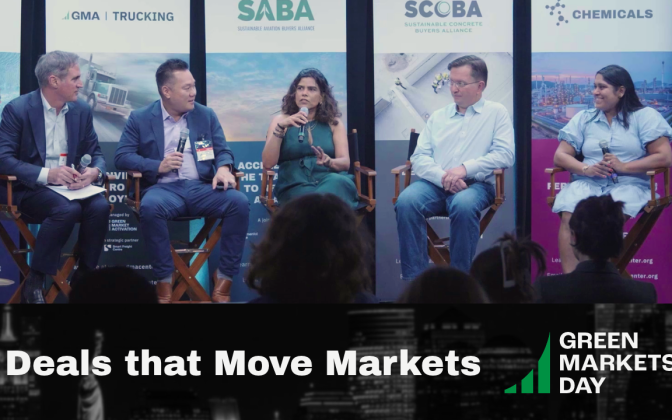
Green Markets Day 2026 | Panel: Deals That Move Markets
Moderated by Andre de Fontaine, Managing Director at GMA, this panel featured Ayesha Choudhury, Chief Commercial Officer at Infinium; Albert Luu, Chief Financial Officer at Fortera; Vrushali Gaud, Global Operations Director at Google; and Andreas Marschner, VP of Global Engineering, Maintenance & Sustainability (GEMS) and Worldwide Operations Sustainability (WWOS) at Amazon. The session opened with the announcement of Fortera as the winner of the Sustainable Concrete Buyers Alliance’s (SCoBA) first RFP for low-carbon cement and concrete attributes, along with news that the first contracts in SABA’s next-gen SAF deal with Infinium have been signed. Panelists then discussed what makes collective procurement deals bankable, how buyers get them approved internally, and what it will take to do more and bigger deals.
See below for a full transcript.
TRANSCRIPT
ANDRE DE FONTAINE:
Thank you, Ingrid. That was a really cool video. And thank you to everybody for being here. It’s great to see such a packed house. And I’m really thrilled to be moderating this panel on deals that move markets because it really gets to the core of the kind of work that we do at GMA along with our partners.
We’re going to spend the next 40 minutes or so trying to understand how collective procurement can drive new technology deployment. Specifically, what needs to be true to really make these procurements work and drive the impact that we are seeking to achieve. You know, for us, at a high level, we think about these kind of major building blocks for these deals of being innovative technology, corporate climate leadership, and then market mechanisms to connect those two. And those are the building blocks. But, of course, a lot more needs to happen from there. And so I think that’s what we’re going to talk about together as a panel is to get into the details a little bit more.
You know, fortunately for us, we’ve got a lot of really great proof points to pull from over the last year. Kim mentioned some of these in her opening remarks. And I think even better, the folks that we have on the panel were involved in most, if not all, of those innovative deals. And so we’ve got a lot of expertise on the panel and some really great perspectives to hear from today.
So let me just share a few highlights before we go into the panel. Kim mentioned some of these, but earlier this year, the Sustainable Aviation Buyers Alliance that we run with RMI and EDF announced the winner of its next-gen RFP. So this was looking at ultra-low-carbon, highly scalable, novel SAF technologies, the point being to try to get enough corporate offtake to help get the plant to final investment decision. And so we announced that Infinium, which is represented on the panel today, was the winner of that RFP. And then today we made a really great announcement that the first batch of contracts associated with that deal have been fully signed. And so that’s about 200,000 tons of CO2 reductions represented by the SAF certificates that are being transacted through this deal. And it includes companies like McKinsey, Google, Bain, and AVEVA, and there’s more on their way. Some have chosen to remain unnamed. Others are still working through the final contracting process. I think the volumes are really impressive, but even better are the structure and the term length of these contracts. Up to 10 years, that’s a real breakthrough for this sector to get corporate offtake of that duration. And then also, these contracts are bankable. Ayesha is going to talk more about what that means during her remarks, but we worked very closely with Infinium to make sure that these contracts met the needs of their financers so that we could help get this plant to FID.
Along with Aviation, as many of you know, we’re very active in trucking as well. Last year on a panel just like this one, we announced Nevoya was the winner of our first ever trucking RFP. And from there, the project has moved along really well. All the contracts are signed, which is great. And we also announced that Google had entered the deal after the first announcement was made, increasing the total volumes from 40 to 60 new trucks on a route in Texas connecting Dallas to Houston.
And so at GMA, we also care a lot about the materials. So not just airplanes and fancy new trucks, but also cement and concrete, which is often an overlooked sector. You literally walk all over it every single day. But it is a very important sector for us because it’s a major emitter, 8% or more of global greenhouse gas emissions. And it’s also a sector that we think is really ripe for innovation, also stimulated by the kind of market mechanisms that we do here at GMA along with our partners. And so that’s why we, together with RMI a couple of years ago, launched a new effort to develop a book and claim system for cement and concrete. That kicked off an effort where we brought together an expert working group to really develop the rules of the roads for how book and claim could work for this sector. We published a framework to help guide that work. And then a year later, again, at a panel just like this one, we announced the launch of the Sustainable Concrete Buyers Alliance, or SCoBA. SCoBA is a buyers alliance that brings together buyers who are seeking low-carbon cement and concrete attributes.
And I’m very pleased today to announce the culmination of a lot of that hard work. Drum roll, please. I have a clicker. For the culmination of a lot of that hard work, we are announcing today the winner of our first RFP for low-carbon cement and concrete attributes, and that winner is… Fortera. So we have Albert Luu from Fortera with us today, who’s going to share a little bit of his perspective on this process. I’ll just say a few words.
Fortera was selected through a very rigorous evaluation process. We were looking for a project that helped advance the goals of getting a new technology to commercialization. Since submission of its proposal, Fortera has continued to demonstrate momentum in this space. They have announced an agreement with the Mississippi Lime Company for the first full-scale commercial development of its ReAct cement product. ReAct uses industrial CO2 as a feedstock for its product, converts that into cement through a proprietary ReCarb process. It demonstrates compatibility with a broad range of construction applications, and it also meets all the established industry performance standards, which is really important. And I think important for us, for the purposes of today, is that it can achieve emissions reductions of two-thirds or more relative to conventional cement products. So very, very exciting. And ultimately, this facility is expected to produce more than 300,000 tons of low-carbon cement per year.
We will be announcing more details associated with this deal in the coming months as contracts are signed, but ultimately we’re targeting, with the participating buyers, offtake agreements of three to five years, and for volumes that will make up a meaningful portion of the plant’s total output. So very, very exciting. A groundbreaking new deal.
And Albert, we’d love to hear a little bit more from you before we open it up to the rest of the panel. If you can tell us a little bit more about your product and your technology, and then describe, you know, the importance of why you decided to participate in this procurement opportunity and what you hope to get out of it in terms of impacts on your company.
ALBERT LUU:
Yeah. Hi, everyone. Albert Luu. Excited to be here. Honored to be accepting this award for Fortera. You know, it’s… When you’re developing a new technology, at the end of the day, you have to get capital providers comfortable with the asset class. So what we do is we are developing production capacity and technology for next-generation cement. It’s cement that outperforms traditional cement. It’s more durable, higher performance, better reliability, and better for the environment. But for capital providers, at the end of the day, they still need to make a capital investment to fund the capex associated with this.
I’m relatively new in this role, and one of the things I’ve learned about cement is that there isn’t long-term offtake in the traditional markets. And when you think about project financing, most of the investors there look for what they call durable, predictable cash flows. And so this award, working with GMA and SCoBA, allows us to, in some ways, create a financing mechanism to bring capital providers into this space. The ability to really separate the environmental attributes from the physical product, I think, is a clever, creative way to lock in cash flows. It borrows a lot of the concepts that have come from renewable energy, where you separate the electrons from the RECs. In a similar way, this allows us to contract a portion of the project, be able to show capital providers that there is a market, there’s interested buyers, while you continue to test out the product, allow for more time for that, and then really work in the traditional space where a lot of the buyers of cement are not thinking multi-year offtake agreements.
ANDRE DE FONTAINE:
Okay. Well, thank you so much for that, Albert. Well, rounding out the panel, we have Ayesha from Infinium, we have Andreas from Amazon, and we have Vrushali from Google. So we have a really great representation of innovative producers, but also folks that represent the corporate demand that really drives these deals forward. And so, Andreas, maybe I’d like to start with you just to balance a little bit of what we heard from the producer. Why, from Amazon’s perspective, do you participate in collective procurements? What are you able to get out of these that goes beyond what you might be able to do on your own?
ANDREAS MARSCHNER:
Well, it has been covered already before in the previous panel, but also in some of the opening remarks. Also, at the size we are operating, getting to the right demand signals is insufficient on our basis. And so, pooling the demand, especially to get nascent technology a boost and allowing for a meaningful risk profile is the critical piece. And that’s why we joined several of the initiatives that are all shown here from the first day. Because we believe that we need to get the signal that the demand is there. It’s not just a single demand, but it’s a group demand and there’s willingness to invest and go that innovation journey because that is what is de-risking the topic on the technology side.
We are always in this chicken or egg dilemma. And well, if there is no demand, then there is no supply. And this is a way to overcome that part, at least in the early days. It’s not necessarily sufficient for the long term, but it is really providing this initial impetus and that’s why we are very convinced that this is the way to go, in particular, where we’re talking about new technology. Product development is never a straight line. And so we need to take the risks and distribute them accordingly.
ANDRE DE FONTAINE:
Yep. Well, thanks for that, Andreas. I think we would agree, you know, almost all demand is good demand, but there is still, I think, ways of structuring demand that can be more impactful than others. And Ayesha, I wonder if you could comment a little bit. I mentioned the bankability aspect in the opening. Can you talk a little bit more about what that means and what are some of the steps that we took together to make sure that the contracts were signed for the SABA members actually do meet the needs of your financiers?
AYESHA CHOUDHURY:
Absolutely. First, thanks for having me, Andre, and GMA. I appreciate the opportunity to be here. First, let me explain what Infinium is in 30 seconds. We are a power-to-liquid SAF producer. What it means is that we make sustainable aviation fuel from renewable power and waste CO2. It’s a different pathway, which is a more novel technology than the other pathways that exist for SAF today, but it has the ability to scale because our feedstocks are fundamentally sun, air, and water. So that’s Infinium in a nutshell.
We talk all day about commercial– er, technological innovation, right? This is a novel technology, and this is something that needs to come down the cost curve. But to Andre’s point, a lot of the work that we’ve done together with GMA and SABA, with American Airlines, our partner in this deal, and all of the Scope 3 buyers is really what I would call the commercial innovation part of things. It’s not just the technology alone that’s going to get these projects off the ground to FID and get built and continue to scale the industry. It has to come from commercial innovation, too.
And so, you know, we always talk about bankability and bankable demand and bankable contracts. What does that really mean? I’m actually a former banker. So I think before I was at Infinium, I was a banker for a long time. So maybe if I can tell it to, you know, to boil it down very simply, it’s duration, the tenor of the contracts, it’s volume certainty and price certainty and predictability on that, right? Those are the obvious things. And the less obvious things are other types of risk sharing and allocation, particularly when it’s a novel technology. What happens if the plant is delayed? What happens if it doesn’t produce with the uptime that you expect? All of that stuff goes into the contract, too.
And so a lot of the work that we did with, first, the SABA team, and then with all the Scope 3 buyers that, like Google, that joined in on this procurement was really the negotiation and standardization, I would say, because it’s sort of the same contract across all of the many buyers that we had. And that was a great innovation and a material step in bringing these projects towards a final investment decision. Because even if the technology is de-risked, the commercial side has to be materially de-risked, too.
ANDRE DE FONTAINE:
Great. And, Vrushali, coming from the buyers’ perspective, you know, when we think about these deals that we’re approaching you with, it’s multi-year bankable for technologies that are not yet commercial and on a time scale where you’re committing to purchase something that doesn’t exist yet. So this is a tall ask, and I wonder if you can comment a little bit on, you know, the process internally to get these kinds of deals approved. What do you need to demonstrate? Or what are the types of challenges you need to overcome to get these approved internally?
VRUSHALI GAUD:
Thank you. Can you guys hear me? I think I’m echoing a little bit. So just bear with me. So first of all, congratulations. What a fantastic day to be here when we had the SABA deal go through this morning. It was announced, and it has Infinium in it. American Airlines, we are very, very proud to be a supporter of that. And it’s a good example of some of the things you mentioned, right? It’s the technology innovation, but it’s also the commercial innovation, and also the standards innovation, because how do we make book and claim, and how do we claim for this and track it? So it’s a good stepping stone all around.
Going back to your question, I think there are two sides of this, but I say it from a Google perspective, or any company that has the privilege of making investments, of having the foresight and the support internally to make investments that are long-term in nature and also have a sizable impact. So I think that, you know, initially that is an impetus we have. I acknowledge that and it’s a privileged position to be in.
Having said that, any deal has the same constraints. It is: is the technology proven? Then is the price point the right that you want? So is it cost-effective? Because eventually you want this to be scaled and scaled such that Google can do it in volume but everybody else can do it in volume. And the third part is your time, the horizon to get to that scale. And, I think if you look at all of those three attributes, it makes a case for two things.
One, there has to be people who are the first movers. And I think Amazon and Microsoft and Googles of the world can be the first movers, which is a great advantage that we have and sort of put our investments in the pilots. And then make the deals in a collaborative way. I think that’s where the power of the collaboration comes in because individually you cannot get– you cannot prove the technology through the scale and in the time frame you want. And for all of those three rubrics is I think what the activation to an alliance comes in.
ANDRE DE FONTAINE:
Thank you. That’s a really great perspective. And maybe to switch gears a little bit, I’d love to know, I mean, these were first of a kind deals. We want to do more and bigger deals as we go. Maybe I’ll start with Ayesha. What do you need to see in order to take this even bigger? Is it regulations? Is it more voluntary demand? Is it greater standardization around the market measures? Or is it some combination of all three?
AYESHA CHOUDHURY:
It’s all of the above and then some. These are hard problems, right? We have a very hard problem to solve. And I think one of the things that I’m very proud to be a part of is very collaborative effort to figure out how to get there. A lot of the work that we’ve done out of this procurement is going to be useful for the next projects and the next projects. I would say that we spent– we invested a lot of time and energy, and I give the SABA team a lot of credit for investing so much time and energy in working on a bankable contract template that is going to be critical and useful for many more projects to come until this market becomes much larger with much more market depth that you don’t have to have these types of procurements anymore. Unfortunately, or fortunately, or unfortunately, you need it all, and this has been a really important step forward.
ANDRE DE FONTAINE:
Maybe I’ll pose the same question to Albert, but you’re not allowed to say the same thing. So you can’t just say it’s all, or if it’s all, can you give me some kind of rank order or priority?
ALBERT LUU:
I’ll try. I think we’re starting off in the journey where we’re relatively– like, when you think about building materials, earlier in this process of contracting. And so I think it’s great to hear when buyers talk about kind of investments, and because it really is an equity investment, it’s not a typical supply agreement. And so it’s how do you allocate risk and think about risk between the different parties for projects that have never been built before, and understanding that things never go as planned, and being able to kind of work through some of those things. So I think having kind of the collective minds just collaborating there, and everybody really taking the view that we’re an equity owner in this project and everybody needs to kind of share in the risk for this project to move forward.
The other area I think about is, listen to Ayesha talk about all the T’s and C’s around this. I’m sure every buyer has things that are going to be unique to them, but for us, we’re starting this journey, so the more we can do to lower soft costs, standardize contracts, standardize terms where the risks are going to be the same between all the buyers, it will allow us to go to capital providers, the law firms that have to review all these agreements in a way where we can be much more efficient and they can see an industry that really will scale from, you know, for us, first few plants are going to be hundreds of millions to multiples of hundreds of millions and then multiple plants. So a lot of, I think, what work has been done in other sectors just needs to be done for cement and concrete.
And then, you know, it’s easy enough to say, but just more buyers. I spent a lot of time talking to capital providers and they always talk about, it’s great that you have a couple of buyers, but that doesn’t really show a market. You need a lot more depth and I think some of the early buyers, the bigger organizations who can kind of create signals for other players in their space to follow on, I think that’s another mechanism that will be helpful.
ANDRE DE FONTAINE:
Yeah. Okay. Thank you, Albert. Maybe turning it over to the buyers, one thing I’m curious about, you know, you’ll see from the posters, GMA with its partners is active in a number of different sectors and you guys have purchased attributes in all, I think, of these programs or close to it. Do you take the same approach to each sector when you consider the opportunities and you consider the purchasing opportunity, or does it vary by sector or technology type? And Andreas, maybe I’ll start with you.
ANDREAS MARSCHNER:
It’s a yes and a no. So the yes is related to, of course, we have learned with the first of these type of agreements. What we have never done before because it is all about aligning interests and acknowledging what are the constraints of each party and then really looking what is now the joint solution space. And I think this is what GMA did fantastic in the past with all of these things because it was all providing that environment and this joint commitment to drive change and figuring out how to actually get there.
The no part is it is, of course, a very different story if you are talking about fuel or if you talk about low-carbon cement solutions. So we also then need to recognize what is the hard problem to solve. And there is just very different elements in play and that is where the things are different.
I remember when my team was looking for getting the direct supply of low-carbon concrete to a site we were building. And it was impossible to find it in a meaningful environment. That’s why also the entire book and claim mechanisms are so important to help getting things off the ground. Because in areas where you would say, well, that should be solvable. It’s just in the regions where you might actually have a project or you have a sizable demand. You might not get the supply at a meaningful cost. And getting these things right is very different throughout the applications we have been talking about.
ANDRE DE FONTAINE:
Great. And Vrushali, same question to you. I mean, how do you think about this? Is it a standard approach or does it vary by sector?
VRUSHALI GAUD:
I think I’m going to just build on what he said. It depends. We, we, it’s my favorite. It’s the one thing I learned in business school. Just say it depends for everything and you can get out through it.
But we, so we do have internal thresholds. A lot of the companies have a dollar per ton threshold or a dollar per megawatt hour. Depending on what you’re looking at, right? And below a certain threshold, it’s easy. Because that’s just, you know, it’s scaled in projects. It’s, it’s scaled interventions. And those kind of go, go for the flow. Beyond that, and that’s where some of these newer things come in. It, it’s sort of in, we bucket it under what is predominantly important for our business. Right?
So certain interventions are critical for us. Data center construction. So green construction is, is an important piece to it. Green steel, looking at different ways within the construction materials. So that I think is, is something we like double down on a little bit more. And that again links very well with the location. So certain locations, we just did a deal in super excited about zero emissions steel in Stegra in, in Europe. And that’s very close to sort of the European data center location. So there is an inbuilt demand. We know it will be sustained. So we have a much better playbook on that in certain regions. And so it’s a combination of the price point. But also the operational need. And I think if you justify the operational need, it’ll most of us in sustainability know then it’ll stick around. It’ll be sustained and not just be a one time deal.
And the other side, something like SAF, you know, it’s not predominantly our business. We are not an airline company, but a lot of our employees travel. It’s part of our footprint. So we have to decide on scale where and how much we invest. So I think in that it’s some of these first of a kind alliances that are helpful, probably not as much as we do in some of the other spaces. So it’s a combination across all of that.
ANDRE DE FONTAINE:
Okay. Great point. And I actually think we do have some time for questions from the audience. So if folks want to raise their hand. Any questions? And as you guys consider questions, I will ask a quick round robin. If folks can, you know, you heard there’s some continuity in the announcements we make at Green Markets Day. So fast forward a year from now, what would you hope to be able to say about the project or deals you’re working on now? And Albert, I’ll start with you.
ALBERT LUU:
Yeah, hopefully a year by now. We will have contracted many of these offtake agreements. And then I think the other area, too, is, you know, I was having lunch with our CEO and an investor, and one of the things I’m learning about cement is that because it goes– because it’s a material beyond just contracts, like product validation is a big thing as well. And so looking at the coalition to, like, are there ways to share data so that we don’t go through the same testing with everyone, just so that we make this a more efficient process? So what are ways that we can just streamline product validation and offtake over the next year?
ANDRE DE FONTAINE:
Yep, that’s great. And Albert, on your first point, if you find that the contracting is taking more than a year, let’s definitely talk about that. That should not be the outcome. But let’s go down the road. Vrushali, what would you say a year from now? What would you like to be saying?
VRUSHALI GAUD:
I think two things. One is incentives. So you have to make it, you have to give incentives to even folks like Google, right? Like, how, you know, making and paying the higher premium, are there contractual benefits? Are there first offtake benefits? So you have to incentivize. And then how do you incentivize others to come? As much as I love my company and, you know, seeing its name everywhere, it doesn’t mean much if we are just, if we are the whole market. You want to see others, others come in.
ANDRE DE FONTAINE:
Absolutely. Andreas?
ANDREAS MARSCHNER:
Making real progress in the hard to abate environment we have here and getting more momentum established by aligning the risk profiles better than what is already the case. In some of the areas we talked about, I think we are still chasing our tail a bit because if you go in the transportation sector, you have several things that need to work well together. And only if all of these conditions, you have a truck that has the sufficient range, you have the charging available when you actually need it, and the grid provides capacity when you need it, if these things don’t play together, you are never able to scale. And that is the part where we need to partner with the different players involved to allow for a much faster scaling in that domain.
ANDRE DE FONTAINE:
Ayesha?
AYESHA CHOUDHURY:
My hot take is much more selfish. I just hope that our project hits a final investment decision a year from now. We’ve made a lot of significant progress on the development of this project, including this very important procurement, and so I hope a year from now we can talk about how we, you know, are going to go to the, you know, ribbon-cutting or, you know, shoveling party.
ANDRE DE FONTAINE:
That would be amazing. Do we have any questions from the audience?
SAMAN BAGHESTANI:
Hi. I’m Saman, co-founder and CEO of S3 Markets. We work on industrial commodity certificates. My question for the group is, and particularly for Google and Amazon, you know, it seems like a lot of companies like yours repeat the same diligence on the same set of companies. To what extent do you think that diligence is a public good that perhaps could bring down costs and let other organizations who just can’t, they don’t have the same budgets as you do, access that same sort of diligence?
VRUSHALI GAUD:
I can, so that’s a great question. And we just, through the Elemental group, we formed a data center innovation initiative which has Meta on it and Amazon on it. And I think that’s a great example because part of what Elemental is trying to do is sort of, you know, express due diligence on things, so right, like so you already have a list of startups they work with or technologies that they’ve progressed in and they become the central repository of sharing information across. And there are times when, look, as much as we like open sourcing things, you also have to be careful around where you’re driving the market, creating the market and shaping it and like all sorts of regulations around it. But having a central entity that does that, and that’s exactly the initiative we have from DSI. And same, I think, I would say about the SABA and the SCoBA deal.
ANDREAS MARSCHNER:
I can only plus one on that, because the regulatory framework provides clear boundaries on what can and what cannot be done, and that is there for a good reason. And that’s why intermediaries who then potentially help with these topics can also help address it. And then, of course, bearing my colleagues in finance, there’s also then always the question in terms of what is the right financial modeling and what are the right inputs. And if that then differs, then you might still have certain aspects that need to be covered independently.
ANDRE DE FONTAINE:
Okay. Just scanning to see if there’s any more questions. I have a couple more that I can keep posing. Maybe I’ll go back to Ayesha, because you mentioned that you hope a year from now to be able to say that the plant has gotten to FID. So what is the next priority post this voluntary deal, what are you focused on to help get to FID?
AYESHA CHOUDHURY:
So project development, there’s, in project finance, there’s often what you call three legs of the stool. That’s the common parlance. So the first pillar, leg of the stool is your offtake. The next second one, no particular order, is capital, right? Both debt and equity. And then the third leg of the stool is called technology, construction, EPC, right? And you’re all kind of doing, you’re kind of doing all three of these at once, right? But obviously if you only have one, then you have no stool, right? So I think that that’s sort of the traditional way of thinking about project development.
What I think is really different about what we’re doing in more novel markets and novel technologies is it’s a whole lot less of a stool and a lot more of a tent. You are pushing the poles together enough in such a way, and you’re getting them to land exactly in the right place. So I would say that, I don’t know, I only have two arms, but like here, like right now we’re really just, we have all of the pieces, we have all the legs of the stool, I guess, but what we’re trying to do is bring the stool, the legs together into more of a tent. That’s what we’re really doing. And so we have all the basics in place. But now it’s getting them tighter.
ANDRE DE FONTAINE:
Yeah. And then, Albert, maybe a similar question for you. What’s the immediate next priority for your process?
ALBERT LUU:
So for us, a couple of weeks ago, as you mentioned earlier, we announced a 300,000 ton plant with MLC. We are working on FEED on that, and we should complete FEED by end of this year, working through permitting. Once we complete FEED, what that unlocks is detailed engineering. Long lead, all working towards that FID concept.
The great thing about FID to me is that you can’t fake it. Like, there are so many things that get announced that you kind of go, is it really going to happen? But at the end of the day, FID is one of those you cannot fake because you have to have all the pieces together and ultimately third party capital to say this has been de-risked to move forward. So we’re working towards that. We expect this plant to be operational in 2028 and take FID sometime next year.
ANDRE DE FONTAINE:
Okay. Great. And then maybe a question, a similar question for both Andreas and for Vrushali. How do you manage the tension around some of the technology types that you might be investing in? When we look across these different sectors, whether it’s trucking or cement and concrete or aviation fuel, there is the kind of like forward-looking ultra-low carbon solutions that tend to come at a higher premium. And may not be available in much quantity today versus potentially cheaper carbon abatement opportunities in those same sectors that are more widely available. How do you manage the tension between investment in one that might deliver a lower cost today, but could be less scalable in the future? Andreas, maybe I’ll start with you.
ANDREAS MARSCHNER:
Our philosophy has always been being willing to fail fast because we want to learn fast. And that means really acknowledging that we are in a product development journey, and it is absolutely natural that things will go wrong and will not work out and not seeing this as a defect, but as part of the learning journey to get to this scalable solution faster and making sure that this is really a joint learning with our partners. And that’s why we are investing in different, very recent technologies, or we are building partnerships and how to explore those. To then really provide, also, the business environment to test these things instead of being solely dependent on the lab type of environment. Because what we typically see is the real business life typically provides different challenges than what you can actually really see in the lab.
ANDRE DE FONTAINE:
And Vrushali, same question to you.
VRUSHALI GAUD:
I think, you know, for us, you have to, there’s two portions of this. One is you have to have the right expertise in whether it’s in-house or whether you have partnerships. Because a lot of the things we’re looking at are, they are scientific in nature. There’s innovation. There’s, you know, there’s like why one versus the other. And it would be obnoxious to say we know it all. So I think relying on those who have expertise and have guidance on that, I think that helps us get that first view.
And then the second thing, you know, I think we don’t have the fail fast one, but we have a very strong theory of change that we walk ourselves through. So is the theory of change as to the fastest, quickest or the most credible or the most impactful? Right. Each one is. You can justify that. And there’s different ways to go about it. But we have a theory of change where we have different facets on those three dials. And then that helps us decide which technology is more credible and then also meets the scale and time that you want.
ANDRE DE FONTAINE:
Great. And then maybe we have time for just one last question. Vrushali, I’ll stick with you because you mentioned something that Google looks for is that you don’t want to be alone on these deals. And so what are some things– I think that’s the question all of us are wrestling with is how do we bring more demand into these markets? Do you have any ideas of how to bring more companies into this?
VRUSHALI GAUD:
Most companies work at the intersection of cost. So what does it cost me and what benefit do I get? And I think you have to work on both those incentives. So find a way to bring the cost down, which is I think what we’re all sort of talking about. That’s one. And then the incentive either is a compliance or a regulation or a demand signal or a consumer signal, something on that side. So I think both of those are critical to get more companies in.
ANDRE DE FONTAINE:
Terrific. Well, thank you. I just want to close by doing two things. One is congratulating Albert and Fortera, congratulating Ayesha and Infinium, and then thanking Vrushali and Google and thanking Andreas and Amazon for providing the demand that makes a lot of these things happen. And if all of you could join me in giving a warm round of applause for these panelists.
Related News & Resources
11.02.26
Green Markets Day 2026 | ZEMBA’s Market-Making Momentum
Ingrid Irigoyen, Managing Director at GMA and founder of the Zero Emission Maritime Buyers Alliance (ZEMBA), shared ZEMBA’s results since its founding in 2022 and its new home within GMA. She announced three new members, Google, Microsoft and DSV (ZEMBA’s 50th member), and celebrated ZEMBA’s selection as a finalist for the Earthshot Prize, introducing a short film about the alliance produced by Earthshot.
See below for a full transcript.
TRANSCRIPT
INGRID IRIGOYEN:
Hi, everybody. Hello, Ingrid. Let’s try it again. Hi, everybody. Thank you. So I love what David just said and I just want to repeat it. So standards and market instruments sounds like eating your vegetables, but system transformation, that is like dessert, right? That is what we’re all after here.
So I’m Ingrid Irigoyen. I’m founder of the Zero Emission Maritime Buyers Alliance, now managing director at GMA. For those of you who don’t know, ZEMBA was founded in 2022 by the Aspen Institute, Amazon, Patagonia, some of whom are here today, of course, Tchibo, and quickly joined by IKEA and many, many other freight buyer companies. And we’ve been close collaborators of GMA since the very, very beginning. So now joining the organization as of September 1st feels like a bit of a homecoming, a very exciting transition for us.
Like other programs at GMA, we work with freight buyers to set ambitious sustainability criteria for procurements. We run those procurements on behalf of our members. We set buyers and winning suppliers up with bilateral contracts. And we most importantly enable real on the ground, or I should say on the water, deployment of new very, very low carbon fuels and technologies.
And so really it is ultimately all about impact. And so what is the impact that we have had in the first three years of ZEMBA existing? We’ve got now 50 members. We have run two successful procurements. We have shepherded three new fuels into ships for commercial deployment, that each achieve over 90% lifecycle emission reduction, something that many believed was totally impossible a few years ago. We also have been able to execute over 40 binding commitments for two to five years of offtake of those fuels in very large container ships around the world.
Our next focus going forward will be on driving scale, getting creative about bringing the cost of e-fuels down. We know that cost is one of the biggest barriers. We will also be looking at expanding geographically, expanding into new technologies that may be non-fuel technologies, as Kim mentioned earlier. And then we’ll also be looking at some segments beyond container shipping because we know that container shipping is only about a third of the impact.
So how do we get to scale? Well, one of the important ways, of course, is to have more members. And so one of the things I’m pleased to announce today is that we have three new members who just recently joined. Google and Microsoft, those are household names, don’t need to tell you who they are. But I will just say a quick word about DSV, one of the largest 3PLs in the world, headquartered in Denmark. And I’m pleased to say that this year is going to be their 50th birthday. And they are our 50th member, so very pleased. Let’s have a round of applause for happy birthday.
And the other exciting thing I would like to share, some of you may also have seen this news, is that ZEMBA was just announced on Friday as one of 15 finalists for His Royal Highness Prince William’s Earthshot Prize. Yeah, I mean, we were, it’s — It makes me just feel choked up with humility thinking about it. We were selected from among 7,000 nominations from 169 countries. And the constant insecurity I have about, do we deserve it? You know, compared to all those amazing, amazing projects around the world, it’s truly moving for those of us who worked on this project for a long time.
And Earthshot kindly in giving us this status has also signaled a growing validation around the world and among some of the smartest people in the world that demand aggregation is a really important tool for driving climate impact in some of the hardest to abate sectors.
So I think this acknowledgement is really an acknowledgement of all of you in the room as well, because we have been building this approach together. It has been hard. Many of you have really dug deep. You’ve taken risks. You’ve done a lot of really intense technical work. You’ve eaten your vegetables on standards and market instruments. And so here we are with something that can really set us on a fantastic path forward.
Earthshot also kindly has produced a wonderful short film. You didn’t know you were coming to a movie premiere today. And so we’ll actually go ahead and play that for you right now. It’s just a few minutes, and it includes several images of me epically walking.
[EARTHSHOT PRIZE FILM]
INGRID IRIGOYEN:
Epic walking, am I right? So let me just close by saying that I was listening to some of the social media coverage of some of the other Earthshot finalists. And there was a finalist named Thomas Njeru from an organization called Pula in Kenya. And what he shared I thought was true wisdom for the moment. And I just want to repeat what he said. “The best innovations are the ones that give people the confidence to keep moving forward.”
In this time of headwinds, that is what we are trying to do. We are not going to solve these massive problems just with voluntary action. We know that. But can we create the goosebumps? Can we create the market uptake? Can we get the market penetration to start to bring the cost down? That is what we are trying to achieve.
And so Thomas was wise. And let me just say that if speaking of moving forward in headwinds, if I was able to not fall off that crane at 300 feet in heels with headwinds, we can do this.
Related News & Resources
11.02.26
Green Markets Day 2026 | Opening the Floodgates: Standards and Market Infrastructure that Unlock Action
Moderator Jim Giles, Vice President and Editor-at-Large at Trellis Group, was joined by David Kennedy, CEO of SBTi; Jim Andrew, Executive Vice President and Chief Sustainability Officer at PepsiCo; Laura Draucker, Standards Director at GMA and the AIM Platform; and Tim Juliani, Director of US Corporate Climate Engagement at WWF. The panelists discussed version 2 of SBTi’s Corporate Net-Zero Standard and its recognition of market instruments, how PepsiCo has already put the new rules into practice in its reporting, the role of the AIM Platform’s guidance, and what is still needed (governance, standardization and registries) to keep market instruments credible as they scale.
See below for a full transcript.
TRANSCRIPT
JIM GILES:
Fantastic, so happy to be here. My name is Jim Giles. I’m an editor at large at Trellis Group. We have a fantastic panel. I think you can all, I don’t need to do the intro, so I hope you know who all these wonderful people are.
And I just think this is a great moment to be having this conversation because the last two years, probably more than that, have seen, they’ve been a really intense period of activity around the standards and the frameworks that shape corporate action on climate. We’ve had a major update to SBTi’s net zero standard we’re going to be hearing about. We’ve had some really interesting work around supply chain and environmental attributes certificates we’re also going to be hearing about. We’ve had some work that’s kind of outside of the system a little bit. We’ve had some groups that are kind of, I would say, pushing the incumbent standards to move faster. And I was at an event early yesterday morning where we heard from, I don’t know, I think it’s a kind of small but, you know, vocal minority of people who are calling for much bigger reform. And all of this is good. This is really good, healthy, exciting debate. And it’s worth remembering that all this debate is channeled into an effort to not create better, yes, to create better rules. But the point of better rules is not to have the rules be better. It’s to unlock real action and to tackle climate change more rapidly. And so excited to hear more about those efforts.
And David, let’s start with you. When I talked about an intense period of activity, I would say the SBTi’s recent update is kind of really core at the heart of that. Tell us, just pick out a few of the, I mean, there’s so much in V2. Just pick out a few things for this audience you think are most significant.
DAVID KENNEDY:
Okay, so hello, everybody. Thank you, Jim. We’ve got corporate net zero standard version two. We published that in the summer.
Let me just anchor it in something that’s not new. So our mission, and remind you, SBTi is there to support the corporate transition to net zero by 2050 or sooner. That is what makes us science-based. That has not changed. I think another thing that’s not changed are the people, anecdotally, think it may have changed is companies continue to engage with the corporate net zero transition. So we are about to reach 12,000 companies that have targets validated by SBTi. That’s 40% of global market capitalization, 30% of the global greenhouse gas footprint. We’ve got submissions and new commitments at record levels that sustains even in challenging geopolitical circumstances. So companies continue to engage. Why is it? Because it makes good business sense. Companies have got transition risk. We have a framework for managing transition risk. That’s what corporate net zero standard is.
I’ll pick four innovations in it. So we had a long process. We engaged with thousands of companies. We had expert working groups. We piloted. That’s how we got to corporate net zero standard version two. There is a focus on supporting incentivizing action, as you say, Jim, but for innovation. So one, target setting options and there’s a whole range of target setting options that work for different corporate contexts, different sectors, different geographies. But the common theme is they represent what companies can and should do to manage transition risk in a science based way.
Second and highly relevant to today is how do you meet targets? So, of course, focus on business transformation, reducing your physical carbon footprint. But there are limits to what you can do and you can make great contributions through the use of market instruments. And it’s always been the case that you could use Scope 2 market instruments. But we’ve extended that now to biogas, SAF, commodity certificates. And these things count towards targets. A lot of people say great that you’ve got your implementation hierarchy. But do these market instruments actually count? The answer is yes. There wouldn’t be much point in having them if they didn’t count. They do. We need to set out a bit more about how they will count and how to account for them, which we can talk about in a minute.
Third innovation is a recognition of dependencies. So in the real world, companies cannot unilaterally in certain respects. But there are external factors which are beyond the control of companies. And so we want, as part of the submission process and the progress reporting, an explicit focus on dependencies. So economic, infrastructure, supply chain, finance, examples of dependencies. And then we have the best efforts approach to targets, which is basically where dependencies are fulfilled, you are expected to act. Where they’re not fulfilled, they may become barriers, those dependencies. And then you should identify and seek to address those barriers. But it may cause a gap in the near term between performance and targets.
Last thing I would highlight as an innovation is ongoing emissions responsibility. So there’s always been a question, I think we’ve settled it now, what is the role of high integrity credits within a broader strategy? Is it legitimate? Can we address the integrity concerns? And we have been very clear, you cannot substitute effort reducing your carbon footprint, including the use of market instruments. You cannot substitute that for credits because you need to transform your business, your systems that you operate in. But we do need a lot of removals. We need 8 gigatons plus in the second half of the century. Business can contribute to that. It’s very valuable. It is a great part of a holistic strategy. A lot of companies are interested in it and we will recognize it through ongoing emissions responsibility.
So some fundamental innovations, again, all aligned with that focus on supporting incentives and incentivizing action towards net zero.
JIM GILES:
Thanks, David. So we talked about the rules unlocking new action. And I was surprised. I kind of figured like the rules are in place. Now I’m going to have a look. I’m going to start reading sustainability reports. Wait to see when they get implemented. I did not expect to see them implemented or used so quickly. So Jim, PepsiCo’s most recent sustainability report came out last month. And it includes kind of new cool things that you did because of these new rules. Tell us about that.
JIM ANDREW:
Yeah, we– I think David put it very well. It’s about how do you drive action? How do you incent action? How do you make the things that we’re doing be able to be recognized? And, you know, I’ve always said if we can’t count it, it’s philanthropy. And then it ends up over in the foundation. So how do we get in? I think that some of the advances have really been very powerful around. So we wanted to report using 2.0. And so we did that. And then we worked very hard to be as transparent as possible. And that’s always been one of the hallmarks of what we’ve tried to do at PepsiCo is be clear on where there is a physical inventory and talk about that. And then also talk. Talk about where we’re using market instruments, making sure that they’re high integrity. And that’s really that’s a major effort because there’s a lot of people that we have to get aligned internally. Right. That’s that’s finance. That’s legal. That’s sustainability for sure. These aren’t just accounting decisions and ultimately they impact action and they impact investment.
And so as we looked at where the reporting was going and some of the changes, you know, that was all in our calculus as to how do we drive action? And, you know, I think the critical next steps are how do we get clarity around projects and market instruments? And what can companies say about them? Because I think companies are very concerned about doing things, being able to count them. Or at least understand. And then what can they say about them with credibility and transparency? So we worked very closely with all the folks internally as well as our external providers to be able to take the latest, be able to use them, talk about them, be transparent.
And I think it’s a journey. You know, I think it’s something we’re all going to learn on. SBTi, as David said, has been very open to engagement, to feedback, to discussion. I think David would be the first to say we don’t have everything figured out. And, you know, we’re a big FLAG. We’re a big land user. So FLAG’s very important to us. And I know that that’s an area that’s ongoing. So we tried to incorporate and we left ourselves very open to what’s going to come. But we wanted to support and use, you know, the latest thinking to be able to convey transparently where we are. And importantly, what are some of the challenges?
JIM GILES:
And for those who are not familiar of your work, just go into a bit more detail there. You mentioned deploying these market instruments. What were they? What commodities are involved? What kind of impact did it have?
JIM ANDREW:
Yeah. So we, I mean, we’ve used a number of different ones, both obviously around Scope 2. But we’re also, you know, low-carbon fertilizer is an area that we’re very active in and working around. Renewable natural gas. You know, and the high BTU versus low, you know, medium BTU and, you know, understanding those things. And again, what we tried to do was here’s what we’re doing. Here’s our physical. Here’s using the hierarchy that David described. Here’s where we sit on each one to be able to be transparent. You know, again, I think different people are going to look at these differently. And it’s going to be interesting to see where we are in a couple of years because I think we’re all going to learn more together.
JIM GILES:
Great. Thank you. Tim, let me just bring you in. I think you have a really interesting position because you get to peer inside lots of companies through the partnership work that you do at WWF. So you’re hearing from people like Jim but across different sectors about what’s missing and what they need from these standards. To what extent is the recent evolution really unlocking the kind of ambition that’s there within companies? And what else do we need to see?
TIM JULIANI:
Yeah. So thanks. Yeah. We work. And I’m on the climate team at WWF US. And I run what’s called our Climate Business Network. And we have two dozen companies, mostly Fortune 500s, that are grappling with all these issues, setting, resetting science-based targets. That resetting process is kind of a gift that keeps on giving, right? And the – but it’s changed quite a bit over time.
So when we helped co-found SBTi back in 2015, that was a different moment than today. And at that point, companies, I think, saw a pathway to setting SBTs for the first time because the Scope 2 protocol came in at that same time. And that allowed the use of market instruments for Scope 2. At that time, the Scope – you know, with V1 of SBTi, you had the ability to set Scope 1 and Scope 2 targets together. And that ability to use market instruments, I think, really catalyzed and allowed companies to see a pathway for how to do this. And I think now in V2, while Scope 1 and Scope 2 are separated, the expanded use of market instruments is doing that same thing, right?
And, you know, what we’re doing – you know, we work one-on-one and together with the companies, thinking about not only SBTi but the entire sort of standards infrastructure that is allowing this to happen. I’m on the Actions and Market Instruments technical working group. My colleague Tim Letts is on Scope 3. He’s also engaging around ISO. So how do we create the incentives through all these for corporates to act? And how do we do it in this time where there’s still uncertainty, you know? GHGP is not going to be completed until 2028. SBTi, you know, is going first. But, you know, we’re very encouraged that we’re, you know, continuing to see that action happen on the ground. We’re seeing companies like McDonald’s and Walmart and others, you know, stick with SBTi, which I think is a fantastic signal.
JIM GILES:
Yeah, great. Thank you. So, and that brings us kind of nicely onto how things might change in the future. So SBTi update, as I said, one of the really big developments. But, Laura, you’ve been involved in something called the AIM Platform, which I think has come up with a ton of interesting ideas that we think will influence standards in the future. Tell us about that work and how you see that evolving.
LAURA DRAUCKER:
Yeah, thanks, Jim. I actually want to pull on something you said earlier about how SBTi version 2 just came out, and it seemed like right away companies were ready to report market instruments. And that is because of the work of GMA and our partners and many of you in this room who have been willing to step out ahead and invest in these solutions, put money into the decarb that we need, not knowing if they would count, right? Not really knowing how we would report them, but knowing that it was the best use of your money to drive what needs to happen in your value chain.
So the AIM Platform was born out of that, recognizing that one of the barriers for companies to really make those investments, to grow that demand that we need to grow, was the lack of clarity in the standard space. So the AIM Platform partnered up or GMA partnered up with C2ES and Gold Standard to develop the AIM Platform. We published our standard in April. And really put very simply, it’s a tool to implement the new target implementation hierarchy under Version 2. Version 2 has about three pages of quality criteria. We have about 120 pages of guidance to help you do that. And we’re continually working, meeting often with the SBTi technical team to work through some of these. What does this stuff actually mean? And how do we make sure we have it available to companies who they have confidence to implement?
And we just this morning had a great meeting with a handful of companies and we asked them to all say what win did they have this year and what challenge did they have this year related to market instruments. And everybody’s win was we’re reporting now. We’re making progress. We’re getting buy-in. And everybody’s challenge was and there’s still uncertainty. And those two things can be true at the same time. And I think we have to kind of live in that. But I’ve just been really excited with the reception to the AIM Platform and, of course, all the work that’s happening. I mean, we’re so much farther ahead than we were even last year at this time.
JIM GILES:
And just the uncertainty is a good point. We’re going to come to that. But I just want you to try and bring it to life for the audience. So it works. It works exactly as you hoped three or five years from now. What’s different? Like what are all the people out there doing that’s different as a result of this work?
LAURA DRAUCKER:
That’s a great question. I mean, I think we want to see money in decarb solutions. We want to see decarb solutions scaling in geographies and regions that they currently aren’t available in, which is the reason why companies have to go to market-based instruments, frankly, right? We don’t want to be – I have enjoyed all the panels I’ve been doing on standards over the last two years, but I’d like to not be doing those all the time. I think we’d want to have some certainty so that people are just doing the work with no excuses. And hopefully, you know, I think if you look at the implementation hierarchy, right, direct action is still what we want to see companies do. But for many sectors, many geographies, that’s not possible yet. And so this is an unlock to make that possible in the future.
JIM GILES:
Great. Thank you. Okay, let’s talk about uncertainties and risks, because a lot of this work, as I see it, is designed to introduce the kind of flexibility that companies need to move faster, which is great. There’s always a risk if you loosen the rules that you loosen too much and things start to go wrong. I mean, SBTi made what I think internally was seen as kind of a small change. This is prior to the V2 release. A bunch of people jumped on and said, well, hold on a minute. Like, I’m actually not sure this new pathway is 1.5 degree aligned, which, of course, is at the heart of that particular pathway. David, maybe you can tell us about that particular incident. But more broadly, just tell us how you kind of manage that balance and make sure that you’re actually driving real action and not allowing free riding and other problems to come into play.
DAVID KENNEDY:
So that is a great question. And science based is our USP is our superpower, and we can never depart from being science based. I think the subtext is, well, you know, maybe there’s a choice. You can be science based or you can have something that works with commercial objectives, but you can’t do both. And maybe market instruments, because they’re not physically deliverable, are somehow cheating. But I think that is not correct at all. So in a carbon constrained world, you can be science based and have things that work. In a long term, in a corporate context and fit with commercial objectives, market instruments make great contributions to system transformation, which is what we’re about.
Let’s be clear what the science says. So for a given climate objective, you can derive a climate budget or a carbon budget, sorry, using a climate model, and you can turn that into a global pathway. Science doesn’t say all companies should follow that pathway, reducing their physical footprint in accordance with it. That is our job now. It is to translate that global pathway into a set of net zero approaches, which together are consistent with that pathway. So that’s what we ask ourselves. Have we got a set of approaches which are consistent with net zero? And that takes you into business transformation and system transformation.
And on the particular aspect of market instruments, I should say what you get out of that translation is you can decarbonize at different rates in different sectors according to what the opportunities, what the technologies are. And so some of the energy-intense, emissions-intense sectors with technologies that are not well-developed obviously will decarbonize a bit further out in time. You decarbonize power. It’s a pretty consistent finding. You do that soon because we’ve got great opportunities to do that. Heat is somewhere in between if you’re talking about low temperature, medium temperature heating and residential business, whatever. So you get different pathways for reduction and that is an innovation because we have one pathway really in the first phase of SBTi.
But the market instruments in particular can make a great contribution to system transformation. They can manage transition risk for companies at the same time. So for me, that is absolutely science-based. We can trace from that objective to the global trajectory to the net zero milestone to individual approaches to market instruments. And that is something we spend a lot of time making sure that we can do that tracing.
JIM GILES:
And I’d love to know more about what the risks are that you considered. And Laura, you know, you’re involved in the development of these rules in different roles. So maybe this is one for you. But, you know, when you figure out how to set these rules, what are the things that you’re worried about? What are the things we like? We’ve got to set them in this way so this doesn’t this unhelpful behavior doesn’t take place.
LAURA DRAUCKER:
Yeah, I mean, it really is in the standard development space. It can be easy to get into a rhythm where you’re thinking, how do I set the rules so no bad action can happen? And the challenge with that, which is what we all want. Right. But the challenge with that is that often that makes the rules so complex that good action also doesn’t happen. And so in some ways we have to. This sounds a little Kumbaya. We have to work together, right? We have to be willing to open things up, allow for innovation. But we need to we need the other people in the ecosystem, the NGO watchdogs, the others to be keeping track to say, OK, wait a minute. That might be going a little bit in the wrong direction.
There’s been a lot of talk now that we sort of opened up the opportunity for more market based instruments. And bilateral agreements to count and SBTi that there are going to be bad actors and that’s inevitable. So what kind of governance do we need around market instruments and environmental attributes certificates? So the AIM Platform is planning to to pull together a task force to really help think through. Like, let’s start now with what recommendations do we need for the governance of this to make sure it’s practical, credibly implemented. And so when that inevitable bad actor comes, we can quickly say, no, that is not in line with best practice. That’s not in line with SBTi criteria.
JIM GILES:
Just just let us understand what the like what what does a bad actor look like in this space so we can understand how you’re designing the rules to counter it?
LAURA DRAUCKER:
Yeah, I mean, I think the the fear of market instruments, particularly in scope three is and Tim alluded to this and maybe can speak more to it, is that, you know, the market mechanism in Scope 2 were critically important and in some geographies are not the best option anymore. In Europe, using unbundled RECs is not the best option anymore. And we’ve gone probably too long and letting that be an option. And so how do we avoid that same trajectory for market mechanisms in Scope 3 or Scope 1? How do we make sure that we are kind of using them as much as we can and driving as much solution development as we can now. And then when it becomes that solutions are cost-parative or regulation has come into play, then maybe we don’t need market instruments for that piece anymore. And so I think we just need to learn from both the voluntary carbon market and the REC space around when’s the right time to pull back and how do we set the right governance?
JIM ANDREW:
Jim, Jim, if I could just jump in. I would agree. You know, 100% with what Laura said. From our perspective, and I know many other companies, a big risk is actually that market mechanisms lose credibility because we all think that they’re very important tools. We support high integrity. We support credibility. Yes, they have to be priced appropriately. Yes, they have to be available. And we’ve talked a little bit about that. A lot of places are not even available, right? So that’s where the hierarchy comes in.
But at least from PepsiCo’s standpoint, losing credibility, not only as a company, which we care a great deal about, obviously, but as a tool, as a set of tools, would be a catastrophe. Because you’d have a very valuable set of tools that I think all of us agree have a place, but then would lose the ability to be used. And that would be worse for the planet as well as driving progress.
So I would say a risk, and again, that’s one of the reasons we’re active and work with everybody on stage, is to make sure that that credibility does exist. Is it a balance? Does there need to be guardrails? Does there need to be actions for bad actors? Yes. Credibility is central to any of these things to actually work.
TIM JULIANI:
Yeah. I’ll jump in and say, I think, again, going back to 2015. The system did create the ability to use unbundled RECs, and at the same time, WWF and others combined to create what was then the Renewable Energy Buyers Alliance, now the Corporate Energy Buyers Alliance, saying, okay, we have the REC as the instrument, but how do we do this with the most impact? Right? So you had NGOs come together with companies and say, this is how we do it with impact.
I think that same thing is going to happen now, right? This is a voluntary ecosystem, and I think the world needs to constantly remember that this is a voluntary ecosystem that we’re building, right? It is, at best, a second-best solution to this problem. And that, you know, getting the incentives right for companies to do things that they do not have to do, you know, is very important. And I’ve always been a pragmatist, and, you know, you’re trying, as you said, to strike that balance between quality, integrity, but also the ability to implement.
JIM GILES:
Great. Great. Time is flying by. It’s amazing. We’ve got less than 10 minutes left, and I want to make sure we kind of spend some time looking at what’s coming up.
So, Jim, I’m going to start with you. I can’t remember the exact numbers. I think the market instruments that you disclosed, you saw in your report, kind of tens, hundreds of thousands of tons. If, you know, in future years, you’ll be using similar instruments in connection with millions of tons, maybe, of reductions or removals, what would it take to get there? Like, what’s missing from the current landscape that you want to see to give you the confidence to do, to make more use of these market instruments?
JIM ANDREW:
Yeah, how much we’ll use when depends on a whole lot of things around system change. So, you know, I think one of the things that needs to happen to drive things forward is greater standardization, right? Greater standardization across the market, because that allows things to scale. That standardizes, addresses a lot of the credibility issues that we’re talking about. It addresses the cost issues. It addresses the credibility and availability issues. So I think standardization is going to be a really, really important part, because companies need to understand, you know, what are they actually buying, and if every single one requires due diligence, requires independent verification, requires all those things, right?
I’ve often said, every dollar I spend on reporting, and I say this as a company that’s, as you know, Jim, very transparent, every dollar we spend on reporting is a dollar we don’t spend on doing. Now, we need to report, but, you know, I want to report, I want to get the maximum, well, every dollar we’re going to spend on verification, on due diligence, on all that is, again, dollars we don’t spend actually doing.
So companies need to know what they’re doing, what they’re buying, what they can talk about, what it counts. And I think that’s where, you know, things like interoperable registries, where various ways to drive verification, you know, more consistent contract– reducing transaction costs, standardizing, is going to be a big, big lever to drive forward. Where the appropriate levers– levels are, I think it’s going to be, you know, subject of the next panel we’re going to have at some point.
LAURA DRAUCKER:
Yeah, oh, can I just jump in real quick and say yes, 100%, registries are critical for building that trust, scaling impact, saving costs, knowing that what you’re buying for is what you get, knowing that the quality criteria you need to meet SBTi is there. So I think, as Kim said, we’ll be talking more about that later, about a registry we’ve been working on. But also, you know, we can’t– we couldn’t say you have to use a registry right now when registries aren’t available. So both SBTi and AIM Platform recognize that in the short term you need other systems of record. As we build these things, we’re definitely building the plane as we fly it, but that’s what the moment needs.
DAVID KENNEDY:
Yeah, what we can add to this as well, and to help the market development: so we have put out the corporate net zero standard. I don’t want to say it’s a high-level framework in the sense it’s a hundred pages long, but it needs the next level of detail. So in the next several months we will put out guidance and we will put out guidance one on–
JIM GILES:
Everyone’s so excited about reading that, you can see.
DAVID KENNEDY:
Read it if you can’t sleep. So yeah, we’ll put out a guidance document on certificates which will cover energy certificates, biogas, SAF, and commodity certificates, and it will interpret the requirements, and it will say, you know, what these actually mean in practice and how will you know that you have met the requirements in practice as well. So that’s one thing. Second, we’ll put out an interim accounting guidance. So we have said you have to account for market instruments separately. That raises a question: what do we mean by separately when there isn’t a greenhouse gas protocol framework?
We will put that out in the next couple of months. It will build on the market-based approach that we have for Scope 2, and it will be consistent with direction of travel for the greenhouse gas protocol.
I think the third thing we need to do is to start to elaborate the claims framework. So as Jim says, if you’re going to invest in market instruments, what can you claim? I think you can’t claim I have reduced my physical carbon footprint because that’s not true. I think companies do not get excited about being able to claim I have made a sector contribution. So can we find something a bit more sexy than a sector contribution that reflects what you’re actually doing, which is contributing to system transformation, mitigation action, and that is something we’ll want to engage with business on to find the right way of describing that.
JIM GILES:
Great. Thank you. So let’s be quick. There’s just a couple of things I want to make sure we get in. Laura, quickly tell us about, because Jim, you said more standardization. I think part of the answer to that is the AMI working group, so Laura, quickly tell us about that.
LAURA DRAUCKER:
Yeah. Actually, I’m going to turn to Tim, because Tim is on the AMI working group.
TIM JULIANI:
I mean, being part of AMI for the last, what is it now, three years, two and a half years, two years-ish, has been great. And it’s, yeah, there’s laughter over there, yeah. And you know, and so is being on the TWG of GHGP, it is amazing how you can get this many smart people in the same space, and it takes a while to agree. And that shows just how complex this is. And you know, this will not be easy over the next couple of years. But that’s why we’re all doing, you know, we’re all in it together. And that companies like PepsiCo are acting. Things are happening on the ground. And we are making some progress, right? You know, we hear a lot about that we’re blowing past 1.5, but we’ve also knocked off the most extreme scenarios in the IPCC, which is good news. So we have to celebrate where we can as well.
JIM GILES:
Great. Two minutes left. So one final question to everyone is kind of a two-part question, actually. What’s missing? You know, we talked, we’ve got some visions here about how these market instruments could scale to have really meaningful impact. What needs to happen in the first, the next couple of years for that to become true? And critically, how can all these people help you? What do you want the people in the audience to go do after this session that will help realize that future?
LAURA DRAUCKER:
Well, I’ll go first. I think if you’re a company in the room and you haven’t dipped your toe in market-based instruments, please do. If you have and you’re afraid of how to report them, say PepsiCo did it. We can do it too. And send that to your auditors and your legal team.
DAVID KENNEDY:
So I think we’ve got the nascent demand. We’ve got the nascent supply. We need to be able to bring those together. We have a first cut now of the rules within the SBTi framework. We need the next level. We’re not going to reinvent the wheel, by the way. So there’s been great work done by GMA and the AIM Platform and various others. So I think if we get those rules, if we get them clear, if everybody knows, if we’ve got the infrastructure then to support bringing that demand and supply together, we can really develop these markets and transform systems.
TIM JULIANI:
And I’d say if you’re not already setting a target with SBTi, do that. Look into the AIM Platform to see how to act in Scope 3. Learn from PepsiCo and others who are doing this on the ground. And if all of that still confuses you, come work with WWF.
JIM ANDREW:
I guess I agree with everything that was said. The only other thing I would say is ask questions, right, because no one knows all the answers. We’re all learning together and having the chance to ask questions both informs the person getting asked the question as well as, you know, you may even get the answer, but if not you’re going to get some people working together to figure it out. So ask the questions is the way I think you can help the whole effort move forward.
JIM GILES:
Great. David, Tim, Laura, Jim, thank you so much. I hope that gave you some sense of the kind of excitement and the potential and it’s going to be super exciting to see how all this work evolves over the next few years.
Related News & Resources
11.02.26
Green Markets Day 2026 | Executive Keynote
In the executive keynote, Robert Kowalik, Vice President of Worldwide Environment at Amazon, described how Amazon approaches decarbonization across its many businesses, from network design and fleet electrification to supplier engagement through the Amazon Sustainability Exchange. He made the case that procurement, and especially collective procurement, is a fundamental tool for turning corporate ambition into real investment, and that credible standards, accounting and registries are what give buyers and suppliers the confidence to scale.
See below for a full transcript.
TRANSCRIPT
KIM CARNAHAN:
I’m excited to invite our Amazon keynote speaker to the stage. Please join me in welcoming Amazon’s Vice President of Worldwide Environment, Robert Kowalik.
ROBERT KOWALIK:
Well, good afternoon. Good afternoon. Thank you for being here. And I’m so excited to be here. I know what I’m going to have for breakfast tomorrow. It’s going to be a pancake. It’s going to be shaped. I’m hungry. Like, this is a fantastic, fantastic photo. Very appealing.
Well, I’ve been with Amazon for 10 years. I used to run a lot of our operations and two and a half years kind of leading our environmental team at Amazon. So anything related to water, carbon, biodiversity, all of our work in in waste and sustainable selection. Prior to that, I’ve spent 20 years in the energy sector pretty much all over the world, including kind of early days of renewable energies in China, even and and some of the early projects in Europe and in the United States.
Now that I learned so much about — you learned so much about me, I just wanted to ask you two questions. One, how many of you are here for the first time? I’m attending Climate Week in New York? Oh, welcome. Welcome. There’s a pretty that’s great. Great. Welcome. So excited for you to be here.
Do you know how many Climate Weeks happened in New York? Anybody knows? The first one was 2009. I googled it and this is number 18. Is there anybody in the room that attended all 18? I thought so. I thought it would be difficult but well, well, thank you. Thank you for being here.
I’ll get kind of to my content but first wanted to really thank GMA and and RMI for and many partners who came here and brought this community together. All the corporate leaders in the room, all the suppliers, policymakers, investors, innovators, nonprofits and everyone that’s kind of contributing to accelerate the transition to green economy. I want to obviously acknowledge all of those wonderful partners. We are working with including SABA, ZEMBA, Trucking and SCoBA. We’ve been actively engaging.
So again, it’s an honor to be here and I will kind of build on what Kim mentioned. We are living through an extremely, extremely different period of growth and change like unlike anything we’ve seen in the recent memory. So the regulations are obviously shifting and changing. The climate impacts are harder to ignore and they’re extremely visible, but also technology and AI is reshaping every single industry and our personal lives. And at the same time, while all of this is happening, we kind of tend to call it the headwinds or kind of challenges, with the choices we’re going to make in the next few years will kind of help us to define what was going to happen in the next decades and generations to come. What I want to mention — there are a light —
We recognize that at Amazon, the journey will never be linear. And can we talk a lot about that including what our CEO, Andy Jassy, mentioned in his recent shareholder letter like we know the path will never be perfectly mapped. It will continue to involve in changing conditions and uneven infrastructure, evolving technologies. There will be a lot of economic considerations and the next move will never be immediately clear, but that uncertainty is not a reason to slow down. It is a reason to operate with a much sharper focus and continue to build on what we can control and on our controllables.
Today, sharper focus means thinking and acting beyond individual commitments towards the practical mechanisms that will enable conditions to scale. Whether it’s credible demand, whether it’s capable suppliers, whether it’s investments, consistent and transparent reporting, measurements, collaboration across all these different value chains.
As sectors — today, across all the sectors, we’re actually seeing the real progress. Companies are making procurement commitments, suppliers are investing in lower carbon emission technologies and many of the new projects are actually getting developed. Accounting standards are also advancing. We’re very happy for that and thank you for influencing those wherever we can. And the solutions that sometimes existed as pilots are getting scaled very actively and we’re scaling a lot of them across Amazon too.
But the transition remains very difficult, especially in the sectors that are hardest to abate that many of those buyer coalitions are representing. One thing is to identify the lower carbon fuel material or technology and another thing is to make sure that it’s actually available in the right geography at scale with the required performance and the cost that companies can accept. And it has a credible way of accounting for it in the emission impact. And this is why building conditions for scale matters.
So the challenge is not only to create lower carbon solutions, but it is also to create conditions in which companies can confidently invest, suppliers can invest, and capital can flow towards those.
I will start first with our approach on Amazon and how we look at that. To understand our approach, it’s actually best to start with actually a picture of our company.
So, you know, we’re a pretty large company. We operate across retail, dot-com. We operate across logistics, obviously one of the largest logistics network in the world. We’re a cloud computing company with a lot of generative AI as well across our AWS. We’re a grocery operator through Whole Foods Market, physical stores, but we also have an online fulfillment of grocery. We own the lineup of devices. Probably many of you are familiar with Echo, with Kindle, with Fire TV. We’re a media company. We own Amazon Studios, we own MGM Studios, and the next James Bond movie you’re going to see. I don’t know who James Bond is going to be, but I’m very excited about the next one coming out of MGM Studios. We own self-driving cars through a company called Zoox that operates across multiple cities in the United States. We are kind of investing in hanging satellites in the air for low broadband internet through our project, Leo. We own the pharmacy business and many other businesses.
So what I’m saying is that all of those businesses are complex and they have a very different operating model. They have a very different set of suppliers at our scale and they have a very distinct emission profile and path to decarbonization.
As you can imagine, powering up data center is very, very different than optimizing delivery routes for our vehicles in last-mile delivery. Same with using packaging or it’s very different from low-carbon construction materials and supporting sustainable agriculture requires different tools than, for example, SAF or electronic components that go to our data center or our devices. And the complexity will continue to be the reality, but again, it does not remove the need for action and progress. It makes shared tools, clear accountability and common standards and cross-functional collaboration of this group and events like this and coalitions like this even more important.
How do we organize an Amazon around that? Like, probably like many of you, we have central team. We’re kind of, myself, sit in a lot of kind of central team that can actually add the most value centrally, whether it’s our company-wide standards, science, reporting, alignment with the standards and our offset procurement on behalf of the company. And then at the same time, we also have the deep technical expertise that sits very close to the business in whatever they can control and the closest to the emission source that they potentially generate.
For example, our operations team will work on transportation, on fuels. And I know a lot, many of you attended downstairs a couple of workshops today or packaging. Our procurement team will stay close to engagement with our suppliers. Our AWS team, or Amazon Web Services, our data centers, will work very closely with things like energy, electronic components, and infrastructure. And then our grocery team will work across the food systems and agricultural supply chains.
So I’m sure this distributed model is very similar to many of you, especially in a corporate world. And the question is actually not whether the work is complex. It’s complex for us. We recognize that. But it is up to us to design the right mechanisms to move through that complexity faster and to deliver.
A great example for us is the transportation network. This is our critical core bread and butter of our business, obviously. And it’s a network that serves our customers. The most important network, one of the most important networks in our company. And where customers are expecting selection, speed, convenience, and reliability, our role is to meet all of those expectations and continue to raise the bar. But at the same time, we also have to continue to think about how we think about products moving through our network and how we reduce emissions of products moving through our network.
To start, this starts with a network design. We’ve designed our network in a way that we position inventory closer to customers. And then we can improve by, through that we can improve speed, efficiency, and also reduce the emissions. And this kind of shows 39% reduction of our emissions. I’m very proud of that. Per package that we ship in the last, I want to say seven years since 2019 when we launched this program, every package that gets to a customer is about 39% less emissions that are embedded as a result of that.
We combine that with electrification of our fleet and then deployment of micro-mobility hubs. That’s an exciting solution that probably many of you have seen at downtown Manhattan here this week where you see a lot of pushcarts and e-carts and kind of e-cargo bar, e-bikes and cargo bikes kind of moving through the city. So all of that helps us to improve customer experience, speed, cost, but also at the same time reduce emissions.
We also have a goal to have 100,000 electric vehicles on the road by 2030. We set that goal. We didn’t know exactly how to achieve that. And we kind of collaborated with, again, with policymakers, with finance, with the finance world. When we set this goal, we didn’t know how to achieve that. But we set this very ambitious goal back in 2019, and we’re halfway there. We have 52,000 electric vehicles on the road today. We have over 50,000 chargers to support that infrastructure.
And it could only happen by leveraging our scale and all the relationships and working through the different coalitions as well. That kind of combined with micromobility solutions and some of the other hard things help us to kind of, again, continue to reduce those emissions in our deliveries.
What I want to say also that the fleet electrification charging infrastructure, all the carbon fuels and supporting services ecosystem do not scale because the single company announced the target. Obviously, it scales when demand becomes visible, as Kim mentioned. It’s sustained, it’s credible enough for all these vehicle manufacturers, fuel producers, infrastructure providers to actually build capacity to support that.
And this is what procurement can do. We really tap into our procurement teams at Amazon. It’s not just a back office function. But in the transition to a low-carbon economy, this is the fundamental powerful tool to translate our individual ambitions into the demand and actual investments.
And when companies act collectively, like we do through many of the coalitions and partners we work with, it gives suppliers and developers signals that the demand is actually worth serving. And it helps suppliers to invest in new production capacity. And project developers to reach kind of their financial goals. And investors see enough demands to back up that kind of emerging technology.
And that’s why I think collective procurement models that, throughout this event, you’ll hear a lot about, are so critical because they turn these fragmented investments into signals that suppliers, investors, and everybody else can act on.
And the same is true for supply chain at Amazon. Our suppliers, as you can imagine, span across a variety of industries, geographies, and their decarbonization pathways different. And we cannot meet our climate objectives at Amazon without making progress across what we call Scope 3 emissions and that entire ecosystem.
That supplier engagement also cannot stop asking companies to just disclose their emissions or set a target. The measurement will obviously matter. Transparency will matter. And targets will matter. But the ultimate objective is action, progress, whether it’s improving energy efficiency, whether it’s using lower carbon energy, whether it’s changing process, adapting cleaner materials or fuels, or investing in technologies that will help to kind of long-term decarbonization.
Supplier commitment is only meaningful, again, when it translates into real measurable action. And that is why we also want to help our suppliers to build credible, practical ways to decarbonize.
We not only encourage our suppliers to set credible emission targets, but we also support them with measurement and tech reporting. We share a lot of tools, a lot of playbooks, a lot of examples, and we also help suppliers to identify actionable emission sources that are the closest and the most relevant to their business. And through that effort, we launched that program about two years ago within our supply chain with our top strategic suppliers. Sixty-two percent of them have shared their decarbonization plans with us, and we see many of them are making a lot of encouraging year-over-year progress.
We also Amazon Sustainability Exchange. It’s part of that effort. We launched the exchange. It’s a website that you can kind of check. It provides a lot of practical decarbonization resources that can help any company, but especially those in our value chain, to take immediate climate action.
It includes guidance and resources that are spanning across carbon, energy, water, waste, and other sustainability disciplines like biodiversity and sustainable selection. And it doesn’t only come from Amazon. It comes from more than 160 other organizations, leading organizations that kind of partnered up with us and shared their content.
The exchange is also where we use our scale and expertise to provide those actionable solutions to our suppliers to help them kind of move faster.
And earlier this year, we also launched three pathways to help suppliers to procure carbon-free energy on exchange. For many suppliers, especially those operating across regions without a dedicated procurement team or where clean energy is not as easily accessible or it’s very expensive, we helped them to kind of get the jumpstart there.
So through Sustainability Exchange, what you will see, Amazon offers not only playbooks and online courses, but we’re also providing access to RECs, or renewable energy certificates, power purchase agreements, and also on-site solar in the facilities throughout the U.S.
We also shared our own playbooks that we used on Amazon that contributed to us investing in over 700 renewable energy and carbon-free energy projects in the last few years. As you can imagine, 700 projects makes, that’s a significant scaling again through other organizations and through signaling that supply chain, but they generate 42 gigawatts of electricity. We kind of own the largest portfolio of renewable energy generation in the world today across the corporations, which kind of, we are very proud of that.
And this recognizes a very, very important reality that suppliers have different starting points. Some of them might be ready to reduce demand inside on-site solar or leverage the other PPAs. For others, it might be too early, too expensive, or they operate in the networks where those options are not yet available. And for those companies, we can obviously use RECs wherever we can. It’s a practical way, not ideal, but practical.
And the same principles will apply to hard-to-abate sectors. Sure, if I got it right. Hard-to-abate sectors. So, like, for example, lower carbon fuels or materials the company wants to buy will not physically be available in the volume, location, and geography that will allow the buyer to procure them directly. But that’s why we’re kind of scaling our insetting and book and claim work at Amazon to kind of challenge that.
And I’m sure many of you know what insets are. It can help kind of direct the investments toward climate solutions related to our value chain where physical access is not economically feasible. And that provides a lot of physical access to fuels and to some of the other agricultural or building materials or agriculture.
And again, the credible inset book and claim mechanism can direct the demand, but also a lot of things have to be true for this to happen. It has to be used with rigor, with transparency, credible accounting, and this mechanism can only channel the demand towards lower-carbon solutions today where the physical investments and the physical infrastructure does not exist.
So, for example, through Sustainability Exchange, our website, as well, qualified companies to Amazon can already procure from us, not only carbon credits or offsets, but also can use lower-carbon insets, especially in the transportation space for aviation, for ocean shipment, and for on-road use.
And again, the point is not that the certificate itself, or credit, or accounting replaces the direct decarbonization. It doesn’t, but it helps to scale and provide access to everybody else. And I’m really proud of that.
And that kind of leads me directly to the question about this event and what this event is asking. I’m really tall here, so… What infrastructure is needed to kind of turn that action into scale?
First, companies need confidence that what they are buying is good. They need confidence that the underlying data and quality can be trusted. They need confidence that the claims are credible, are tracked, and consistently accounted for. And suppliers, project developments, will need confidence that the buyer demand will be durable enough to justify investments.
And that is why standards, accounting and guidance, registries and tracking systems really matter. They’re just not technical topics, but they are actually have very practical commercial consequences. The good infrastructure will help to lower the friction and do what’s right.
And again, no one can do this alone. No company can do this alone. No government, no investor, no suppliers. We need very strong forms of collaboration across suppliers and buyers, producers, between suppliers and technical experts, innovators, and between the companies, policy makers and organizations that help to kind of solve the rules, infrastructure, and measurement.
That is why GMA is just so important. It creates this connective tissue that helps everyone move from individual ambition to shared progress.
Again, the core principle of all of that will remain consistent. When buyers act together, they will have a confidence to invest and that will give also investors confidence to invest in money and to build.
So as we begin today, in the next couple of hours, I just wanted to leave you really with three thoughts and kind of call to action.
First, action creates learning. We wouldn’t have achieved what we have achieved with our electrification, with renewable energy, with vehicles, with fuels, if we were kind of waiting for the perfect moment to take action. We take action. We really, and bias for action is one of our leadership principles at Amazon. We do not wait to resolve every single question, although we try, but we need to act responsibly and learn through implementation. If we fail, we fail quickly. We learn and we move forward. And we build stronger mechanisms and rigors and continuously improve. And that kind of shows in some of those outputs.
We also continue to leverage our demand as a leadership tool. Corporate purchasing decisions can do more than reduce individual companies’ footprint. They can create demand signals. That enables suppliers, investors, innovators to kind of gain confidence to invest in those solutions.
And then collaboration will not be optional. This transition will be built through collaborations. And we’ll move faster when we move together.
We are really committed, as you can see, through our results and helping to scale a lot of that work, to be part of that work. We want to continue to use our operations, our technology, our supply chain, and our relationships to kind of move this forward and make it very practical.
Thank you for being here. This was a lot of content. I know I speak fast, but very excited to welcome you to the next session. And thank you for being here.
Related News & Resources
11.02.26
Green Markets Day 2026 | Welcome and State of the Market
Kim Carnahan, CEO of the Center for Green Market Activation (GMA), opened the third annual Green Markets Day with a look at the state of the market. She reviewed a year of progress across GMA’s programs: the first-ever collective procurement for low-carbon cement, a pilot procurement for low-emissions ethylene, SABA’s first bankable 10-year contracts for an e-SAF facility, an expanded zero-emission trucking deal, the launch of the Green Ammonia Buyers Alliance, and ZEMBA joining the GMA family. She urged companies still on the sidelines to start buying now, because demand, not waiting, is what brings costs down.
See below for a full transcript.
TRANSCRIPT
KIM CARNAHAN:
Hello and welcome to the third annual Green Markets Day. I’m Kim Carnahan, I’m the CEO of the Center for Green Markets—Green Market Activation, excuse me, or GMA, as we like to call ourselves. I want to start off by thanking Amazon for providing us this amazing space and the food and… so much logistical help. They’ve been one of our strongest supporters since… well before GMA existed and we were just running the Sustainable Aviation Buyers Alliance, so really grateful for them.
Also really grateful for the GMA team and the teams at Smart Freight Centre and RMI who have done a lot of help… who’ve done a lot of work to help us pull together this agenda for today. In particular to GMA’s communications manager, Alison Greene, who’s been amazing, and Kari Pederson, who is absolutely the orchestrator of this whole thing. She’s our Chief Strategy Officer, and her job description does not come anywhere close to including running this event, and she does it magically. So… really huge thank you to Kari. I don’t see her anymore. She’s hiding somewhere.
And thank you, of course, all of you for showing up today. I know there’s a lot going on in this city. So we’re really grateful that you’re choosing to spend a little bit of today with us.
I want to start by asking a question. It might seem a little bit controversial. How do you eat an elephant? Anybody know? One bite at a time. That’s right. That’s right. That’s been my personal maxim for my entire adult life. I do not condone eating elephants. Do not go write a blog post about this, please. Um… So please, when I say eating an elephant, imagine this guy. This is a very real photo of me getting ready to eat an adorable, I mean, really, it’s adorable, isn’t it? Elephant pancake. So we’re going to talk about pancakes today.
The point is… when the challenge seems enormous, the only way to tackle it is, of course, piece by piece.
And for many of us working on corporate decarbonization over the past year, it has really been focused on standards. Which is a big one. Maybe even the trunk of the elephant? I’m pretty happy with where that work is landing. The AIM Platform published its standard and guidance earlier this year, giving companies a tool to use right now when accounting for, reporting and claiming market-based approaches towards target implementation. SBTi, even more importantly, gave companies the bright green light to use market-based approaches towards target implementation, and the GHG Protocol, through its Actions and Market Instruments white paper, signaled that it will provide a structured avenue for reporting market-based approaches in its revised Corporate Standard.
So the direction of travel is clear and standards cannot be the excuse anymore. But remember, we’re talking about an elephant here. Elephant pancake, excuse me.
Standards may have been the trunk, but demand is really the belly. I am very proud of the work, very, very proud of the work that GMA and our partners have done to kick off the process of activating demand in some pretty tricky sectors. Over the last 12 months, we have managed the first-ever collective procurement for low-carbon cement, with sufficient demand to support a first-of-a-kind commercial-scale facility. We’re announcing the winner of that procurement process this afternoon, so please stay tuned.
We have launched our High Value Chemicals program and are currently running a pilot procurement process for low-emissions ethylene, a building block for most plastics. We executed the Sustainable Aviation Buyers Alliance, SABA’s, most ambitious SAF procurement to date, securing our first-ever truly bankable 10-year-long contracts for a future e-SAF facility, helping to get that facility to FID. We scaled our first zero-emission trucking procurement by over 50% after the deal closed. By over 50%! Thank you, Google. And partnered with the Smart Freight Centre to chart the program’s much more ambitious next phase.
We launched the Green Ammonia Buyers Alliance, or GABA (please don’t say gabba, people), with RMI and 3Degrees, with the remit of tapping corporates’ demand for low-emission fertilizer.
And finally, definitely not least, we were thrilled to bring the Zero Emission Maritime Buyers Alliance, ZEMBA, formally into the GMA family of programs. ZEMBA is now expanding its ambition to additional zero-emission technologies, including battery electric vessels, which we think is pretty cool.
And that’s quite a lot. We’ve done all of this in the face of some pretty incredible headwinds. Hostile conditions, you might even say. But that makes me feel like we’re onto something and we really cannot slow down.
But I have to level with you. Our members are not all buying yet. And beyond that, there are a lot of companies who are still on the sidelines waiting to engage.
What are the companies waiting for exactly? This is what I spend my time thinking about. It’s mostly for costs to come down. And I understand decarbonization of hard to abate sectors is expensive, especially when we’re just getting started as we are in many of these programs.
The thing is, waiting doesn’t bring down costs. Demand does. And waiting will not create more competitive markets for decarbonized products, but signing contracts today will. We desperately need more companies to grab a fork and start eating that elephant. Pancake.
So my question to all of you is: can we work together to get this done?
For companies in the room, help us get your major customers and suppliers in the game. This year, GMA will be developing new tools to help companies share costs and co-claim with other players in their value chain. This reduces the cost burden immediately. We can also reduce cost in the near term simply by bringing more buyers into the fold, helping to bend that cost curve down.
And by scaling up. How can you help there? We have seen great success when several peers in a sector jump into a procurement together, from pharma to entertainment to apparel. Because the first question that’s… or one of the first questions that the C-suite often asks is whether their competitors are also procuring. So let’s make the answer yes, yes, yes, yes, yes, yes.
Another option: do you have colleagues in another region that also has a decarbonization mandate, a separate one from you? GMA is expanding focus abroad over the next 12 months in search of more demand. That’s our primary goal. We will be spending a lot of time in the APAC region in particular. You’ll hear more about that today. Please introduce us to your colleagues there.
And beyond increasing the number of buyers and the size of buys, we also want to make sure that there isn’t a cost penalty for being a first mover. For first-of-a-kind projects, the per-unit cost can be… painful. So GMA is working with suppliers and experimenting with new deal structures that make it the smart move to participate in that first deal rather than waiting for the second one. If participating in the first deal guarantees you access to a much lower cost second deal, would that interest companies to jump in sooner? Maybe even just for a tiny buy. Dip your toe in. If this sounds interesting and you have an interest in concrete or ethylene, come talk to us immediately.
Now, even if you’ve secured a budget and are ready to buy, we know that decarbonizing supply chains is still too complicated. Way too complicated. And that’s why just this morning, GMA, RMI and the Mærsk Mc-Kinney Møller Center announced a new joint initiative to develop a unified book and claim registry across transport and heavy industry. Our goal is to make markets… accessing these markets simpler and easier for companies to participate in at scale. RMI CEO Jon Creyts will be here later today, and we’ll share much more about this effort.
As I come to a close, I want to take a second to talk about policy. People are always asking me why GMA doesn’t do policy. I always say, to be clear, I would do cartwheels across this stage if we could see more climate regulation, but my entire career tells me that waiting for policy is insane. We just don’t know when it’s going to happen. When it does, we’ll be ready to act right alongside it.
But instead of waiting, we ask that you flip the script with us, and create proof points for future regulation, because the stories of game-changing innovation that we can manifest together are the stuff that gives policymakers goosebumps. Seeing these technologies in action, seeing these products heading out the door, can convince them that not only is it possible, but that they have the power to create the future that we also desperately need.
And to be able to tell those stories, we have to keep making our way through the pancake.
Related News & Resources