
10.07.26
Webinar | GMA Trucking Education Workshop 1
In this first session of GMA Trucking’s carrier education series, recorded on October 6, 2026, the GMA team explains how book and claim works, how it fits into greenhouse gas accounting, and how pairing it with demand aggregation can help carriers get more zero-emission heavy-duty trucks on the road.
A full transcript of the webinar is available below. Presentation slides can be accessed here.
The following transcript has been edited for legibility and clarity.
ANDRE DE FONTAINE:
Okay. Good morning, good afternoon to everybody. Thank you for joining us today for a webinar that GMA Trucking is hosting to give a little bit of background on book and claim and share some plans for future work. Jakob, if you could go to the next slide. Thank you.
So why are we doing this? We have set up a series of workshops, one-hour webinars, over the course of the next couple of months. As I think many of you know, GMA Trucking has been working on book and claim for zero-emission trucks along with our partners. We ran an RFP last year and had a successful pilot project, but we’re looking to grow and scale that effort. As part of that, we want to make sure that the community of carriers and the business partners you work with understand the system, have knowledge about it, and are prepared to participate when we launch our next procurement, which will be in 2027 — so next year. We’re running these workshops with that goal in mind.
Today is really about the basics: a 101 on book and claim and some accounting. Then we’re going to get progressively more specific in future workshops, covering accounting, claiming, additionality, et cetera, in more depth.
For today, as you can see on the agenda on screen, I will spend a few minutes teeing up the issues. I’ll then pass it over to my colleague Jakob, who will cover some accounting and the basics of book and claim, both in general and as it applies to this sector. Clayton will discuss the business case and the benefits this model can bring, especially when it’s combined with demand aggregation, which is what we also do. We’ll have a short discussion about next steps, and then we will open it up to Q&A. If things go well, we should have about 15 minutes of Q&A to answer any questions you might have.
Please drop your questions in the chat — that’s probably the most efficient way of getting them. We’ll hold the questions until the end to make sure we can get through all the content. If we end up with more questions than we can answer today, we have these future webinars coming up over the next couple of months, and we’ll make sure to answer whatever we weren’t able to get to then.
So, the team with me today. First of all — I should have probably done this at the beginning — my name is Andre de Fontaine. I’m a managing director at GMA, where I have the privilege of working with the rest of the team on our trucking program. A lot of that is led by Clayton Gerber, our senior manager, supported by Jakob Sanchez and Stacy McCluskey.
While she is not on the call today, Illina from the Smart Freight Centre has been a great partner throughout all of this, and you’ll definitely be seeing more of her in future webinars. She’s on a well-deserved holiday. In general, we’re working very closely with SFC to understand a number of different things, but especially how book and claim can be integrated into physical demand aggregation through efforts they’ve stood up, like ZET SCALE, which I’m sure many of you are aware of.
Let me give a little bit of background on GMA. I’m going to move through this quickly, because I think we’re all eager to get into the guts of the presentation.
Briefly, GMA — the Center for Green Market Activation — has been around for a couple of years, so we’re a relatively new NGO. We are focused on market-based and demand-side measures to decarbonize the hard-to-abate sectors, and you can see the sectors we’re active in running along the top. These are your traditional hard-to-abate sectors.
We go about this work in a couple of different ways that are complementary to one another. We design and build book and claim systems, often working with partners, often building on existing work, and sometimes building things relatively from scratch. But we are always borrowing lessons learned from the other sectors we operate in, to make sure there’s a consistent structure to this work and for efficiency gains.
We usually do the demand aggregation after the system is built, once we have a functioning book and claim system. Through this, we work with a group of committed buyers — this is what we did with GMA Trucking last year. We form a buyers alliance, and we run a competitive procurement process on their behalf. The idea is to send a larger demand signal to the market to help scale these technologies faster than if we were to rely on individual bilateral negotiations.
An important differentiator for GMA is that we run this process all the way through to contracting. We want to make sure that binding contracts are signed for the attributes so that the investments really do occur.
You can go to the next slide, Jakob.
I’m fairly certain that everybody on the call recognizes the imperative behind the work we all do. It is really important to get more electric trucks on the road as quickly as possible if we are to stay on track for long-term decarbonization objectives. The IEA says we need a little more than a third of all heavy-duty truck sales to be zero-emission by 2035 — less than 10 years away — if we want to stay on track for the 2050 goal.
At the moment, we are not really on track. In the US in particular, which is a major market for heavy-duty trucks, only about three-tenths of 1% of new heavy-duty truck sales are zero-emission. There’s reason to be optimistic that the curve will accelerate, but the current situation is still pretty minimal.
At GMA, we are focused primarily on heavy-duty trucks. All of the road freight sector — really, all of the road transport sector — needs to electrify, but we launched this program specifically to tackle heavy-duty trucks for two reasons. First, they are the hardest to decarbonize, and I think they need the most help. Second, you get the biggest bang for the buck. Heavy-duty trucks are a little less than 10% of the total US truck fleet, but they are responsible for close to half of all the emissions. So you can get some really significant emission savings by replacing a relatively small portion of those trucks.
When you do so, the benefits are significant and cut across a number of different categories. The emissions benefits are clear from what we just talked about, but you also have lower energy costs and lower maintenance needs. This is what allows these trucks to eventually reach cost parity.
In addition to the greenhouse gas emission savings, you also get reductions in localized air pollution, which improves public health, especially in communities that are already exposed to a lot of air pollution. Then, of course, there are the energy security benefits of reducing reliance on fossil fuels. And something we hear time and time again is that drivers just like these vehicles better. They’re new, it’s a smoother ride, it’s quieter. There are a lot of reasons to like these trucks. So the benefits are very real.
If you go to the next slide — they are being realized today, but not in a way that’s well distributed. We’re seeing great variance in the penetration rates of zero-emission heavy-duty trucks. China is really zooming ahead with transitioning its fleets to electric. The same cannot currently be said of the European Union and the United States.
When you look at the US, there’s a lot of unevenness across states, and it should be no surprise that the states with the most significant public incentives currently have, by far, the largest share of deployments, with California far and away the biggest concentration of electric heavy-duty trucks. So we think this is an opportunity for all of us, working together, to deploy more trucks in more locations across the country.
So that’s a little bit of background on where we are and where we hope to go. At this point, I’m going to turn it over to Jakob to talk more about book and claim and accounting.
JAKOB SANCHEZ:
Thank you, Andre.
Before diving into some of the accounting details, I think it would be really useful to zoom back out and look at the levers we have as a market to reach our ultimate end goals.
Historically, policy and incentive structures have helped overcome a lot of the early adoption barriers that much of the sustainability world faces. For trucking in particular, this has come in the form of California’s HVIP program, the Western Seaboard’s Low Carbon Fuel Standards, and utility make-ready electrification programs. These can be very supportive, but policy support is not uniform across the country, and it is also subject to change over time.
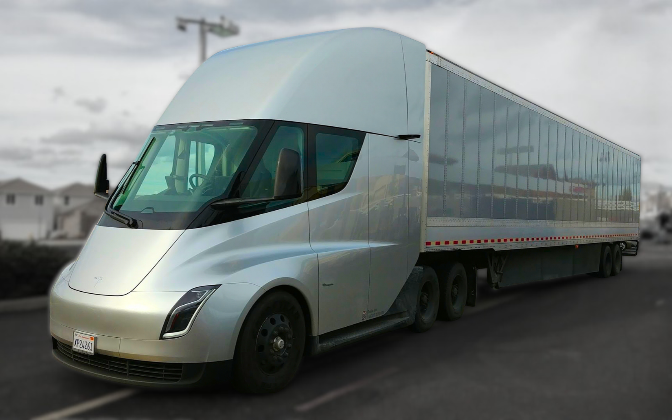
Looking ahead, we want to arrive at cost competitiveness. This is where the business case for low- and zero-emission vehicles really stands on its own merits. That could be supported through next-generation technology, such as the new Tesla Semi; reduced on-peak electricity prices; expanded access to reliable and accessible charging infrastructure; and better financing terms as leasing partners mature and start to realize the long-term value of these electric cabs.
Coming back to that middle column, corporate demand, we see this as really being the bridge between policy support, which can be quite supportive, and the ultimate end state, which is cost parity, where these trucks really speak for themselves. This is an arc that will be very familiar from so many sustainable technologies, just as it was for solar and wind. Those technologies were supported by policy until the market grew enough and advances in technology allowed them to stand on their own economics.
That middle column is really where GMA focuses its work, and it’s the lever we’re able to activate today. The intent is not for corporate demand to replace supportive public policy or fix every element of the business case, but rather to provide a source of support that companies can act on today.
Corporate buyers already purchase freight services and are quantifying portions of their transportation emissions. As a function of that, they are setting goals that increasingly include the broader parts of their value chain. If that existing demand can be translated into stronger commercial commitments, it can give carriers and the market more confidence around the revenue side of the electric truck investment.
Corporate sustainability commitments quite frequently come in the form of SBTi commitments — the Science Based Targets initiative, which I’ll touch on more later — but also other initiatives, such as the UN’s Race to Zero campaign, and the work we do here at GMA through demand aggregation.
This is especially important because a carrier is being asked to make a long-term investment in a truck and potentially charging infrastructure, while historically, freight contracts and individual shipper relationships can be much shorter-lived or less predictable. So we see corporate demand as the main vector through which we can channel investment toward these decarbonization goals.
To understand why corporates have these goals in the first place, it’s important to step back a layer and understand what corporate greenhouse gas accounting is and what it even means.
Perhaps the most widely cited and used global standard for greenhouse gas accounting is from the Greenhouse Gas Protocol. It introduced scoped accounting, whereby an organization can organize its emissions into buckets known as Scope 1, 2, and 3. This allows companies to baseline where their emissions are, identify hotspots, set goals, and track progress toward them.
In the context of trucking, emissions from freight and logistics are often a very significant and challenging source of emissions to address, because of how far removed they can be from a corporate’s actual control. If a company isn’t actually paying for the freight, or isn’t the one contracting for it directly, these can be really nebulous relationships to manage. This helps explain why corporates have a hard time addressing these emissions, and also the role we have to play.
If we look at the diagram on the right, this is pulled from the GHG Protocol. The GHG Protocol Corporate Accounting and Reporting Standard, as I said, is the most widely used and referenced corporate accounting standard globally. It serves as the foundation for how companies measure and report on these different scopes.
Scope 1 includes everything within your direct operational control: stationary combustion, such as natural gas or oil burned in boilers, furnaces, and generators; mobile combustion, meaning fuel used in a company-owned vehicle, aircraft, or vessel; and other emissions, such as process and fugitive emissions from chemical reactions or refrigerant or methane leaks. That all goes into your Scope 1. Importantly, your Scope 1 is also somebody else’s Scope 3, and Scope 3 makes up the entirety of the rest of a corporate’s value chain.
Scope 2 covers emissions from the generation of purchased electricity, steam, heating, or cooling that the company consumes. This is where the electricity purchased to run our battery electric trucks comes in.
And then Scope 3 is the giant monster that covers the rest of the accounting process.
When thinking about greenhouse gas accounting, it’s important to understand that these are ultimately tools. The purpose of accounting is to give us the ability to prioritize action, track against baselines, and communicate our results in ways that are reliable, defensible, and standardized.
As I mentioned, because Scope 3 encompasses so many components of a value chain — from the purchase of capital goods, business travel, and waste generated in operations, to the processing of your products, how those products are actually used, and their disposal and end-of-life treatment — it can be quite a lot for a corporate to address. And because corporates are setting these goals, we are seeing growing demand for solutions that can help them advance their sustainability objectives.
For freight in particular, emissions appear in three major places. For carriers, this is Scope 1 mobile combustion. Importantly, the GHG Protocol defines your Scope 1 as anything over which you have operational or financial control, so if a carrier leases trucks, those would also fall into its Scope 1 emissions.
For Scope 3, freight falls into either Category 4, upstream transportation and distribution — the transportation and distribution of goods that the company has itself purchased and paid for — or Category 9, downstream transportation and distribution, which is everything that happens after the point of sale that the reporting company does not pay for.
As you can imagine, Category 9 in particular can be very challenging for a corporate to address, because they don’t have direct financial insight into it. This is why it’s so important to begin these conversations throughout your value chain now: so we can start to provide greater visibility into data, improve its fidelity, and grease the wheels of those relationships so that companies can begin tracking those emissions reliably and set goals against them. And the point of setting goals and targets is so we can ultimately reach our planetary goals of near-term and net-zero targets.
As I mentioned earlier, SBTi, the Science Based Targets initiative, is the main target-setting and validation body. SBTi provides independent review and validates whether a company’s emissions reduction targets are ambitious enough to support global climate objectives. As a result, any SBTi-approved target is viewed as a credible signal that the company has a serious and measurable decarbonization plan.
SBTi targets have become an important benchmark for customers, investors, suppliers, and internal sustainability teams. Many large companies are now expected to have science-based targets and to have begun engaging their suppliers to measure emissions and demonstrate a meaningful pathway to reduce them.
So for companies with significant freight emissions, SBTi targets create pressure to find practical ways to reduce Scope 3 emissions. That’s one of the reasons there’s growing interest in zero-emission trucking, low-carbon freight programs, and book and claim more broadly.
From this graphic, we can see that a pretty large proportion of companies have validated targets under SBTi, and more than 70% of those include Scope 3 within their targets. To put the scale of the demand into perspective, as much as 75% of a corporate’s emissions can come from Scope 3. So it really is a huge component of corporate inventories, and companies are looking for meaningful ways to address it.
Historically, though, freight and trucking in particular has been a very fragmented ecosystem. A shipper who is motivated and willing to support zero-emission trucks might not be in a geography or on a route, or have carriers within its network, that can support battery electric deployment.
Of course, direct matching can work really well when it works, and we need more of it. But if there’s insufficient infrastructure, if electricity costs aren’t low enough, and if carriers can’t source enough volume to hit critical utilization thresholds, the economics start to become more challenging.
In this example, Shipper 1, who is interested but can’t find suitable carriers in its network, is forced to use a traditional diesel trucking service despite its intentions. Meanwhile, a carrier who has already made the initial investment and deployed a zero-emission vehicle might not have shippers in its network willing to help cover some of the additional costs arising from capital expenditures, infrastructure deployment, and so on. This is exactly the problem book and claim was invented to solve.
So if we revisit that example, here’s a brief overview of what book and claim is. It is the process by which the environmental attributes of a service — in this case, Carrier A’s battery electric truck service — are decoupled from the actual freight and sold to a shipper as an environmental attribute certificate, or EAC.
Shipper 1, who was motivated to support electric trucks but didn’t have any in its network, pays the green premium to the carrier, and in return receives the EAC. So even though its freight was physically moved by Carrier B using a traditional diesel truck, Shipper 1 can take that environmental attribute certificate, claim it against its Scope 3 inventory, and take the road transport emissions reductions. Meanwhile, Shipper 2, who was uninterested in or unmotivated to purchase the battery electric trucking service, simply receives a default diesel truck emission factor.
The process by which the environmental attribute is decoupled and then sold is book and claim. It’s the mechanism through which a lot of catalytic demand for Scope 3 decarbonization solutions is channeled from motivated shippers and buyers who have set ambitious climate goals.
So we’ve briefly covered the role of the carrier in deploying the electric vehicle and generating the EAC, and the role and motivations of shippers in purchasing those EACs to abate their Scope 3 emissions. I’m now going to focus a bit on the middle category: the CPOs, or charge point operators.
For our first procurement, we required that CPOs purchase renewable energy to match the electricity consumption of the electric vehicles one to one. We did this because we want to push the market toward being as sustainable and decarbonized as it can be, and we thought this would be a useful tool to help propel that objective forward.
It’s important to note that market-based accounting for electricity is still evolving, especially for freight and the allocation of electricity attributes. Additional guidance is needed on how different actors should account for and disclose within Scope 2. That will be forthcoming, and it’s something we can touch on in greater detail in the following webinars.
But in many cases, CPOs will play a really important role in providing charging data and electricity sourcing information. Again, we would encourage all involved parties to begin these conversations sooner rather than later so we can start forging those relationships.
This is the ecosystem as it stands, and around all of that activity is where we sit here at GMA. We help design the book and claim system, we identify willing carrier partners, we convene a buyers alliance of member shippers interested in procuring zero-emission trucking attributes, and we facilitate the bilateral contracting between the parties.
To walk through this in greater detail and really dive into the specifics of what GMA Trucking does, I’m going to hand it over to Clayton Gerber.
CLAYTON GERBER:
Awesome. Thanks, Jakob.
Continuing where Jakob left off, he mentioned a bit about the pillars and key activities of GMA Trucking. I’m going to take us into specifically what we do and how we see the interconnection between demand aggregation, book and claim, and the physical demand aggregation efforts we’ve been seeing in the market.
Quickly, on GMA Trucking: the program was launched roughly three years ago, bringing together a number of shippers to operationalize these different pillars — really helping to build and refine the book and claim systems, and then operationalizing them through these procurement processes. You can see some of the names of our members on the right-hand side. The membership spans tech, CPG, and several freight forwarders as well. The goal in our upcoming procurement process is to grow this number and bring in more shippers to activate more demand.
We’re also very grateful for our partnership with SFC, the Smart Freight Centre, and their expertise on a number of things, both accounting-related and fleet electrification.
I’ll note here that we don’t have many details on our first procurement in this presentation, but as was mentioned, we completed the procurement process at the end of last year. We selected the all-electric carrier Nevoya as the winner of that competitive process, finalized the contracts at the end of last year, and those trucks will be delivered this year. In the next webinars, we’ll touch more on the lessons learned and the procurement process in detail, so more to come on that.
If you go to the next slide — I want to go a layer deeper on how these two things come together. As mentioned, we bring together a number of shippers to help catalyze demand and bring it to fruition in a way that is bankable and scalable, and that also lowers cost. We see economies of scale: more trucks per charger, more utilization of those trucks. How can we grease the wheels of the system so that we can actually realize cost reductions through high utilization?
The book and claim system Jakob walked through is what provides the flexibility to bring these things together the way we do, because it enables long-term contracting. Whereas many freight logistics contracts are short-term — ranging from daily up to perhaps a year — book and claim contracts let us more flexibly sign multi-year contracts. That gives the carrier more assurance of a revenue stream and allows them to offer competitive rates and make the investment case. It’s really these two things coming together that allow us to do what we do in the way we do it.
If you go to the next slide — in this next procurement, a bit differently from the first round, we’re hoping to more intentionally bring book and claim together with physical demand. By physical demand, I mean that a shipper who is motivated to decarbonize, or to deploy electric trucks on its routes, actually has its goods on the trucks. With book and claim, it isn’t necessarily their goods on the trucks; they’re buying a certificate.
As many of you are probably aware, the ZET SCALE project was just announced a couple of weeks ago by SFC and Catalyst Mobility. ZET SCALE worked with several shippers in the market to aggregate their collective interest and demand, in order to secure lower truck pricing through a large-scale procurement of Class 8 trucks.
We are working with the SFC and Catalyst teams to bring these two things together, so that we can complement the work the ZET SCALE program has done — creating competitive leases and identifying the routes with the most favorable TCO — and then layer in book and claim. I’ll get into that in a minute, but I also want to give kudos to the team that led ZET SCALE.
Quickly, back to the book and claim side. I want to double-click on some of the benefits we see for both carriers and shippers in engaging in the book and claim market.
The first is de-risking the investments themselves. As I mentioned, multi-year contracts from creditworthy shippers provide revenue certainty to carriers making these investments, or signing contracts at a higher price — for example, if you’re leasing or using any sort of charging-as-a-service. You have assurance that there is revenue and demand in a contractual, bankable form, which helps you make the investment case to leadership as well as to finance partners.
The second is how that revenue gets used. The certificates have to be generated from moves. You can’t just buy certificates from the trucks themselves; they have to come from the truck actually being utilized, because that’s what avoids the diesel alternative. The revenue from the certificates can then help the carrier offer the most competitive rates to the market and ensure those vehicles are utilized. In particular, this can mean winning business from shippers who aren’t necessarily motivated by the greenness or electrification of the trucks — shippers who are simply price-sensitive. With this additional revenue stream, carriers can find those shippers, service their loads, utilize the trucks more, and in turn reach cost parity faster.
Third, this is a way to differentiate yourself as a carrier from the rest of the market. Book and claim can be a flexible tool to help you engage in this market and continue to scale, so that you become a front-runner in the zero-emission transition.
And lastly, this is a new kind of revenue stream and a new way of engaging with shippers. It looks a bit different, but it’s a way of being introduced to these companies.
If we go to the next slide — I want to touch on how we see these things coming together.
Physical demand is critical and important. It reflects the end state we want: companies that are motivated to have their goods physically moved on these trucks going out into the market. Having that physical demand solidified provides a form of guarantee to a carrier that there are shippers who want to prioritize the electric vehicle service. That utilization leads to lower TCO as carriers reach their investment decisions and what they expect to be parity over time.
Where we see the complication is when there isn’t sufficient utilization from the physical shipper network in a region to justify the full benefits of electrification. If a carrier is unsure whether it can reach the needed utilization with its existing shipper relationships, or from shippers motivated by electrification, there may be more empty loads and empty backhauls on those EVs. That means lower utilization than expected, which undermines the path to parity. That in turn may make the carrier less willing to deploy its next trucks, because if it hasn’t been able to utilize them to the extent expected, it isn’t reaching the payback it anticipated when it made the investment case. So without sufficient utilization, there’s a worry that in some instances carriers won’t be able to reach the revenue they need.
Obviously, this isn’t the case in all instances. We know of many cases where carriers get strong demand assurance from shippers, can match different shippers, or have a shipper with enough volume to fully utilize those electric trucks. But we also know there are other cases where the matching needed for full utilization isn’t yet known, or isn’t secure enough for a carrier to make the investment.
If we go to the next slide — what we see as the catalytic new element here is the injection of book and claim. If we follow this flywheel again, you have physical demand. That physical demand is an anchor that helps solidify a certain portion of a carrier’s expected utilization.
Then book and claim comes in and says, “We will help contribute an additional revenue stream.” That complementary revenue both bolsters the carrier’s economics and allows it to offer more competitive rates to the market, identifying additional shippers beyond those motivated strictly by the electric nature of the service. That leads to more utilization and, in turn, helps the carrier hit the targets it needed to make the investment case. With that, the carrier sees the market and the utilization of these trucks, has that flexibility, and makes the next investment in the next trucks.
That’s how we see this scalable flywheel and positive feedback loop, where we can actually reach the needed utilization, have flexibility from the book and claim certificate revenue, and lower overall premiums for everybody engaged in the market. This can be an interim solution on the way to where we want to be in the future: a world where everyone is deploying EVs on every route because it’s the most cost-effective thing to do. We know we’re not there today, and we need to do everything we can to get there. This is one of the solutions we see to create more flexibility in the market.
If we go to the next slide — in terms of next steps, within the next few days we are launching a Request For Information to gather information and perspectives from you all in the market to help inform the next procurement. We’re still refining the procurement model itself — the design, the reporting requirements, the commercial structure — to make sure it is tailored to where the market is.
We also want to identify opportunities: where are you looking to deploy zero-emission trucks, and how? And we want to know what questions and needs you have for this market, so we can be intentional and thoughtful and put you all in the best position to apply.
If we go to the next slide — Tactically, the RFI will come out in the next few days. We have the email addresses of everyone who registered, so we’ll send it directly to you, but it will also be broadly disseminated and posted on the GMA website. The email will include instructions on how to respond, and the due date will be the end of November. That will feed into our last webinar as well. We’ll gather as many questions and perspectives as we can, and ultimately those will be incorporated into the procurement process, which will launch in early 2027.
If you have any questions, first, put them in the chat now. We can also try to cover anything in the next webinars. And lastly, you can always reach out to any of us on the team, or at the trucking@gmacenter.org email. We’re trying to have as many avenues for questions and clarifications as possible.
Quickly, on the last slide: I know today’s meeting was relatively high-level, so for those of you already engaged in the book and claim market, it was probably largely a refresher. But we know many of you may be pretty new to this as well, so we wanted to start at a very high level: What is book and claim? What is greenhouse gas accounting? How are we using the tools at our disposal to help deploy these trucks and spur the market?
In the next two workshops, we’re going to go a couple of layers deeper. In the November workshop, we’ll talk more tactically about EAC generation: what data is needed, what the reporting requirements are, and more specifically, the roles of carriers versus CPOs and others. We’ll also share some of what we learned from executing the first pilot. The goal is to give you all the information you need to engage in this market and respond to the upcoming RFP.
In the last workshop, we’ll get more into the credibility components: how to avoid double counting and what’s needed. There are things you give up by participating, so to speak — it’s not simply a grant. So we want to be very clear about the integrity measures that need to be incorporated, as well as the contracting components. As we said at the top, what we really do is help facilitate strong contracts for these certificates, so that a carrier knows, before it needs to make these investments, that it has assurance in doing so. The goal for that last workshop is to move toward a state of readiness and to provide more space for questions and clarifications as we get into the deeper content.
With that, that concludes the main body of today’s presentation, and we’ll transition to questions and answers for the next 15 or so minutes. I’ve seen a bunch of questions come in, so please keep putting them in the chat — you may think of more as others ask theirs.
I’ll note up front that, because we have these other webinars coming, we may not go into great detail on some of the nitty-gritty accounting questions. We can touch on some of it at a high level, but there will definitely be more to come on the accounting components in particular.
So with that, Stacey, would you like to help shepherd us through the questions that have been coming in?
STACEY MCCLUSKEY:
Yes, gladly — and thank you to everyone who has submitted questions already.
For the first question, Andre, if you’d like to come on camera, I’ll send this one to you: Is book and claim only available to a fleet through an RFP and award, or can a fleet that has battery electric vehicles sell the EAC directly to a shipper?
ANDRE DE FONTAINE:
Yep. Okay, that’s a really good question — thank you to whoever asked it. There are a couple of ways of answering it, but I’ll start by stating our objectives at GMA: we are trying to get more battery electric trucks on the road, and we think book and claim is a very effective mechanism for doing so.
Our goal is not to corner the market for EACs or to run the only pathway for purchasing them. Already today, fleet owners can sell attributes directly to shippers, and we’re seeing some services and companies do so. What we’re really trying to do is create a market for these attributes. So no, it doesn’t need to go through GMA.
Having said all that, what we’ve experienced in other sectors is that in the early stages of these markets, there is a lot of benefit to working through an NGO platform to buy and sell certificates. We certainly hear that a lot from the buyers we work with, who are venturing into a new market that poses some risk and presents a lot of complexity. They like working through a managed process with experts who have done this kind of work in other sectors.
But as the market matures, we fully expect to see other purchasing pathways begin to flourish. This is something we saw with the Sustainable Aviation Buyers Alliance. In the early stages of the SAF certificate market, a lot of traffic went through SABA. Today, the most significant transactions are actually occurring outside of SABA, but they are leveraging a lot of the tools and market infrastructure we built, whether it’s the digital registry or the sustainability framework that sets the criteria for high-integrity SAF certificates. We could definitely see a similar trajectory in trucking.
I hope that answers the question. The bottom line is that there are, and will be, multiple pathways for engaging the market. We think we play a pretty important role in the early stages, but as the market grows, we would expect to see multiple different pathways for trading attributes.
STACEY MCCLUSKEY:
Great, thank you, Andre. Our next question relates to slide 16, so let’s go back to that slide so we can reference it. How is Carrier A managing and treating its Scope 2 emissions? Clayton, would you like to take that one?
CLAYTON GERBER:
Yeah, sure thing. Let me just make sure I’m on the right slide. So Carrier A here is the one actually operating the electric trucking service and the electric truck itself.
In line with how corporate GHG accounting works, they are also able to count those emissions toward their own targets and their own emissions report. The Scope 2 emissions in this case will be gathered from the charging infrastructure or the telematics, following all the relevant greenhouse gas accounting rules, and they can report that as their Scope 2. They’re operating these trucks, so it’s part of their reporting inventory.
That’s allowable double counting, so to speak. As Jakob mentioned earlier in the presentation, emissions across the value chain actually overlap with one another. A carrier’s Scope 1 or Scope 2 is the same as its shipper’s Scope 3. That’s the intention of the different GHG scopes: to provide an incentive for shippers to decarbonize and to make them accountable for emissions that aren’t within their direct operational control.
So if I’m understanding the question correctly, the Scope 2 emissions would simply be part of Carrier A’s report. They would be able to report and claim them and make external communications about their emissions. If they’re a large carrier with both diesel and EV services, they would similarly be able to report lower emissions in their corporate reporting because of the shift from Scope 1 to Scope 2, or just the Scope 2 itself.
It’s important to note — and I think there’s another question we’ll get to on this — that if the carrier is selling a certificate from that activity, the emissions profile of that electric service can’t then be used by the physical customer receiving the service. The physical customer has to use a default or residual factor that essentially does not reflect the electric nature of the truck.
So I think I’ve answered a couple of different questions — I hope one of them was the intended one.
STACEY MCCLUSKEY:
Perfect, thank you. Our next question: If book and claim certificates are coming from a carrier — for example, J.B. Hunt — but I don’t use J.B. Hunt for any transportation, can I still buy J.B. Hunt credits through book and claim and apply them to meet my carbon target goals? Jakob, I’ll send that one to you.
JAKOB SANCHEZ:
Yeah, and I think we can stay on this slide, too.
So, in short, yes. It does not require the carrier you use to be the same carrier you buy a certificate from.
The caveat I would include is that when using market-based instruments like these book and claim certificates, best practice and the rules say we wouldn’t want to buy certificates from Class 8 heavy-duty trucks and apply them to, say, your passenger commuting footprint. We call this constraining by the transport operation chain, or TOC. So we would want to see TOC matching and bounding. We would also not want to purchase more certificates than what is actually reflected in our inventory.
As for who those certificates come from, this is exactly the solution book and claim offers: they can come from anyone, regardless of geography. As long as you’re motivated and willing to pay for it, you will receive those environmental attributes. But yes, there are a couple of constraints and rules around how those certificates are actually applied, and that’s a topic we’ll want to dive into a lot more deeply in a future webinar.
CLAYTON GERBER:
One thing I might add here, Jakob — you covered everything, but one thing that came to mind is that over time, as these markets mature, there can be an evolution toward additional matching criteria. For those familiar with the renewable energy market, for example, we’re seeing a trend, after 20 or 30 years of operation, toward requiring more connectivity.
We’re very early in this market. At this point, we don’t see further constraints — based on very specific routes or lanes — as needed, or as really manageable or feasible. Over time, we may get to a place where we as an organization promote best practices that get stricter and stricter. But we’re early enough in the maturity of both book and claim in this sector and electric trucking in general that we don’t think further matching should be required or even recommended — especially as it relates to whether you need to do business with a specific carrier.
STACEY MCCLUSKEY:
This next question relates to ZET SCALE: Under ZET SCALE, are the shippers not expecting EACs to be bundled with their physical demand? Clayton, I’ll send that one to you as well.
CLAYTON GERBER:
Awesome. Yeah, thank you for the question. It’s a great one, and it’s one we want to make sure is crystal clear to everybody engaging on the book and claim side.
The expectation is that those involved in ZET SCALE are interested in the environmental attributes. They are motivated by the greenness, so to speak — the emissions impact of the electric deployment.
So when we think about combining physical demand and book and claim demand, the actual activity underlying the book and claim certificate needs to come from shippers who are not interested in the environmental attribute, because they have to forgo the rights to it in order for it to be claimed by a different shipper through the certificate.
Here’s how that could work. As a carrier, you might have a contract or book of business with a motivated shipper, potentially part of ZET SCALE. Let’s say that, in a certain region, it covers 70% of the utilization you need from that truck to reach your targets. For the remaining 30%, you might not otherwise be able to win business from other shippers in the market who aren’t motivated by electrification — who are just cost-conscious and want their goods moved with high-quality operations and terms, but aren’t necessarily looking for a lower-emissions service.
Those are the opportunities where book and claim can help reduce the revenue you need to charge. You don’t necessarily need to charge a premium or higher cost to the physical customers in that region who don’t care about the greenness of the trucks. You can use the revenue from the book and claim certificates to be more competitive in the market and therefore win other business.
We’ve seen several of the carriers engaging in this market working a lot with 3PLs, for example, to identify and source routes — working both on contracted business with shippers and on more day-to-day spot market business.
So, long story short: the ZET SCALE shippers are motivated by the attributes, so the certificates need to come from business with shippers who are not interested in the attributes. And it’s the certificate revenue that provides the flexibility to go out and find those shippers.
STACEY MCCLUSKEY:
Jakob, I’ll send this next question to you. If I’m selling the environmental attributes, can I still market myself as a zero-emission carrier to physical customers?
Jakob SANCHEZ:
Yeah, this is a good and tricky one.
Yes, but — big but — if you’re selling the environmental attributes of your trucking service, you have to be very clear when contracting with your physical supply chain that anybody receiving your service on a route for which you’ve already sold the attributes cannot also claim them. This is where we start to get into double-claiming and double-counting territory, which we will definitely cover in more depth.
But yes, as an all-electric carrier, you can say that you are deploying electric trucks and having a positive impact on the decarbonization of the freight sector. You can point to your positive benefits in the marketplace broadly. But it’s important to be very clear — and best practice is to be contractually clear — that your physical customers cannot claim the greenness of your electric trucks if you’ve already sold that off.
This is where it becomes really important to be very transparent about your use of market instruments, so that all the players in the ecosystem can act responsibly and accurately.
STACEY MCCLUSKEY:
Thank you. Clayton: How do I know there will be buyers for these attributes in the future?
CLAYTON GERBER:
Yeah. To be honest, we feel this is kind of our role in this market. As the demand aggregation function, we bring together the companies that are motivated and interested in this market, and we try to take out the uncertainty — especially in each discrete procurement process — by providing a long-term contract. In the first procurement, that was a four-year contract with options on the back end to extend. That takes some of the ambiguity out and gives carriers engaging in the procurement process assurance that they will, in fact, receive that revenue for the duration of the contract.
More generally, we see a lot of positive momentum around the adoption of these kinds of instruments beyond our procurement process. With SBTi — the target-setting initiative Jakob mentioned, which is one of the factors driving many companies to engage — we’ve seen a lot of positive movement toward accepting these kinds of mechanisms. Previously, there was ambiguity about whether they would count toward targets. Now it’s pretty clear that they can count toward targets for companies that want to reach those goals.
As a result of SBTi and the GHG Protocol, we’ve seen increased interest from corporate shippers across trucking, as well as other transport modes and other sectors generally.
So overall, we take our demand and try to make it bankable and set in hard contracts, so you know it’s assured and you know it’s there. And through the repetition of these procurement cycles, we hope that creates assurance in overall demand.
STACEY MCCLUSKEY:
We have time for one more question, so I’m going to go to Andre. Why should I buy EVs now instead of waiting for truck prices to fall?
ANDRE DE FONTAINE:
Well, I’ll answer this from an environmental perspective. You sometimes hear the expression, when it comes to climate change, that winning slowly is the same as losing. That’s definitely something that motivates our urgency at GMA.
I think we went over some pretty clear benefits of purchasing and deploying these trucks. In many cases, you can start to see TCO parity. But even absent that, the local air pollution benefits, the insulation from some of the risks of the fossil fuel market, and the fact that they’re a better ride for drivers — the benefits are clear and present now. We don’t know exactly what will happen with truck prices in the future, but I think there are strong enough reasons to act now that it makes sense to get into this market and start taking advantage of those benefits.
STACEY MCCLUSKEY:
Well, that’s all the time we have. Thank you, everyone, for attending the first webinar in our carrier education series. As mentioned at the beginning, our next webinar will be on November 10th at 1:00 PM Eastern / 10:00 AM Pacific. We hope to see you then.
Also, keep an eye out for our request for information, or RFI, which will launch later this week or early next week. You’ll receive an email about that as well.
Thank you all very much for attending, and we look forward to seeing you at the next one.
CLAYTON GERBER:
Thanks, everyone.
ANDRE DE FONTAINE:
Thank you.
Related News & Resources






06.04.26
Webinar | How MBIs can enable scalable and credible low‑emission fertilizer markets
Fertilizer production represents an important Scope 3 decarbonization opportunity for food and beverage companies. While the current focus on regenerative agricultural practices is essential, reducing emissions in fertilizer production is sometimes overlooked – despite being both a necessary and complementary lever. For many food and agriculture brands, undertaking interventions to reduce emissions associated with producing fertilizers presents challenges. Market-based instruments (MBIs) offer an opportunity to address value chain barriers to fertilizer decarbonization and unlock much-needed finance. MBI structures such as book and claim are beginning to gain traction, but for such approaches to be credible, they must comply with integrity criteria. The Center for Green Market Activation (GMA) co-hosted a webinar with the Value Change Initiative (VCI) to explore the opportunities for MBIs to unlock credible fertilizer decarbonization in food and agriculture supply chains. This webinar addresses:
- The importance of fertilizer decarbonization and the challenges associated with undertaking and claiming Scope 3 interventions
- Potential MBI solutions to enable credible low-emission fertilizer procurement and necessary credibility criteria
- Emerging examples of how food and agriculture brands are using MBIs to support fertilizer decarbonization
Related News & Resources
04.16.26
Webinar | SCoBA Supplier Webinar April 2026
In this webinar recorded on April 15, 2026, staff from the Center for Green Market Activation and RMI explain the process for the Sustainable Concrete Buyers Alliance (SCoBA) RFP, including eligibility requirements.
A full transcript of the webinar is available below. Presentation slides can be accessed here.
ANDREW ALCORTA:
I’ll begin by thanking everyone for joining us this morning, or afternoon, depending on where you are in the world, to learn a little bit about the work that we are doing here at SCoBA. We will have time for questions at the end, and so I would encourage folks to keep those questions. I believe there should be an option for you to input them throughout the presentation, and we will come back to those. With that, if we can dive into the presentation.
We’ll start with just a quick overview of the agenda and objectives for today. We really want to use the next hour to make sure that suppliers in the cement space are informed and understand the RFP process that the Sustainable Concrete Buyers Alliance is currently operating, so that we can walk through the details of that, the intent, as well as to address your questions. We will spend quite a bit of time on eligibility requirements to try to ensure that that is as clear as possible over the course of the time today. So we’ll go through a quick welcome. We’ll spend a little bit of time talking about SCoBA as an organization, and then we will really dive into the RFP process before getting into Q&A.
With that, I will also start quickly by saying that antitrust compliance is something that we take very seriously throughout the entirety of this process. If at any point folks feel that there is anything that is starting to edge up to a competitive line that may be an area of concern, please flag that in the questions, and we don’t anticipate this, but happy to adjust course if that is necessary. Anything that is commercial in nature, we ask that you all do not share that during the course of this conversation to make sure that we are staying on the right side of these lines.
And with that, I’ll take a moment here to introduce myself and the broader team here. So I am Andrew Alcorta. I am a senior director at the Center for Green Market Activation. I’ll talk a little bit more about what both GMA and RMI do in just a moment. But on the screen here, you will see the broader team that has contributed to the SCoBA effort more broadly and to establishing this RFP, as well as doing quite a bit of work to try to establish a framework for book and claim in the cement and concrete sector. I will not go through introductions for everyone on this page, but you will hear from many folks here over the course of the presentation, as well as during the Q&A time.
Quickly, I do want to introduce the organizers of SCoBA. This is a joint initiative between RMI and GMA, or the Center for Green Market Activation. And we have both collaborated on designing this system, standing up SCoBA, and operating it to try to catalyze the development of low-emission cement and concrete in this sector more broadly.
RMI is an organization that I suspect many folks are familiar with here. Their mission is really focused on accelerating the clean energy transition. And they have been working on the challenge of decarbonizing cement and concrete for several years, and I have had the good fortune of interacting with them across multiple roles that I have had and different hats I have worn in this pursuit.
GMA, or the Center for Green Market Activation, is also a nonprofit, and we are focused fundamentally on deploying novel systems like book and claim to hard-to-abate sectors to try to accelerate and catalyze decarbonization of those sectors. And we have a long history of organizing and running buyers alliances to try to connect companies with meaningful Scope 3 targets and initiatives to decarbonize their supply chains with producers that actually drive decisions that will result in lower product emissions, and connect the two to try to accelerate action here.
You see some of the sectors that we have been engaged in at the bottom here across various RMI and GMA initiatives, and I will talk a little bit more about that later.
If we zoom in on the challenge of cement and concrete decarbonization specifically, I suspect I am preaching to the choir, looking at many of the names of the participants here, and so I will be brief, but it is a really tricky sector to decarbonize and to make the business case to decarbonize here.
What we see is, one, the underlying technical challenge, the emissions profile associated with producing cement and concrete is inherently challenging to address when you consider the process emissions.
What we have seen is for deeply decarbonized products, there is a material premium. And getting folks to actually pay that premium has been a source of uncertainty for many producers.
Uncertainty about demand for low-carbon products. Is it actually going to materialize? How long is it going to materialize for? At what price point?
Production is highly localized here. So even where low-carbon production has emerged, how can we find a set of buyers within the catchment area of that facility, or through a book and claim system, trying to break that down and really enlarge the geography that could be served here?
Limited visibility into products in the supply chain. So the end users that are trying to decarbonize their supply chains are often struggling to find solutions in the markets in which they operate. And if we take that from the other end of the chain, producers in these markets are often looking at the fact that buyers with targets, with budgets to pay for a low-carbon product, are often very far removed from where they sit in the value chain. And coordinating through the intermediaries in the middle of the cement and concrete value chain can be very difficult, resulting in challenges of monetizing low-carbon production.
The results of this context and this landscape is that we see supply, in many cases, is really, I don’t think waiting for it is necessarily the right answer here, but needs to see that strong demand signal and see motion towards firm monetization of low-carbon products before they can make very significant investments to produce those products. And on the demand side, they are often looking around saying, “I can’t find the low-carbon products that I need.” And this is the challenge that we fundamentally see a need to solve here.
If we go to the next slide, we see book and claim systems as a very effective way of trying to break this gridlock, and specifically here by separating from the physical product, the emissions intensity of that product, and recording that on a separate environmental attribute certificate. We see an opportunity to allow the physical product to transact just as it always has but take that environmental attribute certificate and directly transact between the producer of the low-emissions product and a downstream buyer that is looking to address their Scope 3 emissions and challenges in that area. And by creating that direct linkage and doing so in a standardized way, we create flexibility and new opportunities for producers of low-carbon materials to monetize that activity.
The goal here at the end of the day is you have given producers a new revenue stream associated with the carbon intensity of their product, and you have given the downstream buyers of these products, or users of these products, the ability to address their Scope 3, where previously they were largely stuck. And so our hope here is that this will actually unlock the investments in large-scale decarbonized projects, and it will allow buyers downstream to actually meet their Scope 3 targets, rather than being stuck in the gridlock that we so often see.
We recently applied this model to cement and concrete specifically and released, earlier this year, a book and claim framework for cement and concrete. We recognize that this is a very complex sector, and applying this model requires quite a bit of nuance when you think about how does this work in practice, what should the guardrails be? And this framework was really an attempt to lay out that logic. It was informed by stakeholders across the sector, NGOs, legacy producers, and novel producers and startups, as well as a large number of buyers, with academics consulted through the process. We think that this is a really important step to begin monetizing low-carbon production in the sector. And this work was prepared in concert with the broader meta standards that are emerging in the space.
And I’ll name the three here briefly on the right. The Advanced Indirect Mitigation standard, which is intending to provide quality criteria for environmental attribute certificates and other similar mechanisms, the Greenhouse Gas Protocol, which is going through a set of revisions, as well as the Science-Based Target initiative, which is drafting a new version of its corporate net zero standard. All of this was really structured to operate in concept, and in concert, because we think that having buy-in from those voluntary standard setters is going to be critical to actually unlock the demand the sector needs.
If we go to the next page, I very quickly want to talk about how all of these pieces interact, because I recognize that the standards landscape is complex and seemingly only becoming more so. The point I will start with is, as GMA and RMI, we very intentionally did not want to recreate the wheel here, but rather use the constructs that already exist in the space, to avoid duplication.
And so as we think about the layers here, the Greenhouse Gas Protocol and the Science-Based Targets initiative really oversee the rules for voluntary carbon accounting and target setting. And we think that that is their role. We are not trying to play directly in that space, but rather take cues from them and follow the guidance and direction that they have given.
One level down, there is the Advanced Indirect Mitigation platform, which was actually published yesterday by a consortium including the Center for Green Market Activation, that provides additional criteria on how you should think about indirect mitigation, how you can think about value chain association, and what actually differentiates a high-quality environmental attribute certificate from a potentially low-quality or risky one. In addition, ISO recently released additional guidance on book and claim systems.
The next level down is the framework that I alluded to a moment ago, that we recently published and released, and we see this conforming to all of the layers that you see above here, and we took very intentional efforts to ensure that there would not be conflict there.
In addition, we have leveraged the structures that you see on the right, the product certifications and LCA guidance, so that we are not trying to invent new ways of doing these calculations, but rather referencing and taking advantage of the existing PCRs and EPDs that are already used in practice today.
The next step for us is taking this framework and operationalizing it in the form of a digital registry, and so we are now working on a registry rule book to actually translate the principles in the framework to effectively binary decisions and zeros and ones that will be captured in a registry system.
And with that, I’m going to transition from book and claim as a solution to accelerate decarbonization in this sector to SCoBA, or the Sustainable Concrete Buyers Alliance, which is really an attempt to actually put these systems into practice. So SCoBA is a set of downstream users of cement and concrete that have material volumes of cement and concrete in their Scope 3 inventory and are trying to address the embodied carbon from those materials. They have generally made major public commitments to decarbonize over a defined time period, and they are actually trying to go out and make the purchases of low-carbon materials that are necessary to meet those commitments.
The way SCoBA operates is it will actually engage multiple buyers that are looking to procure attributes associated with low-emission cement production and aggregate their demand to bring it to market together. What that means is these buyers will engage over a long process to align on a common set of procurement criteria, a common procurement timeline, and a common evaluation structure before SCoBA releases a request for proposals on those buyers’ behalf.
And this is really where the folks on this call will come in. We are looking for you all to submit bids in response to that request for proposal to provide low-emission cement environmental attribute certificates in line with what is laid out in this RFP. Our hope is we will get a large number of those bids and submissions, and we will evaluate those using the procurement criteria laid out in the RFP and a predetermined framework to select a small number of projects, generally one to two, that meets the buyer’s demand. And this allows that demand to actually flow to a project to help move it forward FID or to commercial success, to ensure that demand does not fragment out in the market such that none of the supply side projects actually have enough demand to move forward and be successful here.
I will also note that the intent here is to get to firm offtake that is contracted in hard, firm terms that the buyers will eventually sign. SCoBA will not take possession of the EACs. It will run this process and ultimately lead to a bilateral transaction between SCoBA members and the selected supplier. But the intent here is really to get to firm contracts that give revenue certainty to suppliers and producers of low-emissions materials.
If we go to the next page, I think it’s important to recognize that this is a novel concept. And any time you are doing something new, it’s important to touch on analogs. What I want to highlight on this page is both GMA and RMI have applied this model with quite meaningful success in a number of sectors. So you will see here that this same buyer’s alliance and demand aggregation model through EACs has been applied to aviation, to trucking, to maritime, and to steel. And across these markets, we have seen meaningful uptake of these EACs and resulting projects that have come online and/or been successful as a result.
And so I’ll take the example of aviation quickly, which is the buyer’s alliance that has run for the longest period of time at this point. We have really seen that move from an initial proof of concept that you could transact on environmental attribute certificates to solve some of the challenges that I described earlier to a scaled system where 50 million gallons of SAF have been mobilized through the buyer’s alliance system and these environmental attribute certificates. And we’ve seen over 200 million in private investment, and that number is growing with an additional RFP live at the moment.
We are seeing this model work in a number of sectors, both transportation, which you see well represented here, but really expanding into materials as well. And we think that as you look at cement and concrete as a sector, the unique challenges here lend themselves to EAC commercialization so effectively that we are very excited to take this model to this sector and try to bridge some of the challenges in a long, complex value chain with players in the middle that are often very squeezed, buying on a project basis. By moving to this model, we think we can mobilize the large blocks of demand that are going to be needed to actually move real projects at scale forward and to do so with multi-year commitments in place.
And so with that context, I want to shift and hand over to my colleague, Joan, who is going to take us through the actual RFP process here and walk through what would be entailed for a producer that is submitting a bid to this RFP.
JOAN GIBBONS:
Awesome. Thank you, Andrew. And just a reminder, I think I see people starting to use the Q&A function, but please feel free to drop any questions that arise during this presentation into the Q&A function within Zoom, and we’ll get to questions at the end.
So to provide more context on the process, we have outlined the various stages in the procurement cycle. There is an intentionally designed staged RFP process where we start with broad engagement through a request for information. For this RFP cycle, this actually happened last fall in October, where we got a great amount of responses and really good indication of excitement and engagement from suppliers in this space.
From there, we intentionally shrink down and ultimately, as Andrew mentioned, end up with a couple, a very small number of very high-quality contract-ready outcomes, and shift through moving through the RFP submission phase, which is we’re right in between the two right now, where we are receiving binding proposals to supply low emissions cement environmental attribute certificates.
After the submission phase, we’ll move into review and shortlist selection, where the organizing team here will be evaluating all of the proposals received, and identifying a shortlist based on our predetermined criteria.
Then we shift into selecting a finalist, which is usually typically one or two finalists will be selected. And those proposals and producers will then move into a contracting phase with SCoBA members.
We do have a bit of a pre-contracting phase and where we try to align on some key contracting terms and establish a template contract that helps support a more smooth contracting process with each SCoBA member. But from there, producers will move into bilateral contracts directly with the purchasing SCoBA members. So the contracts will be directly between producers and SCoBA member companies. And from there, we move into the procurement and implementation phase, where once contracts are signed, EACs begin to be delivered based on the delivery schedule that’s agreed upon during the contracting phase. And we shift into ongoing tracking, verification, and registration of EACs on a registry. So that’s the whole procurement cycle mapped out into the various different stages.
And as we shift to the next slide, we’ll look at those stages spread out over the next year. So the important dates to remember for now are that we are requesting any sort of questions or written clarifications, by the 20th. So April 20th of this month, that’s Monday of next week. We’re requesting any written questions. So feel free to send those in to the email address that’s listed in the RFP materials. We’re also happy to submit questions today, and we’ll get to as many as we can. We will be listing all responses to all questions asked on the GMA website, and so those will be available for reference by everyone, to make sure that there is consistent and easy access to information that is provided.
The next key date to keep in mind is the letter of intent deadline. So we are asking the suppliers that are intending to submit to submit a letter of intent by May 1st. Again, it’s helpful to understand who is intending on submitting, and we’re happy to answer any questions about the letter of intent or deadlines as well during the written clarification period.
From there, in June, the response deadline for RFP responses is June 19th currently. So that’s another key date to keep in mind.
From there, we haven’t put exact deadlines for the shortlisting phase or finalist selection. But those we intend to occur during the months of August and September, and then we’ll shift into the pre-contracting and contracting phases.
I’ll note dates beyond July 1st right now are tentative and subject to change, but we will make sure to keep all respondents and producers engaged and updated as we progress through these different stages. So we do intend to have firm deadlines for stages into the future.
The next slide, we get into how producers can engage with SCoBA. We get some of these questions all the time as we’re launching this effort as a new buyers alliance of how producers can stay engaged and interact with SCoBA. And so the primary way that we engage with producers and suppliers is through the request for information and request for proposals. So as I said in the other slide, the first stage to our procurement cycle is typically setting out that request for information, where we’re trying to understand the market, and really get a good idea of the potential supply and potential opportunities for engagement through the RFP. And then down the road following that, once we align on the specific RFP criteria and target with our SCoBA members, we will then release the request for proposal, which is the phase we’re in now.
So really, the SCoBA members and organizers will define the emissions goals, quantities, contract length, all of the specific criteria for EAC procurement ahead of releasing the RFP. But all of that is informed by the RFI.
I will flag, we do have right now, based on our cement and concrete booking claim framework, the eligible producers or world of producers that we’re targeting are specifically clinker, cement, concrete, and SCM producers in partnership right now with cement or concrete players. So I will flag that as of right now, asphalt products, admixture and additive producers, and steel and rebar producers are some example of folks that are not within the scope or realm of SCoBA procurement as of today.
SCoBA members range, as Andrew mentioned, in company size and type, but generally is inclusive of companies that have concrete exposure in their scope 3 emissions. We do see a lot of folks that are involved in the data center or hyperscaler world, but also more traditional developers and owners that range from a variety of industries, from commercial, residential, and infrastructure, and industrial buildings. So really, we’re focused on matching up any sort of organization that is looking to mitigate the concrete emissions within their scope 3, with producers that are interested in providing EACs and looking for investment in low emissions technologies and investments.
With that, I will flag too, as I mentioned, in relation to the clarification deadline, if you have any questions about whether your product or if you are a producer that fits that definition of in-scope, feel free to submit a written question during the clarification period. That is exactly what it’s for.
And with that, we will move on to the specific eligibility criteria for this RFP. So for the 2026 RFP, we have set specific eligibility criteria to define the scope of the products that SCoBA members are looking to procure. I’ll flag that this is a step more specific than the framework requirements. So I would definitely encourage producers to reference the book and claim framework for any information on specifically how to evaluate your product or how the book and claim system works. The SCoBA procurement is directly built off of the book and claim framework, but we have defined slightly more specific criteria in order to create a more targeted demand signal for this RFP.
So starting off– and I will also mention too at the top here that more information on these criteria can be found in the RFP documentation. So would definitely recommend taking a read through that before submitting more questions.
Kicking off with the specific criteria for this RFP, the emissions threshold is GCCA Band B rating or better. As you can see on the right-hand side, we have the the rating and eligibility system is leveraging the GCCA low carbon cement rating definition. So we are targeting that Band B, which is slightly more ambitious than the framework eligibility threshold of Band C.
For timing, SCoBA members are looking for EAC delivery in 2027 or 2028, and so we define that requirement as year one, first EAC delivery by December 31st of 2028 at the latest.
As has been mentioned, we are targeting cement products for this RFP, specifically. And really, the choice around that was intended to both send a more specific demand signal and make sure that we’re narrowing some of the scope for this specific RFP. But we also found a lot, and it aligns with both the majority of emissions associated with cement and concrete products, as well as we did see a lot of engagement from cement producers during our RFI phase.
This is the first RFP for SCoBA. There is a definite possibility that other RFPs in the future, we do plan on running several RFPs on a fairly regular cadence. Maybe focused on different products or different technologies, or different points in the cement and concrete value chain, but this RFP is going to be focused on cement products.
I will flag that this is inclusive of blended cement products, and so for eligible producers, there’s both a pathway for traditional cement producers, more innovative cement producers, but more generally also SCM producers that are working in partnership with a cement producer for a blended cement product are welcome to submit as the lead respondent for that partnership. But the product does need to meet the eligibility requirements for a cement functional unit, as outlined in the booking plan framework. We’re happy to answer more questions on that too.
We have another requirement criteria for catalytic impact. We’re focused on primary interventions that are not fossil dependent or based, and primary intervention is meant to be the primary decarbonization lever for that product. We have required EACs to represent emissions benefits that exceed regulatory compliance obligations. More information on regulatory compliance and how we’re evaluating that can both be read in the RFP documentation as well as the AIM Standard and Guidance that just came out yesterday.
And for certification, in addition to providing a third-party verified type 3 product specific EPD for verifying the emissions of the product, we are also going to ask some questions around non-greenhouse gas related criteria, and asking about the relevant social and environmental safeguards for the product.
So those are the base criteria. If there are questions, like I mentioned, we’re happy to respond to those during the Q&A section. And next we’ll move on to how submissions will be evaluated.
So as Andrew mentioned, we will be evaluating submissions both across price, but also a range of criteria that are intended to make sure that we are evaluating the broader impact of the product, both at a product emissions impact level, but also taking a bit of a systems impact view.
And so we are going to be approaching it with a least cost, best fit approach, both making sure that responses meet the minimum requirements that I just touched on in the slide before, but also taking a more holistic view and evaluating based on some of the criteria that we’ve included here.
So looking at volume impact, we do have a minimum meets or exceed 35,000 metric tons of CO2e abated annually target. That is one way of looking at a volume requirement. We are also able to convert into tons of cement. But really looking at that CO2e abated is the way in which a lot of our members are looking at their procurement and looking for abating their concrete emissions exposure.
We’ll be looking at sustainability and value. Both whether the product meets the GCCA Band B rating, but also looking at, like I mentioned, the innovation and system-level impact that that product might have.
And then also delivery certainty. We are very focused on making sure that these offtake commitments can help support producers in investing in low emissions technology and making those updates. But we are very also focused on making sure that we can work with producers that will deliver EACs on the contract timelines. So risk is definitely a part of our evaluation.
From there, we’ll develop a shortlist, in partnership with the criteria outlined and agreed upon by the SCoBA members. And then from there, we’ll move on to the finalist selection.
Our next slide provides a little bit more context on what those final stages might look like for producers and suppliers that are engaged in this process. And so, as I mentioned, we will holistically review all of the proposals against the criteria, develop that shortlist of producers, and then re-engage with those producers in order to ask any sort of follow-up questions, invite them to refine proposals or provide a best and final, and engage to better align with SCoBA member preferences that we have talked about at the beginning of this process, but also sometimes emerge throughout the procurement process.
From there, we’ll be selecting one or more producers as the winner of the RFP, who will then move forward into contracting bilaterally with each purchasing SCoBA member. From there, they can expect a formal notification of selection, and then potential public engagement. We typically like to make sure that the producers that are selected have the benefit of being recognized publicly. And a lot of the SCoBA members that we are working with are seen as leaders in the space, and so there is typically alignment on communication and announcement approach.
And then from there, producers will begin contracting directly with the interested SCoBA members. And typically, as I mentioned, we’ll start with a pre-negotiated SCoBA template contract to help facilitate the process. But the parties will individually finalize specific pricing and volume commitments, delivery timelines, milestones, and any other key commercial details.
Agreements are executed as firm multi-year offtake contracts for this RFP. That’s what we’re expecting and targeting. So those are intended to be, as Andrew laid out at the beginning, supportive of providing producers with the necessary revenue certainty and offtake certainty for the EDCs to support either a significant commercial scale-up, or that final investment decision for a new production facility or retrofit.
So I went through those rather quickly, but the intent was to hope that we have enough time for Q&A at the end. Before we get to Q&A, I’m going to pass it off to my colleague, Monet, who’s going to walk through more of the specifics of the submission process.
MONET KUNZ:
Awesome. Thanks so much, Joan. So on the next slide, we’ll talk through a little bit of the logistics of how you get to the RFP materials, and then fill out and submit the materials for submission.
So first, you’ll navigate to the GMA website. There’ll be a link that’ll be sent out. But there’s also a banner across the website to find the RFP documents. You’ll be prompted to submit your name and organization and email, which you’ll then receive a link to download the RFP materials. And you’ll see two main documents. One is the introduction materials. Recommend you start there, read through that. And the second one is the actual RFP submission document, which will be an Excel template.
Next slide, please. So as you look at the documents, the Excel template is really going to outline all the instructions and specific information that the SCoBA organizers are seeking as part of this RFP process. And you will see that the data will be entered into different cell shades. The light gray cells are the required inputs, and the light blue cells are the optional inputs. So if there’s additional qualifying information you would like to submit, or if you would like to reference a supplementary material document name, that’s where you would put that information. And then the light pink cells would be the example values. Please note to not move, add, modify, delete cells in this document, as that will disqualify your participation from the process.
And the next two slides will take a closer look at the Excel document before finishing out the process for submission. So on this page, you’ll see a quick overview of what the Excel file looks like. There’s multiple tabs. The first three tabs, Cover Page, Binding Terms, and Instructions, don’t require any input from suppliers for submission, but just provide some additional context information and instructions for filling out the RFP.
You’ll also see five more tabs that do require submissions and responses from the RFP respondents. You’ll have the Respondent Information page, which is general information about your company and the services that you all provide, the Volumes and Pricing tab, which is really where we’re getting the bid volume pricing and price premium methodologies and other relevant price and volume details. There’s also an optional price conversion tool that we will dive into a little bit more to help you navigate from tons of cement to tons of CO2. And then there’s also the Sustainability and Facility Information tabs that have a few other required inputs.
So, on the next slide, we’ll look a little bit closer at this price conversion page. So, the reason for this is because pricing is expected to be submitted both on a per ton of cement and per ton of CO2 basis. This essentially allows us to align our buyer demand, which is typically evaluated in tons of CO2 equivalents, with the contracting that will occur on a per ton of cement basis. So, in this example, you’ll see four inputs in those gray boxes. That’s where suppliers will input their information. The calculations will happen, and then auto outputs will be applied in the sort of orange salmon-colored cells below.
It’s important to note that the EAC pricing is the intended green premium of the price to produce the product, and then the cement GWP emissions factor and the baseline emissions factor can be found on your EPD and on the emissions factor baseline methodology that is outlined in section seven of the Book and Claim Framework for Cement and Concrete.
So, as we move to the next slide, once you have filled out the Excel template and collected any supplemental materials that you want, you’ll then move to the Submissions portal, where you’ll fill out this first page on identifying information and making sure that all the required information is filled in.
Then on the next slide, you will collect all of your files. And note that a total of three files can be submitted. So, the first file will be that Excel submission document, and then any supplemental materials like your EPDs or supporting documentation can be uploaded in the following sections. It is important to note that if you have more than a total of three files, you’ll want to compress those into a zip file to upload in those sections. And any additional information that you can provide can support your response in this submission process.
And then finally, on the last slide, when you’re ready to submit your documents, you will see these three boxes. Again, that first one is for your submission document, the Excel file, and then the supplementary materials in the following boxes. Once you hit Submit, you’ll receive a confirmation from info@buildscoba.org, and then you’ll be done at that point. If you would like to revise your submission, let us know at that same email address, but on the June 19th deadline, we will consider all submissions final and not accept any further revisions at that time.
So, just a quick look at the submission process for this RFP, but I think we will now move into the Q&A to answer your questions, and I will pass it over to Ben to moderate those questions.
BEN SKINNER:
Thank you, Monet, and thank you everyone who has attended today. We’ve gotten a bunch of questions in the Zoom function, and so thank you for that. We’re going to do our best here to work through all of them. I’ll note as well that we’ll be putting out a more public Q&A document. So, if we don’t get to your question, hopefully we’ll be able to answer everything. And then, of course, you can also reach out if you have additional questions.
The first question we have here is around the book and claim framework itself, and it is: How are we ensuring that these benefits aren’t being double-booked? As it was mentioned at the top of this presentation, the SCoBA RFP does fit in more broadly to the book and claim ecosystem and builds off of the Book and Claim Framework that we built out, which does have strict rules and guidance around double counting. And I’d love to pass it to Chandler or Joan to maybe give a little bit more insights around how we’re thinking about double counting, and in addition to that, how physical off-takers are still incentivized within this system.
CHANDLER RANDOL:
Yeah, really good questions here, and happy to kick us off. And Joan, please feel free to jump in with anything as well.
On double booking and double counting in particular, there are a couple of factors within the framework that minimize the risk of erroneous double counting. One is by having a registry itself. So, having the registry where we can physically track where the issuance, transfer, and retirement of the EAC goes is a great tool to identify that the only party that should be claiming those reductions are verified.
The other component, and this is one that is pretty specific to cement and concrete, rather than just a registry to solve these problems, is that we’re relying very heavily on EPDs. And EPDs are great. We want to incentivize EPDs. They also introduce some double counting risk, and we acknowledge that.
The section eight of the framework does go into some of the ways that we’re minimizing this risk, but essentially, how we’re suggesting to minimize this risk is a producer is required to disclose to the physical recipient that an EAC has been sold associated with this EPD and require some form of disclosure of that, whether it’s a EPD cover letter or in the notes section and within that, also produce an alternative baseline that the physical recipient should be using to use in their inventory and product level accounting, rather than using the GWP values from the EPD itself.
The second question was on incentivizing the physical off-takers to actually use these materials in general, and this is a really great question. And one mechanism for that is while quantitative claims, so those emission-related claims, those are strictly forbidden, but what a physical recipient could do is they could make qualitative claims about the products that they’re using. These ultimately would be negotiated between the producer and the physical recipient themselves to negotiate the bounds of the types of claims that could be made, or types of qualitative claims that could be made.
But some examples of what this could look like are using a innovative product or using a novel product. They could even use the brand of the product. What would not be permissible under these qualitative claims, though, are things like saying, “We used a low-carbon product,” or, “a green product.” Those would probably err on the side of an erroneous claim because the greenness of that product has been sold with the attribute.
So I’ll pause there, and Joan, do you have anything else to add to either of these?
JOAN GIBBONS:
No, I think you did a great job, Chandler, explaining. And I would say there’s just, I think in engaging with this system, we’re introducing more communication within the value chain about the nature of the product, the fact that EACs have been sold. And so really that’s supposed to start with that bilateral contract between the EAC producer and low emissions material producer and the EAC buyer. Terms are expected to be worked out around claiming, around use of the physical product or claims by the user of the physical product, and then flow down from there. So we are asking for an additional level of transparency and documentation, and communication as that product moves through the value chain. And Ben, we’ll hand it back to you.
BEN SKINNER:
Thank you both. We’ve got a couple of questions about registries and the broader ecosystem here, and so going to combine a few into one. Would love Chandler, or perhaps Andrew as well, to jump in and describe a little bit more about how this system interacts with registries, how does a registry rule book fit in, and what are we doing given that there aren’t any registries in existence right now?
CHANDLER RANDOL:
Yeah, this is great. Andrew, I’m happy to start and then would love for any thoughts that you have.
I think on the registry, the Framework provides high level guidance on how to design a book and claim and operate a book and claim, but it doesn’t provide the level of detail that’s necessary to actually talk about how we’re tracking these EACs on a registry, which is a really critical component. I would point to other sectors that have registries and registry rule books as really good examples. One that comes to mind is the SAFc registry.
And I think what you’ll notice between the document that we have and ultimately that registry rule book is there’s just another level of detail of how specifically you transfer an EAC to a different user within the system, and then how it’s actually retired. And I think that’s the biggest gap right now.
But at a high level, the principles for what are needed in the system are covered in the framework. Andrew, any additional thoughts to that?
ANDREW ALCORTA:
No, I think you’ve covered it well, Chandler. So I’ll just briefly say, part of this process is as you are standing up a registry, ensuring that you have the right structures in place, the right technical partners to actually implement this. And so we are continuing down the path of writing that registry rule book to ensure that the detail and the clarity translating from the framework to effectively a software program developer is all there, and that’s what Chandler was referring to. We are also in the process of going out and engaging with potential partners to try to figure out what that long-term solution should be.
At the same time, we want to ensure that we are not slowing down the commercial process in these markets, and so we are moving forward at pace with this first RFP and procurement. And there is a long history in these markets of finding interim solutions while that long-term technical infrastructure is built.
BEN SKINNER:
Thank you. Moving into a question around contracting. This one will be for Joan and Andrew. What is meant by binding proposals?
JOAN GIBBONS:
I can start, and Andrew, feel free to add in. I think binding proposals is meant to indicate that we are expecting a firm proposal that can be contracted upon. And so the intent is that producers are evaluating the RFP criteria, and submitting a proposal that they are expecting to be able to be used for contracting, and that is representative of a firm proposal.
So the intent is that those prices, the timelines, the delivery terms, could be directly used in a contract as is, as submitted, by a buyer. As we’ve outlined, there typically is a process within shortlisting where we are talking through terms. There may be a potential for updating down the road, but we want producers to submit a firm proposal upfront.
And Andrew, we’re happy to have you add anything there too.
ANDREW ALCORTA:
I think you covered the proposal side well. Effectively, the price and volume cannot change materially because we’re going to run the evaluation process on that. And I think you covered the finer points there.
The one additional piece that I may just highlight, and I don’t know if the question was intended to address this, but I think there’s also a question here around, how should we think about the firmness of contracting and the offtake that results from this process? And what I would note there is, historically, what we have seen in these contracts is an agreement between the parties where buyers are contractually bound to buy a particular volume of EACs on a particular timeline at a particular price.
Now, the only contingency here is the production of those EACs, which is contingent on the production of the low-carbon product. But generally speaking, the way that we have structured these in other sectors is if the producer actually produces the low-carbon product that they have said they would in this RFP, if they issue the EACs as they say they would through the registry, they will get paid, and we are providing that revenue assurance effectively, through this process. And the backstop here is having a contract, right, and having all of the protections that you would normally have from a firm contract in place.
So I don’t know if the question was intended for the offtake side, but that’s the other piece that we are really trying to firm through this process that I at least wanted to touch on.
BEN SKINNER:
Thanks, Andrew. We’re going to shift into a couple of questions around eligibility for the RFP. The first one is for SCM companies, SCM producers, can they partner with a cement company to put forward a joint submission as a cement blend, and how should they reflect this in a letter of intent?
I’ll start off by answering that. Yes, we are absolutely wanting to see blended cements be submitted here, and that a partnership between an SCM company and a cement producer who would actually book that attribute for a blended cement is encouraged.
We also are thinking more about SCMs more broadly, and so I’ll pass it to Andrew and Chandler to give a little bit more information around how we’re thinking about incorporating SCMs in the future.
ANDREW ALCORTA:
I’m happy to start here, and Chandler, if you have anything to add, please do. I will note, as a separate track of work from this RFP, we are investigating the possibility of a direct EAC issuance from SCM producers. That is still very much in the exploratory phase. So we are going out, we’re having conversations about how that could work, what methodologies or certifications you would rely on in order to do that, how technically it would be reflected on an EAC, and ultimately, from that, trying to evaluate what both the benefits and risks of that system structure versus what was described in the question and I think in Ben’s response here, where SCM producers are partnering with cement producers, how to think about the relative trade-offs there.
So, we are undertaking that work separately because we have not come to a resolution on that question yet. And that will have to go through our governance process formally at some point. We, again, did not want to slow down the commercialization process, did not want to hold the RFP on resolution of that. And so this RFP is moving forward based solely on what is in the framework, which would require an SCM producer to partner with a cement producer.
BEN SKINNER:
Thanks, Andrew. And Joan, do you want to put maybe a finer point on the letter of intent component?
JOAN GIBBONS:
Yeah. So we would expect just a letter of intent from the primary respondent. So that could be the SCM producer in this case. But any additional information on the partnership, or information on how the plan is for booking EACs and having access to the information for that, would be appreciated. We expect that we can also continue the conversation during the review process, if there are additional questions on the partnership.
BEN SKINNER:
Thank you. We’ll stick with Joan and Andrew here to answer another RFP eligibility question. There’s been a few questions around fossil-based SCMs and subsequent blended cements and their eligibility in the system. In addition to that, if they’re reclaimed, beneficiated, or mineralized, how does that fit in here?
JOAN GIBBONS:
Thanks, Ben. So I think there is a component in the framework or a note in the framework that outlines the framework’s approach to thinking about fossil-based materials that are reclaimed or beneficiated or mineralized, activated, more broadly in general.
For this RFP, we have taken a slightly different approach in outlining a criteria that says that the primary decarbonization lever should not be fossil-based, or a material that is a byproduct of fossil fuel processes. And so that is taking it a step further, in that what we are looking for is the primary mechanism for reducing the emissions intensity of the product is not a material that is associated with a fossil process. So it does include materials that might be reclaimed or beneficiated, as the primary decarbonization lever.
ANDREW ALCORTA:
I think well said, Joan. I don’t have anything to add on the technical side of this. I will just flag that, in extended consultations with the buyers that make up the SCoBA members, a desire to identify solutions that are really going to drive deep decarbonization and be applicable well into the future after you see some of these fossil byproducts decrease over time, was a core element of what they were solving for. And so that is really the intent behind this, is how do we find those technologies that can drive forward and be applied well into the future, recognizing that application of fossil-based materials into blended cements or as SCMs is happening today, there is real benefit to that. We expect that to continue and think that is a great way to reduce the carbon intensity of cement and concrete today. But really the buyers here wanted to find how can we catalyze the next innovation to make this sector more sustainable.
BEN SKINNER:
Then another question, or two questions here on eligibility. Is the RFP targeting a specific geography in terms of EAC generation or where the physical product is being delivered? And is there any sort of differentiation between under construction plants and operational plants?
JOAN GIBBONS:
Yeah, I can take that one first. So we are open to anywhere on the globe for geography. There isn’t any sort of specific geography requirement. So open to any submissions from that aspect.
On the under construction versus operational facilities, part of the submission template does have a facility information tab, and there are different sections to fill out based on where the stage that the facility that is being submitted is in. So we do have a few different questions for facilities that are under construction or pre-FID in order to, again, assess that delivery risk. There’s a couple of questions for operational facilities as well, but since the RFP is open to facilities that are in any stage, there’s a few different sections there.
I will flag that if you are potentially submitting different proposals for multiple different facilities, or if there are multiple facility options that you might be submitting for, we would ask that you are submitting a different facility tab for each facility. So that might look like create saving down another version of the submission template and filling it out separately for each facility that you’re submitting in order to provide the right information for that facility tab on operational status and delivery.
BEN SKINNER:
Thank you, Joan. Unfortunately, we are just about at time here, so we’re going to transition into next steps. If we didn’t answer your question, we’ll aim to follow up. And of course, we encourage you all to submit any additional questions that you may have by April 20th.
The final RFP bids, again, are going to be due on June 19th. We do encourage folks, if you have any outstanding questions or are confused about the process, our email is here. It’s info@buildscoba.org, so feel free to reach out. Thank you everyone who is interested in helping to support this process. Again, we appreciate your participation and are looking forward to working together in the future. Thank you all.
Related News & Resources
03.17.26
Webinar | Cement and Concrete Book and Claim Framework
In this webinar recorded on March 16, 2026, staff from the Center for Green Market Activation and RMI present their Book and Claim Framework for the Cement and Concrete sector, which is available for download here.
A full transcript of the webinar is available below. Presentation slides can be accessed here.
HEATHER HOUSE:
Welcome everyone, and good morning. We’re really excited for the webinar today. Thanks so much for joining us. We are gonna be giving an overview of the book and claim framework that our team has been working on over the last year and a half. So we’re really grateful for your attendance, and we’ll be looking forward to all of your questions at the end here. Let’s go ahead and advance.
Our main objective today for the meeting is just to highlight the context and the key features of our cement and concrete book and claim framework that we just recently published. When you drop your Q&A, your questions in the chat box, let us know if you’ve also had a chance to read it or not, it’ll be great to hear from you. But we’re just gonna do sort of a quick background and context, before diving into the details of the book and claim framework, and give you a pretty thorough overview of what we’ve been working on over the last year and a half. If you have any questions throughout the process, feel free to just go ahead and drop them into the chat box, and we’ll get to them once we do wrap up the framework overview. And as a note, you probably heard this when you joined, but this meeting will be recorded so that we can share it publicly. Next slide.
This is the team that has been working on this low-carbon cement and concrete book and claim framework over the last year and a half. RMI and Green Market Activation decided to partner up, and we launched a twelve-plus month design input process where we had thirty-plus stakeholders working alongside us to design this framework. So while this is really the central organizing team and the team that ultimately finalized the framework, there was thirty other faces behind this. And with that, I’m gonna pass it over to Andrew.
ANDREW ALCORTA:
Wonderful. Thank you, Heather. So I wanna provide a little bit of context on the framework before we dive into the details. A lot of this will probably be relatively well-known for many in this group, but I think it’s important to hit on some of these points at least briefly.
The first piece here is on the left we have cement production, but I think broadly we can say cement and concrete are materials that are critically important that we are going to continue to use as we look into the future, at volumes that are absolutely incredible. And the GHGs associated with the production of those materials are something that we really need to get our arms around. And so today, we use about four billion tons of cement annually, and that number is only expected to grow as we look out to 2050. And the challenge is the eight percent of anthropogenic emissions that are represented by cement production today will also only grow, both as demand increases per the graph that you see on the left, but also as other sectors of the economy decarbonize, leaving cement share to be bigger and bigger. And so this is a problem we need to get our arms around, and I think many on this call would agree, is critical to tackle in the coming years. If we go to the next slide.
The challenge is it’s a really hard problem to solve, for a bunch of reasons. The first is the emissions profile of cement and concrete production is just particularly challenging. A very large portion of the overall emissions associated with cement and concrete production are core process emissions, rather than fuel combustion, and so it makes it even trickier to abate than many other challenging sectors. The result is, for a large portion of decarbonization solutions out there, you end up with very high costs for low-emissions products. In many instances you may be looking up to fifty percent cost premium relative to conventional production, at least today, and obviously there are a range of solutions and a range of costs associated with that. But it does make commercializing low-emissions products very challenging.
What it really creates is uncertainty for producers about the demand that they are going to receive for low-emissions materials. This is compounded by the fact that construction demand is somewhat hard to predict to begin with. That goes through cycles. But when you think about the willingness to pay, for a decarbonized material that has traditionally been viewed and sold as a commodity, it puts a real challenge on the producers to be able to justify what can approach a billion-dollar investment in some cases at scale. And obviously, we’re looking at technologies that will change some of that math. But when you’re talking about real capital outlays, there are substantial challenges associated with doing that without very firm demand well into the future.
When you then look at the actual value chain and how production plays out in practice, cement production is concentrated in a region. And generally, there’s some exceptions to this, but generally you try to not move cement all that far. And so finding buyers for a low-emissions product within that catchment area can be quite challenging, even before you get to the next piece here around limited visibility, where buyers often don’t know where low-emissions production may be occurring, right? And finding it is a challenge, particularly finding it where their projects may be sited.
And then finally, if you can tackle all of these other pieces, you have the challenge of a very long and complex value chain where between a cement producer or a concrete producer and the ultimate owner of an asset that is trying to manage the Scope 3 emissions associated with that asset, you often have multiple intermediaries, including contractors that, operate on thin margins and really aren’t going to be willing to take a higher cost input until they know their customer is willing to pay for that low-emissions material.
And so all of these result in a situation where supply is looking for strong demand assurance to allow it to make large capital investments to decarbonize production. And demand is looking around and saying, “I’m struggling to find low-carbon products where I’m building.” And we need some way to break the gridlock that is occurring here.
So if we go to the next page, we see book and claim as a very effective way to break that gridlock and try to accelerate deployment of low-emission solutions. And specifically, the way we envision that happening is you take a low emissions product, you separate the emissions attribute off from that product, and you record it on a certificate, so an environmental attribute certificate like you see at the bottom of that diagram, and you sell that certificate separately to the parties that are looking to manage their emissions. In effect, you are selling the decarbonization value associated with that cement or concrete separately from the physical product. And that allows the physical product to pass through the value chain just like it always has as a gray product without disruption along the way.
We see this system increasing flexibility for both buyers and suppliers by giving them new ways to commercialize for suppliers and to meet Scope 3 targets for buyers. We see it providing demand assurance and firm offtake and revenues for suppliers that are looking at low-emissions production, such that they can make an investment case, to actually produce in that way, work. We see contracting for an attribute rather than the physical product enabling multi-year contracts that can actually ensure revenue not only in year one of a plant’s operations but well into the future, supporting the business case. And finally, we see this as a standardized way to connect supply of low-emissions materials or low-emissions certificates with demand, with the parties that really want to manage Scope 3 emissions and manage their footprint. And by connecting those parties with a standardized product, we believe that you are going to get much faster decarbonization in the sector than forcing each of those parties to work through many intermediaries in the value chain and try to coordinate, kind of a grand deal, a grand coalition bargain each time.
What that enables at the end of the day is supply can finally make investments in large scale low-carbon production, and they know they’re gonna have the revenues to back that up because it is part of an offtake contract for EACs. And demand can, one, directly support decarbonization of cement and concrete production, but importantly, it also allows them a streamlined way to achieve their Scope 3 goals without having to do a lot more coordination work in the ecosystem.
So that brings us to why we pursued a book and claim framework, and now we really wanna kind of walk through, how we thought about that, the principles that drove the development of the framework, the process, and ultimately how we see that fitting within the ecosystem.
So at the top level, what we were trying to do is establish clear and sector-specific guidance for how to apply book and claim within the cement and concrete value chain. The goal of that framework is to enable the transactions that I was just talking about to accelerate the decarbonization of cement and concrete production. As we thought about that, we really believed that six principles had to be true as we looked at the resulting framework.
First, it had to be credible from an environmental standpoint. We had to be representing real emissions reductions, real benefits to the atmosphere, and ensure that we were managing unintended consequences in the space, so that this is really driving towards decarbonization around high-quality solutions.
The second, it had to be usable. It has to ultimately be practical for market participants to transact using the framework if you are going to drive change through it. It can’t be so complex, that market participants are trying to use it and, and just running into various obstacles as they do so.
Third, it had to be compatible with existing regulatory and market constructs. And in particular we thought a lot about the EPD landscape, that already dominates in the built environment, ensuring that our framework was consistent with existing PCRs and the EPD landscape was really important to us as we embarked on this endeavor.
It had to be comprehensive, so it had to look at a range of decarbonization technologies and pathways and really try to find opportunities for all of those to compete within the system.
It had to be unifying. We wanted this to apply broadly and, and really be a global framework that could be, applied from market to market, and ideally that would minimize fragmentation in this landscape so that, the pool of demand that is there can really move using a common set of rules.
And then finally, recognizing that we are in the early days of driving low-emissions production in this space, it had to be adaptable. It had to be adaptable both to new technologies as well as market developments that may come. If we go to the next page.
I wanna talk a little bit about how we actually develop this framework in practice once we aligned on those principles. I’m gonna actually start with the bottom here. We engaged a very large range of stakeholders across the cement and concrete value chain, and I won’t go through every one of the icons at the bottom. but we established a working group, of around thirty members, and it was really important to us that that group contained major buyers that actually wanted to purchase EACs, trade associations and technical parties that could comment on, some of the intricacies associated with the creation of an EAC and alignment with existing PCRs and EPDs, NGOs that could, could comment on the environmental quality criteria, as well as producers in the space, both novel producers that are trying to really reinvent the process of producing low-emission cement and concrete, as well as the traditional majors that operate at scale within the space.
We launched that working group in September of 2024. And really over a year and a half, we worked through a number of very tricky problems, and we’ll touch on some of those over the remainder of the webinar to form the basis of the framework that was ultimately published earlier this month and approved by the steering committee, associated with that working group with very broad support, across many of the stakeholders.
Finally, I wanna, touch on how this fits within the broader standard landscape, if we can go to the next page before, we get into some of the details here. We recognize that we are operating in a complex and busy standards landscape at the moment. GHGP is going through revisions. SBTi is close to releasing a final version of its corporate net-zero framework V2. The AIM platform, for those that may not be familiar, is an effort that GMA, Gold Standard, and C2ES are convening to establish a standard on how you assess quality and value chain association for indirect mitigation mechanisms such as book and claim. And then ISO plays a role both on the underlying product category rules to understand the emissions profile of a cement or concrete product, but also with emerging standards on alternative chain of custody systems like mass balance and book and claim.
And so all of these are important players, and the first thing that I wanna note is we actively engage with all of these parties. And this framework has very intentionally endeavored to be consistent and aligned with the emerging guidance on all of these, leveraging conversations we are having on the side, participation in some of the consultative processes here across the board as well.
And if we go one more slide, I wanna double-click on how we then see all these pieces fitting together. So GHGP and SBTi are the broad voluntary accounting and reporting, as well as target-setting standards, that really dictate the rules of the road for how we think about greenhouse gas accounting as well as voluntary corporate targets.
One layer below that are AIM and ISO that are specifically speaking to how we think about best practice in the use of alternative chain of custody systems, such as a book and claim system, as well as how we think about quality and association as we are using those systems.
Then this cement and concrete book and claim framework sits one level down. It intends to be consistent with everything that you see above it but provide more specific sector-level guidance for how a book and claim framework can be applied to cement and concrete specifically, taking into account the nuances of the sector.
And then finally, one click below that is a registry rule book and an operational technology platform that will take the rules that have been agreed in the framework and actually operationalize them in effectively true/false statements such that this market can transact at scale in a digital registry. We’ll talk a little bit more about this at the end, but we are working towards that last step in the process now.
So hopefully this is, perhaps a little bit of a fire hose, but some background on why we felt the framework was necessary, how we thought about developing the framework, both from a principles standpoint as well as the process that we ran to do so in concert with many of the folks on this call and stakeholders across the ecosystem, and then finally, how we see this framework fitting into, a kind of multifaceted standards landscape that continues to evolve.
We’ll have time for questions at the end. I suspect that generated a few, but for now, let me pass along to Chandler, who is going to begin to walk us through some of the elements of the framework itself.
CHANDLER RANDOL:
Great. Thank you so much, Andrew. My name is Chandler Randol, and I’m a senior associate at RMI. And for the remainder of today’s webinar, we will be highlighting several key components of the framework. I do want to note that at the outset, we won’t have time to cover every single detail, and this is not intended to be a fully comprehensive walkthrough. Instead, our goal is to focus on the most important criteria and concepts that underpin the framework, and would highly encourage you to feel free to submit any questions that you have in the question box throughout this presentation.
Over the next few minutes, I’ll walk through several sections of the framework, including the functional units, eligibility criteria, and the emissions intensity measurement methodology. And after that, I will pass things over to Clayton Gerber, who will cover the remaining sections on issuance, accounting, baselines, and physical recipients.
So with that, we’re gonna get into just the overall concept of book and claim. Andrew, I think, did a great job already covering what book and claim is, but we also recognize this is complicated and important, so I think it’s worth briefly repeating.
At its core, book and claim is a chain of custody model that separates or decouples an environmental attribute from the physical product associated with it. In this case, that environmental attribute represents the lower global warming potential or GWP of a product. The environmental attribute is associated, is issued and sold separately as a certificate. And while the underlying physical product is sold into the market as a gray product or a product that has no underlying environmental benefit.
A common question that we hear is why is a book and claim sector needed in the cement and concrete sector? I think Andrew did a great job covering this already, but one of those key challenges really is the geographic mismatch between where low-carbon materials are produced and where buyers are ready and able to purchase them. As Andrew eloquently explained, book and claim helps bridge that gap between enabling buyers to support low-carbon production even when the physical material cannot be delivered directly to them.
In the diagram on this slide, the top line represents the physical value chain. That is the flow of the actual physical material. And the bottom line represents the virtual value chain, which tracks the flow of the environmental attribute certificates. One important takeaway and something we will return to throughout this presentation is that the virtual value chain is designed to closely mirror how a transaction occurs in the physical value chain. We’ll definitely elaborate on this further as we get into the functional units.
Another point worth emphasizing, especially for those who may be newer to the concepts of book and claim, is that while this approach is new to cement and concrete, it has been successfully implemented in several other sectors. Examples include renewable energy markets, sustainable aviation fuel, and sustainable maritime fuels. These precedents demonstrate how book and claim systems can help scale emerging low-carbon technologies while markets continue to develop.
With that, I’m gonna move us on to spend a couple minutes talking about functional units. As I mentioned earlier, environmental attribute certificate or EAC transactions are designed to reflect how the physical value chain operates. Really importantly, EACs are not denominated in emissions reductions or tons of CO2 avoided. Instead, they’re denominated in the functional unit of the product itself. Or in other words, the functional unit represents the unit in which EACs are issued and traded.
For example, this could be tons of clinker, tons of cement, or a cubic yard or cubic meter of concrete. The choice of functional unit is extremely important because it has significant implications for which decarbonization solutions can participate in a book-and-claim system. For instance, clinker or cement level functional units can capture interventions such as carbon capture and storage or alternative cement manufacturing processes. However, these functional units would not capture downstream interventions that occur at the ready-mix level, such as mix optimization. The functional unit therefore influences who within the value chain is able to generate an EAC.
For these reasons, we worked very closely with the working group to align on three different functional units: clinker, cement, and concrete. These interventions reflect the reality that there is no single pathway to decarbonize the cement and concrete sector, and instead, a range of solutions will be needed across the value chain, and we wanted the framework to accommodate as many credible decarbonization approaches as possible.
On that note, I do want to acknowledge something in the current framework. At present, the framework does not include a pathway for supplementary cementitious material or SCM producers to directly issue EACs. I wanna make clear that SCMs can be incorporated at the current existing functional units, but they cannot directly issue these EACs.
There are several technical considerations and guardrails that we felt required further analysis before incorporating this pathway. One example is the need for a robust methodology to demonstrate the replacement rate of an SCM within cement or concrete. Another is ensuring that the accounting methodologies align with standards that are likely to be accepted across the broader ecosystem of standards bodies. We are actively exploring how direct issuance for SCMs could be enabled in the future, and potential updates to the framework may be considered later in 2026 if a credible and accepted approach is identified.
Moving on, we’ve discussed where in the value chain EACs can be issued. Now we’ll turn to the question of how do we actually define the environmental attribute itself? In other words, how do we determine which products are eligible to generate an EAC? As Andrew mentioned earlier, one of our guiding objectives throughout this process was building on existing market infrastructure and to align the systems as closely as possible with how physical products are already measured and categorized.
One approach is to closely define low-carbon products. In the framework, we aligned with the Global Cement and Concrete Association’s low-carbon rating scheme for cement and concrete. This rating scheme categorizes products based on their emissions intensity relative to benchmarks, such as the country’s average clinker-to-cement ratio or a concrete strength class. The rating scales from G, representing the highest emissions intensity, to AA, representing the lowest.
We felt it was important that EACs be reserved for products that are truly catalytic to the market. In other words, that they should represent emissions levels that are significantly lower than what most producers can achieve under typical operating conditions and often require meaningful operational changes or capital investment. For this reason, the framework establishes an emissions eligibility threshold aligned with the GCCA rating of C through 2030. This corresponds to approximately a forty percent reduction in emissions intensity relative to a conventional benchmark. After 2030, the threshold tightens to a B rating, which corresponds to roughly a fifty percent reduction.
The reason we don’t set the threshold immediately at this B level is that we recognize the wide variety and range of maturity across producers. Some companies are long-established producers with existing infrastructure, while others are newer entrants that are still scaling innovative technologies. This phased approach creates a runway for solutions to reach scale while maintaining an ambitious decarbonization trajectory.
You may also be wondering how does the system apply to clinker? We’ve mentioned cement and concrete, but not clinker. Since the GCCA rating system is defined primarily for cement and concrete, but the cement rating is based on a clinker-to-cement ratio, we derived clinker ratings by setting that ratio equal to one, representing a product that is composed of a hundred percent clinker.
Moving on in this, another important eligibility criteria, relates to regulation. Across many book-and-claim systems, an important principle is that voluntary environmental attribute transactions should be additional to regulatory mandates. To address this, the framework adopts a relative regulatory disclosure approach. Producers issuing EACs must disclose all regulations that apply to their operations, as well as any relevant upstream regulations affecting production. This disclosure enables buyers to evaluate regulatory additionality based on their own procurement criteria. Importantly, this approach is consistent with other book-and-claim systems, including RSB’s book-and-claim manual.
Finally, I want to move on to this catalytic impact, sometimes also called market additionality. As mentioned earlier, EACs are intended to support solutions that go beyond emissions reductions that buyers could readily procure through normal physical purchasing channels. One example of a use case that we do not intend to incentivize is the use of non-beneficiated or non-activated fly ash or slag as the primary intervention for generating EACs. While these materials can reduce clinker, they are already widely available and typically do not involve additional costs or new investments.
More broadly, the expectation is that projects issuing EACs should require EAC revenue in order to be financially viable. In other words, they should demonstrate some aspect of financial additionality. That being said, standardized methodologies for determining financial additionality are difficult to develop and maintain across diverse markets. For that reason, the framework recommends that buyers assess financial additionality using their own internal criteria. This is an area which is likely to be further developed by the Sustainable Concrete Buyers Alliance, or SCoBA, to provide greater guidance.
So to summarize this section, eligible products must meet the GCCA low-carbon rating threshold of C through 2030 and B after 2030. Producers must disclose applicable regulations, and the projects should represent solutions that are additional to the market and financially dependent on EAC revenue.
On to the next slide here. We are going to move a bit deeper into the mechanics of how the system actually functions. In the previous section, we discussed the emissions intensity threshold required for eligibility. In this section, we’ll focus on how those emissions intensities are actually measured.
Andrew started to touch on this, but one of our goals was to align this framework as closely as possible with existing industry infrastructure. To do that, we rely closely on product category rules, or PCRs, and the environmental product declarations, or EPDs, that are developed under those rules. EPDs are widely used within the cement and concrete sector to disclose the lifecycle emissions intensity of products. It’s also worth noting that the GCCA low-carbon rating system we discussed earlier also relies upon EPD data to determine product ratings.
That said, we also recognize several real challenges associated with PCRs. One significant challenge is that PCR system boundaries and rules can vary by region, particularly between the United States and Europe. Clayton will be getting into this a bit in more detail, especially in the accounting section. But in general, we acknowledge the importance of ensuring the products in a company’s emissions inventory and the PCR system boundaries of an EAC product are sufficiently aligned so that products can be compared consistently across regions. There is certainly much nuance within that, and we will get into some of that. But definitely encourage a close reading of the accounting sections and the section four for more details.
Another challenge is that certain emerging technologies are not fully addressed within current PCR methodologies. One example is carbon capture, utilization, and storage, often referred to as CCUS. To address this gap, the Smart EPD Program, which is an environmental declaration program operator, has developed rules which provides guidance on how to account for CCS within EPD calculations.
In cases where regional PCRs do not clearly address CCUS, the framework allows producers to use the Smart EPD Annex A methodology as an alternative approach, which may be included in the EPD’s note section. In addition, because the climate benefit of carbon capture is ultimately realized when carbon is permanently stored, the framework requires that projects involving carbon capture and storage provide a third-party storage certificate. This certificate must disclose key information regarding storage volumes and associated emissions data. And finally, while carbon utilization can play an important role in supporting carbon capture deployment, we also recognize that not all forms of utilization deliver a clear atmospheric benefit. For example, certain applications such as enhanced oil recovery may ultimately lead to additional emissions with the release of additional fossil fuel production. Monitoring the long-term flow of carbon and utilization pathways is also still developing. And for these reasons, for now, the framework has limited eligible carbon utilization pathways to mineralization, where the carbon is chemically bound to stable materials.
So in summary, the framework aligns emission measurements with existing PCRs and EPD infrastructure, and while also providing supplemental guidance such as the Smart EPD CCUS annex to ensure emerging technologies can be accounted for in a credible and consistent way. Thank you so much. And with that, I’m going to pass it over to Clayton.
CLAYTON GERBER:
Awesome. Thanks so much, Chandler. And please keep the questions coming. We’re tracking all those now, and so we’ll make sure that we have the time at the end of the call to be able to address those. I will move on to the next slide here and talk through a little bit about the EAC issuance process and data tracking. And just kinda wanna note that, of course, transparency and accuracy and making sure that we’re actually being able to track and validate certificates is critical to this market being able to transact, being able to really grow and scale and build confidence in the system.
So, at the foundation, the first step of the issuance process is obviously going to be the material as actually being produced. And this is either could be coming from new facilities, or those that are actually already operating. And I’ll come back to the question of kind of commercial agreements in forward transactions. But the first thing is that the material must be produced.
From there, we have the EPD issuance and the verification. And so this will be actually what is underpinning the emissions intensity, calculation and methodology. And it’s supposed to be performed a type three EPD that’s verified, and must be within twelve months from the production, if it’s issued beforehand, or having additional verification on an ongoing basis of the underlying assumptions practices that went into that EPD, process.
There would also, as Chandler noted, need to be an additional step for the carbon sequestration for any carbon capture because that can have losses and other kinds of leakage from the capture to the sequestration. And we wanna ensure that what is actually being reflected is the sequestered CO2, as that’s really what the benefit to the atmosphere is gonna be coming from.
From there, you have the production or sale of the product itself. And now this is the closest kind of proxy to the imminent use of the product that we can kinda reasonably use as a marker to the market. And so while it is not the specific “when was the cement or concrete poured in the facility,” this is kinda the closest “it left the gate,” and therefore we can determine that it has high likelihood of imminent use or else the product would not be continuing to be purchased, and therefore it would not be used.
We do not use necessarily just the production alone because, that can have very different kind of time bound to when the product is actually gonna be implemented, and therefore imp-impacts on things like vintage, et cetera. And we don’t have assurance that the product will be used by just the production alone. And so that’s where, this framework kind of grounds the issuance eligibility upon the sale and distribution of the product itself.
I’ll note that the specific order of these first three steps may vary depending on some of the different use cases. For example, if you have to validate sequestration, that may take slightly longer, and the physical product may have been sold already. And so some of these first few steps can vary slightly. But these are all the pre-issuance steps that need to happen before the actual certificate is going to be booked on a registry.
So it brings me there, to that step. The registry is the data tracking and digital platform that ensures transparency through being able to track the product, what are the underlying assumptions, and the calculations that underpin the product itself. And therefore, when a buyer is then looking to claim and report that certificate, they are able to have the underlying information to make sure that it fits in with their inventory accounting, et cetera.
The registry, we do best practice, and we do recommend that registries are managed by third-party entities to reduce conflict of interest, as well as have public retirement statements to be able to transparently demonstrate to the market the interactions and issuance process to ensure minimal double issuance or other kind of bad actors within the space. I won’t go through all of the requirements, but we do list in the framework a number of data components that should be included in the registry itself and on the certificate. Things like the producer and location, the date of distribution, the functional unit, the EPD, the emissions intensity, and other things like that to really be able to provide the purchaser of that certificate the full gamut of valuable information that might impact how they would report or make claims on the product itself.
Moving then to the transfer on the registry. Once the certificate is booked, this is when the issuer or supplier would then be able to actually transfer the claims to those entities that are then looking to retire and purchase the certificates themselves. And so there may be one co-claimant at the different stages of the value chain, and we outline this in the later section on accounting around co-claiming. And so, while we wanna ensure that there’s only one claimant on each part of the value chain, we recognize that the value chain for these products typically are very long and include multiple stakeholders. And so we want the EAC value chain to be able to match that of the physical product. And so this could, for example, look like an architect or an engineering firm claiming a certificate towards their Scope 3 targets as well as an end user, because that’s how the product and the emissions intensity would typically flow within a physical value chain.
I’ll note that this issuance process is not the full kinda comprehensive registry rule book, and there will be further guidance, from a registry rule book and the registry itself on specific data flows, vintage requirements, and some of the other granular tracking components.
Coming back to the question around kind of commercial agreements and forward transactions, we see forward transactions and offtake agreements to really be catalytic in some of the core components that this sort of system, a book and claim system, can really enable to help those high CapEx long-term investments actually get off the ground. However, it’s important to note that the transaction is separate from the issuance process. And so what that means is you may have a forward offtake agreement and go through that contractual commercial contract, but you cannot actually issue certificates before the product is made. So this is not any form of ex ante kind of emissions accounting like you may see by other kinds of offset projects and things like that, that may need a kind of a forward look. We are really only trying to support this market for book and claim certificates based on actual production of the materials, and that is what then triggers the enablement of the issuance process. So the forward offtake agreement would then be based on how much is expected to be produced, and then once it’s produced, the certificates will be issued and transferred.
Moving on to the next slide, also noting that the EAC accounting is part of this broader landscape, as Andrew mentioned earlier. And so there are a number of different components that we really took into consideration and we’re up to date and tracking closely when thinking about how these certificates should be accounted for, and therefore, what should be on the certificate and how should it be designed. I’ll note that this framework is not a comprehensive accounting protocol or standard, as those are namely gonna be coming from organizations like GHGP or the AIM platform that go into a lot more detail. And so we really felt like it was needed to at least bring in this accounting component to make sure that it’s clear and transparent, the general framework for how you do these, and then provide guidance on where to look to kind of actually operationalize more of the accounting nitty-gritty components.
And so really wanna kinda start with the two different accounting approaches. Both sit within a substitution kind of framework that really looks to substitute or adjust emissions intensities of the products, of the functional unit, as we noted earlier, as opposed to just a base CO2 reduction.
And so the first is on the direct substitution, and this is when the emissions intensity on the certificate is directly replaced for the inventory intensity of an equivalent product of cement or concrete or clinker. And this would be then reported in a separate contractual ledger. And again, important to note here that the ledgers, while the guidance from GHGP and AIM is still being finalized and refined, we do envision that these certificates are going to be reported in a separate ledger than the kind of base location-based ledger. That’s not finalized, but that’s typically going to be the way that we see these EACs being reported, similar to how it is in Scope 2.
Within the direct substitution accounting approach, there are certain guardrails that we wanted to put in to make sure that there is kind of enough equivalence and a tight enough matching for the different functional unit products. And so, for example, from a geographical lens, we do think that for direct substitution, you must match by country or regional level. So for cement, that might mean, if you are buying an EAC from cement in the US, then you would need to be directly substituting that for the emissions intensity of cement that you have within the US or, for example, in the EU. For concrete, given the specificity and localization of the concrete market, those requirements are even further refined to be able to most likely reflect the benefit to the atmosphere and not misrepresent by taking into consideration just regional differences in the baseline emissions intensity.
When we move to enhanced substitution or substitution with kind of adjustments to be able to correct for that regional and product differences, this is when we would look at the baseline for environmental attribute certificate or rather for the low-carbon product itself, the most likely alternative to that market and product, and then calculate the difference and the impact of that from the baseline, and then use that and reflect that in your contractual ledger. And so what this approach looks to do is to be able to internalize some of those regional differences and perhaps some product specificity that the direct substitution would not enable. And so this would mean that you could buy a certificate from a different region, but you must reflect that region has a different baseline. And therefore, the atmosphere is seeing a different impact than if you were to directly substitute it in your inventory, which is from a different area.
So the framework itself goes through a little bit more and has some examples of this. So highly encourage you all to review those and to be able to understand these concepts a bit more. The forthcoming AIM guidance also will look to provide some more guidance and transparency on this. And so as we note at the bottom here, this is again, not the fully comprehensive, accounting guidance, but does at least provide some clarity and lens into how these certificates can be accounted for.
If we go to the next slide, wanting to double-click in section seven here really provides a bit more guidance on that accounting baseline for the case of enhanced substitution. So I’ll note that for direct substitution, the baseline is essentially just what’s in your inventory. So you don’t need any other kind of baselining product. But in the case for enhanced substitution, it really kind of is based on what are you comparing to? What is the likely alternative within the market that you should be kind of using as a reference point to calculate your impact? And so this methodology we provide, we feel is quite pivotal, and therefore, further guidance was, was needed within the framework.
So the, the kind of decision and selection tree follows an approach of first looking at whether the underlying product that’s issuing the EAC is coming from an existing plant where a decarbonization activity is happening from where the plant previously was, or whether it’s coming from an intervention that can kind of on an ongoing basis separate the impact from that intervention. For the second kinda pathway within that, we might think of like CCS, for example. You can separate the impact of CCS on an ongoing basis because you can calculate how much you’re capturing, and therefore what would have been emitted had the intervention not happened.
And so if you can, if you have a previously existing plant or you can capture the ongoing impact, then you should use that facility level data as the baseline because that is most granularly and most accurately what the atmosphere would have witnessed and what would have happened if the intervention did not occur.
If you cannot do that, so let’s say you’re in a new plant that doesn’t have any activity, or you’re looking to engage in an intervention that is therefore changing the operations so much that you cannot have an ongoing separation, an auditable separation. From there, then you would look at, are there specific regional available benchmarks that could be used for that product in the bounds of equivalence. So for example, is it the same cement type or is it the same concrete compressive strength? So those are some of the criteria. We recognize that there are multitude of millions, many, many, many other kinds of specific products and that there are other kinds of criteria to be looking at. But what we see typically is the cement and product type as well as the compressive strength are the most correlated to emissions intensity, and therefore, what we use as the basis, for the baselining methodology. If there is a regionally specific data available, then we recommend using that as the average. If there is not, then we would recommend either going to a GCCA band of D using the normalized clinker factor or if not, using the global average.
And so this is kind of a selection flow. We outline a bit more of this within the appendix as well in the framework, as well as highlight this kinda specific regional averages that we see as credible sources. But that is meant to be a dynamic list that as more granular averages and reference points become published, then we would be able to update that list to enable organizations to use more granular data than having to go to the GCCA bands, for example.
If we click through just to kind of highlight a couple examples here. The first one is on, let’s say, a CCS deployment on an existing facility. And so this in the first question, the answer would be yes to the first question, and therefore, you would use that facility data of what it was without the CCS because you can track that, as I mentioned.
In the second example, for, let’s say, an alternative product, that is a greenfield, and therefore does not have an existing facility to be able to leverage. This would be no, it is not able to track on an ongoing basis or have any previous information. It is based in the US for this example, and therefore there is a regional data baseline that can be used, and therefore you would use that regional baseline.
So if we go on to the next slide. for this one, this is kinda the last section within the framework itself. And we really look to— I provide more guidance and transparency into how the physical recipient should be using or not using in the impacts of the low-carbon product itself. And so what we really wanna do in this section is avoid what’s called double counting of the impact to be able to increase the credibility and trust environmental integrity of the system, which in turn would help with the scaling of this system. What we really want to underpin is these systems need to be credible and have high integrity, and therefore, they may be able to scale, and really help deployment in a much larger impact. If that credibility is at risk, then the market could fail.
And so the physical recipients, as we call them, are the folks who are actually receiving the low-carbon product whose environmental attribute has been separated and sold, elsewhere. And so these are on the top right section of the graph here. And so what you’ll see in kinda small writing there, so this is the contractors or the intermediaries in the end use of the product. And what we want to ensure is that they are not claiming the benefit of the emissions impact from the low-carbon product or the EAC towards their greenhouse gas accounting and reporting. And so double counting or erroneous double counting is when you have two stakeholders at the same place in the value chain accounting for the impact of the low-carbon product. You’re double-taking credit, essentially, for that product where, therefore, you’re overrepresenting the impact in that value chain, in that place in the value chain.
And so instead, what we recommend within the framework is that producers must provide either an EPD that excludes the low-carbon nature of the product and reflects, without the intervention. So for example, in the EU, you don’t need to include the CCS component, or you can’t, in the current EPDs. And therefore, you could reflect that the product without that low-carbon intervention, and therefore, the physical recipient would just be receiving the product without that impact. And therefore, it would just be kind of a more traditional product that they’d be accounting in their inventory.
Or you could provide that baseline factor that we just talked about, in the EPD notes section, and then contractually make aware that the baseline should be used for their corporate inventory reporting. And so we wanna make sure that the physical recipient is using a baseline factor, whether that be from any of their kind of accounting approaches, to be able to not reflect the low-carbon nature of the product being sold and avoid the double counting problem.
With that, kind of wraps up the general framework overview. As we mentioned at the top of the hour here, this is not the full comprehensive dive into every single component of the framework itself. It is quite a long document that has a lot more to be able to leverage. And so we highly encourage you to review the sections, and kind of build upon what we’ve talked about today and get deeper into it.
I see a bunch of questions coming in. So again, keep those coming in, and we’ll try to answer what we can during the time that we have. Before moving to questions, wanna quickly note on the next steps, as some of this might, might answer some of the questions as well. So we will continue to support the development of this broader system through both the market infrastructure that can enable the transactions and the flow of certificates, as well as helping to activate the market through the transactions, both in aggregate as well as bilateral.
And so on the market infrastructure, there are efforts underway to operationalize this through the registry itself, to be able to issue the certificates. And so we are working to further the registry plan itself. I’ll let some others speak to that as part of the questions.
And then also, we are looking to accelerate the decarbonization of the sector, through things, through products such as SEMs and are looking to understand and evaluate the benefits and risks of EAC issuance directly from SEM producers and SEM products. And so as Chandler mentioned, are working through, kind of an additional work stream to understand whether that should be incorporated into the framework in the middle end of this year.
And then on the activation side, we work through the Sustainable Concrete Buyers Alliance that was launched, earlier this year, end of last year, to be able to issue the first RFP in the coming weeks to bring demand together to then help scale suppliers and scale the low-carbon market. What we also see is that we also encourage buyers to be able to engage in bilateral negotiation in contracts themselves. So we don’t see this framework just being for SCoBA or any individual supplier or buyers, but rather, leverageable by the entire market to go through any of their own bilateral conversations and transactions.
And so really, what kind of underpins and really will look to use this framework is the demand and is the market for low-carbon products. And so really demand is the critical component that we need and that book and claim can help support by connecting the demand with the supply. And so we encourage any companies looking to decarbonize their value chain and their footprint to contact us to learn more about the framework, to learn more about SCoBA or how they might be able to engage in bilateral conversations as well.
With that, I think we’re at just at about time for questions. So I will open up and introduce Joan. Joan, if you can take us through the Q&A and kinda direct us to where we wanna go next.
JOAN GIBBONS:
Awesome. Sounds good. Thanks, Clayton.
So hi, everyone. I’m a program manager at GMA, working with the team on the book and claim for cement and concrete. And we’ll go through a lot of questions. So thank you everyone for all your questions. We’ll get through kind of as many as we can in the remaining time. And I’ve done a bit of grouping because I think there’s been some overlap in some of the themes. So right off the bat, we did have a question about registry. And so Heather, if you’re able to hop on, it’d be great to have you answer the question of whether we’re kind of partnering or developing a registry.
HEATHER HOUSE:
Sure. Happy to. Thanks, Joan. As you probably all know, GMA and RMI partnered on SABA, of which we created a registry for SAFc. RMI has also created a registry in the maritime space, Katalist. We both collectively intend to continue building out registries for all the sectors that we’re working on, that includes cement and concrete, chemicals, and steel as well. We have been in sort of an exploratory mode, connecting with a variety of different partners to figure out what the right makeup will look like. But, we will indeed have a registry by the end of this.
JOAN GIBBONS:
Awesome. Thank you, Heather. Andrew, I’m gonna pivot over to you next for a couple of questions. Maybe first, quickly, there was a question that came in, I think, during the initial part of your presentation portion about in what context do you see a long-term contract being possible? It’d be great to have you quickly touch on that, and then we’ll switch to another topic.
ANDREW ALCORTA:
That sounds good, and thank you for the question. I’ll try to stay relatively brief here because I think Clayton covered some of this during his section. But fundamentally what we see here is recognizing that suppliers need firm multi-year offtake to make some of these investments work. What we envision is that contracts will take place that can be signed in the near term, and in many cases, what we have seen, and we may see more creativity in terms of the models that are deployed here, the contracts stipulate payment upon issuance of the EAC. So you will have a firm contract that dictates the volumes that a buyer will purchase, dictates the price at which that purchase will occur, and effectively just says, “And this will be paid within these bounds when the EAC is issued, and we expect it over this timeline.”
So the intent here is that still allows the EAC to be issued when the product is actually sold, and you don’t have to jeopardize or water down that link, which we felt was very important from an integrity perspective. But that doesn’t actually stop or prevent you from being able to contract around that future issuance of the EAC. I hope that’s clear. If there are more questions there, feel free to pop them in and we can follow up.
JOAN GIBBONS:
Awesome. Thanks, Andrew. And the next one for you, we did get a few questions around our engagement with GCCA, and then there’s a few more questions later about the low-carbon rating system itself. But maybe first, can you describe a bit how we’ve engaged with GCCA as their framework has a few different criteria than ours or points of separation?
ANDREW ALCORTA:
Yeah, happy to. We’ve had conversations with the GCCA as we have developed this framework. They were not a member of the working group, but outside of that, we touched base with them on a number of occasions. You know, I’ll probably stay relatively high level here, but what I will say is, we have had, continue to have, productive conversations back and forth, and we believe that minimizing fragmentation in this landscape, particularly when demand remains relatively nascent, is beneficial for the landscape, and we will continue to look for opportunities to collaborate and try to reduce that fragmentation as we continue here over time.
JOAN GIBBONS:
Awesome. Thank you, Andrew. Shifting gears a little bit, I think, Clayton, I have a couple questions for you, maybe starting with eligibility threshold. This kind of relates to the low-carbon definitions, but there was a question about whether threshold is based on offtake agreement or vintage. For example, if an offtaker locks in EACs today for delivery beginning after 2030, do they need to meet the GCCA band B or GCCA band C?
CLAYTON GERBER:
Yeah. Great question. Thank you. Thank you for that. So as I mentioned, we really see this market being kind of that ex post as opposed to ex ante. And so what that means is that the emissions intensity and the eligibility threshold would be based— all of the issuance kind of criteria are based on point of time when the product is produced, distributed, and then therefore booked. And so what that means is that you are gonna be looking at in year thirty, if you’re doing an offtake agreement, for example, today, that has a contract that goes through 2030 or even beyond, you would be looking at, that time specifically, do you meet the eligibility threshold that is for that time? So in that example, you would be looking at B for any certificates that would be issued past 2030.
JOAN GIBBONS:
Thank you. And Chandler, I’ll pivot over to you for the next one. The question was more specifically, I think, related to the GCCA low-carbon definitions, but it’d be great for you to connect on our framework as well. And I think it’s really, is it valid for generally the global market, or are there any regional specific— The question was, is the GCCA bands can only be used for Europe or the US market, but I’d ask you to kind of elaborate on our framework as well with respect to geography.
CHANDLER RANDOL:
Yeah, absolutely. And it’s a great question. Simply yes, the framework is intended to be globally applicable, and that does apply to the low-carbon ratings as well. There are a couple appendices in the framework that describe the clinker-to-cement ratio that can be used to essentially define and normalize the cement rating to a particular country. If there isn’t an applicable clinker-to-cement ratio, you can use a global average to dictate that. And Clayton did a great job covering our accounting baseline as well and can follow that methodology. So yes, it is applicable to the global market, and it would apply for both Europe and the US, including the move from C to B by 2030.
JOAN GIBBONS:
Awesome. Thank you, Chandler. So jumping around a little bit here, ’cause there were a few questions related to the bands as well. I think another one, that I’ll pass over to you, Clayton, is around baselining, and this does have to do kind of with the GCCA low-carbon definition. So can you expand on whether the baseline selection tree ensures that if there’s no specific data, conservative values are used?
CLAYTON GERBER:
Yeah. Yeah, absolutely, and appreciate the question. I think even within the question, there’s actually kind of the rationale for why we chose band D as the global average if you were to be using a non-regionalized metric. And so, in the event that you cannot— there is no regionally available baseline, and you are not issuing from a facility that has existing data or is from a CCS plant or other solutions that can be parsed separately from the intervention itself, then you would go into that, okay, I have to use the GCCA bands. And for that, we chose band D as opposed to band E as a conservative metric, right? And so when we say conservative, when we’re thinking about a baseline, it actually means using the slightly lower baseline, lower emissions intensity, because then you are saying… you’re essentially assuming that the market has a slightly better than average emissions intensity with which you are displacing. And so, that is kind of the main conservative measure that we’ve taken within the framework when there is less granular data to be able to use for the baseline. Now we do hope that there will be more accurate, regionalized baselines that we can leverage to get more specific, but that’s kind of the approach we’ve taken to both enable the broad participation across markets and also erring on the side of conservative when the more granular data is not available.
JOAN GIBBONS:
Thank you, Clayton. Switching gears a bit to a question on regulatory surplus. There was a question about, kind of differences between this book-and-claim framework and other markets in terms of requiring regulatory surplus versus the framework that we just published requires disclosure. Can you just talk a little bit about kind of the approach taken there?
CLAYTON GERBER:
Absolutely. So, we do absolutely feel that regulatory surplus is still a valuable and very important criteria for this market. And so the move to disclosure of regulations and regulatory incentives was primarily in alignment with some of the other frameworks that exist for book and claim certificates and markets. So again, as I think Chandler mentioned, the kind of RSB approach has typically been to focus on disclosure and then allow other standards or other market participants, such as the buyers, to be able to then kinda provide more granular perspectives. The market has been quite kind of evolving on its perspective on certain types of regulations, and we didn’t wanna put out something within this framework that may be changed or underpinned by some of the other broader standards that will likely take positions on this as well. And so we kept the eligibility components to disclosure, and then that allows other standards, whether it be AIM or GHGP, SBTi or others, that will provide more guidance on this to let them kind of take that on, as well as individual companies today. And we see a lot of companies already, either companies or buyers alliances providing their own perspectives on kind of the definition of regulatory surplus. And so therefore, taking this kind of disclosure approach then can enable a little bit more dynamic and adaptable kind of operationalization as the landscape is continuing to change.
JOAN GIBBONS:
Thanks, Clayton. and Andrew, I see you pop on here. Do you wanna add anything to that as well?
ANDREW ALCORTA:
Yeah. No, I think very well said, Clayton. The one minor thing I would add is we really focused on how can you ensure that you are maintaining transparency and effective data flows to enable decision-making. And I think given a lot of the dynamics that Clayton just described, we wanted to ensure that we were providing that transparency and then allow buyers, whether it is buyers groups, individual buyers, and standard setters to make the final decision on exactly how those things should be defined. But we felt it was really important to make sure that that transparency remained, that none of that data was effectively destroyed or masked in the process.
JOAN GIBBONS:
Thanks, Andrew. All right. We had a few questions, there was one around eligibility, and I think specifically also touching on SCMs. I know we mentioned the kind of ongoing work stream, to kind of develop for SCMs and determine whether there’s an additional pathway there. But Clayton, maybe you can expand on that a little bit. The question was around beneficiated fly ash as an SCM, and if it’s been able to produce a certificate with a CAR methodology is available to use in this book and claim system. And then maybe if you can more broadly touch on kind of the approach with SCMs.
CLAYTON GERBER:
Yeah, absolutely. And so the approach is kind of grounding us in the framework itself again. So the approach we’ve taken of the functional units has been to really focus on cement and concrete, both of which SCMs would be able to issue kind of through those functional units by getting the EPDs for the downstream products. And so in both of those routes, SCMs can be used to issue certificates in the framework today. What we are looking to explore over the next few months is this question and consideration for the cap on replacement rate that most SCMs have, to be able to then understand whether there’s a pathway to directly issue a certificate which would come from a potential update in the future to the framework. And so what that means is, in the framework today, a beneficiated fly ash product would not be able to issue directly itself an EAC, and would have to work through a concrete or cement functional unit with the downstream player to be able to issue that certificate. And that again is really based on the technical limitations of the products themselves and the ways with which they’re used in the market. And yes, that is different from like the CAR methodology, but I think it’s important to note that, this system in a kind of budding book and claim value chain interventions market, generally, are not the same as an offset market. And I would also note that if you are already looking to, or already monetizing and selling through an offset market, that you would not also be able to issue an EAC in that as well. There are other offset methodologies for things like mineralization, for example, but you should not be both selling an offset credit and selling an EAC. That would be very clearly kind of double issuing emissions benefits to the market. It should be one or the other.
JOAN GIBBONS:
Thank you for that, Clayton. That’s helpful clarification. There are a few questions related to kind of Scope 1 and Scope 3 claims. So we had a question around whether a cement producer and an end user can both claim the reduction. Similarly, we had questions around kind of whether there’s kind of a bundled Scope 1 and Scope 3 claim, which happens in the SAF space with SAFc. And so Clayton, I’m wondering if you can speak to that a little bit around, claiming in the framework and how we’ve detailed that, and how those claims might be split between different players in the value chain.
CLAYTON GERBER:
Yeah, absolutely. So as I mentioned, the flow of the claims for the certificate, we wanna match as best as possible how that already flows within the value chain for the physical product itself. So let’s take a cement product as an example here. So the producer is gonna be the one who’s actually having the Scope 1 and 2 emissions. They are producing the clinker and the cement using the fuels, having those process emissions that Andrew mentioned as well. So those would be their Scope 1 and 2. And then from there, they sell the product to the various downstream entities. So that goes a general contractor, and then kinda moves on. And all of those downstream players, that product, those Scope 1 and 2 emissions are gonna show up as their Scope 3 emissions.
And so from there, that Scope 3 claim is really what’s being kind of transferred through it with the certificate itself. And that’s what’s gonna be used to reflect the emission benefit to the Scope 3 entities. And so in the physical value chain, that could go from a cement producer to a concrete producer who would then be internalizing the cement emissions as their Scope 3, the input to the concrete, as well as other market players like an engineering, architecture firm, general contractors, concrete contractors, and then the end user itself. So all of those companies typically can claim the same Scope 3 impact from the Scope 1 and 2 of the cement product itself.
And this is pursuant with other book and claim systems, so similar to SAF, where you can have a claimant of a freight forwarder as well as the airline and the end, the end customer. We also would envision the same thing for the cement and concrete, meaning that multiple players within that value chain could also co-claim the Scope 3 impact to the low-carbon product itself. And so, the registry rule book will look to provide more guidance on the kinda specific definition of the points in the value chain. But generally, the framework acknowledges this co-claiming allowability and kind of the ability to have multiple participants justifiably and with environmental integrity still claim the same impact.
JOAN GIBBONS:
Thank you, Clayton, that’s helpful. And I will flag that is outlined in the framework, and we flag that more detail might be established with a registry rule book as to those specific claimant parties.
Moving on to a couple questions around, I think, measurement methodology. There’s a question around kind of CCS and how that might be reflected in a certificate, and alignment with reporting according to GHGP. And there’s kind of another question related to raw material production and whether, if a raw material substitute or alternative fuel carries ISCC PLUS credits, will there be any consideration in EAC issuance of that? Chandler, I might hand that over to you to speak a little bit to the measurement methodology, and how we’ve kind of approached that with respect to following PCRs.
CHANDLER RANDOL:
Yeah, absolutely. I think CCS in particular, there are nascent rules for CCS currently. And so we have pointed to Smart EPD’s Annex A as an opportunity to align to an existing PCR that does have rules. We note and acknowledge that that may not be applicable in every region. And so in that instance, we would recommend to place those in a notes section so it is captured within an EPD, but recognize that it may not be able to actually impact the GWP limits of a PCR in a region that does not allow for a particular PCR rule. So we recognize that we can’t have a conflict between the rules in a particular region, but want to acknowledge that there may be GWP benefits that are not recognized by the rules that exist. And so a notes section would be the most appropriate in the meantime while PCRs continue to develop to enable those additional technologies. And Joan, can you remind me the second question?
JOAN GIBBONS:
The second question had to do with kind of raw material substitutes that might carry additional ISCC PLUS credits. And I think generally we’ve been leaning on PCR guidance within the framework for measurement methodology. And so, while PCRs might not kind of include guidance around everything, every possible scenario, our goal was to align as much as possible with measurement of the physical materials. And so we wanna make sure that we’re continuing and maintaining alignment between low-carbon products that are participating in book and claim and low-carbon products that are not, and ensuring that, especially with respect to policies, procurement policies, things like LEED, other certifications, that we’re kind of maintaining that alignment across both physical and, market-based mechanisms as much as possible. So I’ll leave it there, and Andrew, feel free to add something too, if you’d like.
ANDREW ALCORTA:
Yeah, just very briefly. I would point back to the principle that I highlighted up front of the framework being compatible with the other frameworks that exist in the space. And there were quite a few debates about how far do you stray from existing PCRs, recognizing that at least in some regions, I would assert, PCRs are incomplete for some of the technologies that we have coming. And we really came to the conclusion that the approach Chandler laid out is the best balance between ensuring compatibility with that system, not diverging too far from it, and trying to provide clear guidance while that standard landscape continues to evolve.
JOAN GIBBONS
Thanks, Andrew. And I think too, there was a bit of an element in that question and within the first question I mentioned around aligning with reporting according to the GHG Protocol. And I will flag, I think we mentioned earlier in the presentation around the kind of different standards that are evolving, and our work with the Advanced Indirect Mitigation Platform, the AIM Platform. And so a lot of the work we do outside of the cement and concrete program, but also at GMA, is to help provide guidance around reporting, in a way that helps fill some of those gaps while other protocols and other standards are evolving. And so, we are expecting updates from GHGP in the coming months, and the AIM platform will also be putting out an updated standard and guidance that helps provide some of that reporting guidance, for exactly how these interventions should be reported in different ledgers. So hopefully that answers that question.
Let’s see. There’s been a few that have come in since we started. I’m just doing a quick scan. There’s a question around the contractor and physical recipient. And so I think, Clayton, I might hand this one over to you. But the question was: Would a contractor who is the physical recipient of the lower carbon cement be able to partake in green public procurement programs using those revised EPDs? So I think for this question, we’re assuming that revised EPD might mean the kind of lower carbon number, but maybe you can kind of respond.
CLAYTON GERBER:
Yeah, absolutely. It’s a good question. So, when we look to avoid that double counting, what we really wanna make sure of is that the low-carbon nature of the product is not being reflected in both inventories or use cases. And therefore, what that really looks like is the low-carbon product should be flowing along the physical value chain as if it was a more traditional product in that market. So I think part of that will depend on what is the— whether it be a Buy Clean policy or the procurement policy, like, is it something that is looking at really pushing the threshold of saying, “Hey, we need fifty percent decarbonized product below this industry baseline?” or is it saying, “Hey, we want to not have the worst twenty percent above the market baseline in that market” to really kind of disincentivize the highest emitting products. So I think it will kind of vary based on the actual policy itself. But we would envision it being more acceptable to use that baseline product for applicability to any sort of procurement policy, rather than the low-carbon nature. So the really the kind of goal is to the product should be flowing all across the value chain as if it were a gray product of the baseline intensity. Is there anything else, Andrew, Joan, you wanna add to that?
JOAN GIBBONS:
I think I might just add that I think there’s another question further down around kind of end users taking advantage of other incentives like LEED, WELL Buildings, Buy Clean preferences, which kind of connects to that a bit. And I will say that those programs, and certification programs kind of are evolving as well. And so while we weren’t able to kind of incorporate any sort of book and claim guidance into any of those other policies or programs at this time because we are building this market, it’s nascent, and we are trying to kind of test and operationalize this book and claim framework, there is the potential for there to be kind of interaction down the line, with further evolutions. But really, we didn’t have control over what is accepted by LEED or buy clean policies today. But we hope that there’s kind of further guidance down the road that would allow potentially some interoperabilities, potentially qualifying with EACs or physical materials. We’ve seen kind of precedents for that with LEED and renewable electricity. And so I think there is the potential for kind of flexibility with those programs or with compliance down the road. But to maintain kind of clean and clear guidance for now, we’ve refrained from allowing or recommending kind of any sort of acceptance or qualification with EACs today.
Moving on, Clayton, there was a question— actually, I’m gonna skip over to— there was a couple questions about registry, and Andrew, maybe I’ll hand them over to you. There was a question around timeline for a registry and first transactions, and then there’s kind of questions around, another registry being developed, GCCA maybe building a book and claim registry and how that interacts with the work that we’re doing in the registry space. I will flag that in terms of first transactions, the Sustainable Concrete Buyers Alliance will be launching a procurement in the coming weeks, and so we do expect those to be some of the first transactions. However, there are existing kind of public, bilateral transactions that have already taken place that may be looking to leverage this framework as well. And so we do expect that there might be, as there have been in other sectors, a temporary registry solution that kind of is piloted while the development of the registry is underway in order to really test the design. And Andrew, happy to have you kind of answer the rest of it too.
ANDREW ALCORTA:
Yeah. Joan, I think very well said. So maybe three things that I would note here. One is the framework includes kind of the minimum data necessary for a registry to track. And I would encourage any parties that are engaging in bilateral transactions before a registry is formally developed to ensure that they are looking at that and ensuring they are capturing a minimum of that information, and if they see value in capturing more than that, that’s certainly great.
The second on timeline, it does take time to develop a registry. We’re in conversations with potential partners on the best way to do that. My expectation is it’ll be 2027 when we actually see a platform up and implemented, but we’re still working to hammer out some of the details around that timeline. Hopefully, that provides at least a directional sense for folks, though. And obviously important to come back to Joan’s note that temporary registries may be used in some instances in the interim, as long as robust information is being gathered, and the intent is ultimately to place that into a registry.
I think the third piece on other registries that may be under development, I think it’s important to call out here that that is the case across many sectors and some of that may be inevitable. Ultimately, where we can drive greater standardization and keep a one-stop shop for the sake of simplicity of an emerging market, we will try to do so, but I don’t see fundamental issues with the possibility that multiple registries may exist in the space. There are often choices where registries may operate slightly differently. In some cases, we’ve seen registries publish their retirements, in other cases not. And so there are choices that are made there, some of which may or may not conform to what we’ve traditionally viewed as best practice. We are focused on working with partners to develop a registry that is consistent with this framework, and will meet what we view as best practice. And what I can say is any others that are popping up in the meantime, we wish them well and we hope that they are kind of moving towards some more standards.
JOAN GIBBONS:
Thanks, Andrew. I think we’re getting to the last minute here. I did wanna mention one last question was around the First Movers Coalition and coordination with FMC participants. And I will say that we have engaged with FMC throughout this process. We do hope that folks are able to leverage the framework in order to meet their commitments. And so the intention there is that there is alignment with FMC and supporting those participants.
And I think with that, we are at time. So thank you very much for everyone who has stayed with us for the past ninety minutes. We really appreciate your engagement. We appreciate everyone who has participated in this process over the past year and a half. You all are the experts, and we really appreciate the time and energy spent in helping craft this framework together, and appreciate all of the questions that have come up. The framework can be downloaded from both the RMI and GMA websites. We will be sharing out this webinar recording following today’s session. And we welcome anyone to reach out to our email address. It’s info@buildscoba.org. We can send that out after this as well, for any follow-up questions, or if you’re looking to get engaged with the Sustainable Concrete Buyers Alliance. So thank you all.
ANDREW ALCORTA:
Thank you. Have a great one.
Related News & Resources
01.20.26
Webinar | GMA Trucking’s Pilot Procurement: Lessons Learned and the Road Ahead
In this webinar recorded on January 15, 2026, GMA was joined by representatives of Nevoya, Etsy, and Amazon to discuss the groundbreaking GMA Trucking pilot procurement that will enable the largest known deployment of Class 8 zero emission trucks and associated charging infrastructure in Texas.
Learn more in GMA’s January 15 press release.
See below for a full transcript of the webinar. Presentation slides can be accessed here. Additionally, questions asked during the webinar were compiled and answered here.
ANDRE DE FONTAINE:
Welcome everyone and thank you all for joining us today for this webinar that we’re hosting to do a bit of an overview and lessons learned from our recently closed procurement for the environmental attributes of low-carbon trucking services. So that’s a bit of a mouthful, but we are going to spend some time today really unpacking that and talking about its significance. And so if you could go to the next slide, please.
My name is Andre de Fontaine. I’m a managing director at the Center for Green Market Activation, and I’m really thrilled to have a great set of speakers that are going to help us really communicate what we just did. That includes on the GMA side, Clayton Gerber, the program manager for GMA Trucking, which really led a lot of this work, and then also Stacey McCluskey, who is a program associate at GMA and provided a lot of great support.
So those are the speakers from the GMA side, but we had a much bigger team that was supporting this initiative to make sure that it could be successful, including Sam Pearl Schwartz, a manager from GMA, James Line, who was formerly an intern, and then also Allison Green, who led all the communications efforts, and of course, Kim Carnahan, our president and CEO.
We are very fortunate to have with us today a group of speakers, participants in this deal, who are going to talk about some insights and perspectives, and this includes JV, who is a co-founder and chief commercial officer from Nevoya. Nevoya is the all-electric carrier that was selected through a competitive process to provide the services that our members are purchasing. You’ll hear more about that shortly.
Then we also have a couple of the shippers or GMA trucking members that really, this wouldn’t have been possible without their leadership throughout this initiative. That includes Eleanor Bastian, senior manager from Amazon, and Sam Brundrett, who is the environmental sustainability lead from Etsy. If you can go to the next slide, I’ll talk a little bit about what we are hoping to accomplish today.
So what we’re going to do is an overview of this procurement process, but more importantly, we want to focus in on the lessons learned. This initiative combined book and claim with demand aggregation. It was complicated. We’re not aware of anyone else having done this before. And so with that, there was a huge amount that we learned that we want to capture and convey. And the reason for that is that we think that these mechanisms have a lot of potential to unlock more investment in low carbon, heavy duty freight. And so we want to do more of it.
So with that, it’s important that we capture the lessons learned and take it forward to new and hopefully bigger initiatives into 2026 and beyond. So I will start what I’m doing right now, which is just a bit of the welcome. And then I will pass it over to Stacey that’ll do a deeper dive on the overview and results from the RFP process. We’ll then ask JV from Nevoya to provide some insights from the carrier perspective. Then Clayton will walk us through some of the lessons learned through the initiative, and then we’ll pass it over to both Etsy and Amazon who can speak from the shipper perspective. We’ll do a bit of a look ahead to future initiatives.
Then if we stay on time, and I hope we will, we should have about 10 minutes or so for Q&A. For those of you that are participating on the webinar, please use the Q&A button to type in your questions, and then at the end of the webinar, we’ll see how many we can get through. It depends on how much time we’ve got.
One other logistical item, we are, you’ve probably heard the voice at the outset, we are recording this webinar. So be advised that it is being recorded.
Now if you go to the next slide, I know that we’re eager to jump into the meat of the content, the specific lessons learned. But before doing so, I wanted to provide just a really quick background on the Center for Green Market Activation, or GMA, as we’re more commonly referred to. So we’re a relatively new nonprofit. We were launched in July of 2024. We’re focused on decarbonizing what are commonly referred to as the hard to abate sectors. So this is your heavy industry and your heavy transport inclusive of heavy duty trucking. The premise behind much of our work is that voluntary corporate demand can be a really important lever to drive change in these industries.
But there are currently a lot of pretty significant barriers that stand in the way that prevent customers and customers that are motivated to purchase low carbon goods and services to meet their ambitious climate goals from actually purchasing those goods and services. So what we’ve been trying to do is to develop mechanisms that can more efficiently connect the producers of those goods with the buyers.
We’ve focused a lot on book and claim. We’ll talk more about this through the course of the webinar, especially its application to trucking. But essentially within book and claim, what you’re doing is you’re separating the environmental attribute from the physical product. When you do so, it creates more flexibility in the system, opens up more demand sources and expands the investment playing field.
Alongside that, what we do is we aggregate demand through these buyers’ alliances. Through that, rather than limiting ourselves to bilateral purchasing, we’re pooling demand across several buyers to send a larger demand signal. That ideally creates the confidence for the producers to scale up more rapidly because they know that there is a group of customers that are out there that are willing to pay the premium and make the investments needed to purchase these low-carbon goods and services. If you advance to the next slide, I’ll talk a little bit more about where we’re active currently.
So we do all of this work in partnership with other NGOs. In the aviation space, SABA is our most mature program. It’s been around the longest, and we do that in partnership with RMI and EDF. In maritime, we support the Aspen Institute, which leads the Zero Emission Maritime Buyers Alliance, and then Trucking, which is the focus of today, we do with our partners at the Smart Freight Center. We recently launched SCoBA, which is the Sustainable Concrete Buyers Alliance, focused on cement and concrete, and that’s also in partnership with RMI. Then as far as the developing initiatives, chemicals is actually pretty far along, and this is another initiative that we do alongside RMI.
So if you go to the next slide, I will spend not much time here because this is really going to be what we expand upon over the course of the remaining time that we have together. The major components or the scope of this effort includes demand aggregation. This is the process of bringing motivated shippers and a few freight forwarders together, understanding how much and what they want to purchase. We were able to leverage the SFC’s market-based measures framework for the book and claim system design, then we identified a high-quality project and route through a competitive RFP processes. This is how we landed on the Nevoya route that we’ll talk about more.
Then finally, contract facilitation. This is a really important part of the process, because we really think it’s important to go from commitment all the way through contracting. The contract is what ultimately unlocks the investment, and it was complex. We’ll talk a little bit more about this as we go through the webinar, but there was a lot that we learned through the contracting process that we are excited to share today.
So with that, I will stop talking and pass it over to Stacey, who’s going to do a little bit more of a detailed overview of the program and the process.
STACEY MCCLUSKEY:
Thanks, Andre. As Andre mentioned, I’m going to be walking through our approach to addressing the road freight challenge. Now, much of this has been covered in previous GMA Trucking webinars, so we’re going to move through it kind of quickly. But if you have any questions, you can find additional resources on our website, or we’ll have time at the end for Q&A.
Heavy-duty trucks are a massive source of global emissions, accounting for roughly 3% of global energy-related emissions. To stay on a net zero trajectory for 2050, we need zero emission trucks to make up 35% of sales by 2035. While some markets like China are moving in that direction, the U.S. market has essentially collapsed. Sales peaked at less than half a percent last year and have since dropped to nearly nothing, with fewer than 200 electric trucks sold in the first half of 2025. That is an 80% decline compared to the same period in 2024.
Policy rollbacks haven’t helped, but this isn’t just about regulation. Even at its best, the U.S. barely sold 700 zero-emission trucks in one quarter. Next slide, please.
The challenges to deploying zero-emission vehicles are numerous, but four really stand out. The vehicles and charging infrastructure are costly, significantly more so than traditional diesel trucks. Corporate customers interested in decarbonizing often find their trucking emissions are buried deep in their value chain, making them difficult to identify and address. Further complicating that issue is the use of third-party logistics providers, which add a degree of separation from the carrier. And even when shippers connect directly with carriers, short-term logistics contracts conflict with the long, useful life of the vehicles that the carriers have purchased.
So without confidence in long-term demand, these carriers just can’t justify the premium for zero-emission trucks. These challenges won’t resolve quickly on their own, so we need new tools. GMA Trucking’s book and claim system is just one lever that can make zero-emission trucks deploy in near-term.
Book and claim, as Andre mentioned, decouples the physical shipping service from the environmental attribute, and that’s what we at GMA Trucking call zero emission trucking certificates, or ZETcs. Though newer in the on-road transport sector, many of you are likely familiar with this concept in other sectors, like RECs for electricity and sustainable aviation fuel certificates for aviation.
Unlike those, though, where, for instance, in electricity, the functional unit of a wreck is the quantity of energy, meaning one megawatt hour of renewable electricity, the functional unit in the trucking sector is the quantity of trucking service provided, meaning moving one ton of goods, one kilometer on a zero-emission truck.
Let’s kind of put this into an example. Let’s say Shipper 1 wants to transport their goods on a zero-emission vehicle, but is unable to find a carrier or a route that supports that. As such, Shipper 1 is going to continue to move their goods through Carrier A, which in this example is a traditional diesel trucking service. Because Shipper 1 is able to move their goods on a zero emission vehicle, they decide to buy a ZETc issued by another carrier, in this case Carrier B. Because Carrier B is selling ZETcs through a book and claim model, they’re able to deploy the zero-emission vehicles in geographies and on routes that are most economical for them, even if the physical shippers on those routes don’t want to pay the premium associated with the zero-emission trucking service.
As such, Shipper 1 contracts with Carrier B to procure the environmental attributes associated with their service. Carrier B is still transporting another shipper’s goods at diesel prices, while Shipper 1 pays the premium associated with operating the zero-emission vehicle in exchange for the ZETc. By procuring the ZETc, Shipper 1 is allowed to claim the resulting emission benefit from Carrier B’s usage of the zero-emission truck. Meanwhile, Shipper 2, whose goods are still being transported by Carrier B, cannot account for or claim the zero-emission reduction.
I also want to note that this example shows two different carriers on two different routes, but book and claim also works when you just have a single carrier who’s able to offer a zero emission route, a zero emission trucking service on one route but not another.
Book and claim in general solves many of the challenges I previously mentioned. It lets carriers deploy zero emission trucks for their most operationally efficient, maximizes vehicle and infrastructure utilization, and because buyers are willing to commit to purchasing ZETcs rather than moving their physical freight on zero emission trucks, they’re more comfortable with longer multi-year contracts, as we saw through our pilot procurement. Together, these factors make projects more economical and feasible.
GMA Trucking goes beyond establishing a book and claim system. We also operate a buyers alliance for companies interested in purchasing the ZETcs, acting as demand aggregators. Coordinated demand sends a strong market signal that there’s real appetite for zero-emission trucking services. Companies in the alliance also get better deal terms because they’re going to the market as part of a larger project than individually, and the alliance facilitates peer-to-peer learning, with members knowing that the environmental attributes that they purchased meet strict environmental integrity standards.
Now that we’ve discussed how book and claim and demand aggregation can be a solution to decarbonizing the trucking sector, I also want to talk about GMA’s pilot procurement for ZETcs in more detail. I just want to note that while we are striving to share as much as possible about this procurement, we are unable to share confidential data such as pricing and specific contract details.
But getting to it, in late 2024, GMA Trucking pulled demand from its members and launched a competitive procurement for zero-emission trucking attributes. The RFP gave carriers about four months to work with truck manufacturers and charging providers to put together proposals. We asked for a variety of information, including the price per unit of activity in 10 kilometers, average payload, and financial and operating history. Because the procurement was going to use a book and claim system, we allowed projects to be anywhere in the continental US. They didn’t actually have to match our members’ actual shipping routes, which gets back to the geographic flexibility that I mentioned previously.
We did set additional guardrails as well. Carriers had to use class 8 battery electric trucks backed by renewable electricity or fuel cell trucks that met the strictest 45V tax credit requirements. Emission reductions also had to exceed legal requirements, adhering to the principle of regulatory surplus.
Overall, we were thrilled with the response, so we received 36 proposals from 9 carriers covering 14 states and representing 1,400 million ton kilometers of potential zero-emission trucking services. Overwhelmingly, 95% of the proposals had carriers choosing battery electric over hydrogen fuel cell. This wasn’t totally surprising to us, and we believe this reflects the market trends more broadly, where improving batteries, falling prices, and growing uncertainty around hydrogen policy kind of led carriers to that decision.
What did surprise us was the geographic spread. We got competitive bids well beyond California, where we expected the most to come from due to infrastructure and supportive policies that typically make zero emission projects easier. Carriers also submitted strong proposals for Pacific Northwest, the Mid-Atlantic, and some routes along the I-10 corridor.
In May 2025, we began evaluating these proposals, and after some follow-ups with carriers, we shortlisted the bids based on a list of criteria, among them being the price per attribute, how well the volume aligned with our member demand, and the overall bid quality. This shortlisting included carrier interviews to gather more information and an in-depth due diligence process that we conducted with a third-party consultant. We believe that the end responses that we got, especially those last three bids, were really solid, and from those 36 bids, we narrowed to three finalists before selecting our final winner.
With that, in September 2025, after months of review and discussion, GMA Trucking announced Nevoya as the winner of our pilot procurement. Nevoya is set to deploy 40 brand new class 8 battery electric vehicles on a route between Dallas and Houston, the largest known deployment of zero emission trucks in Texas.
To put this number into even more context, remember that the first half of 2025 only saw 200 electric trucks that were sold. So these 40 trucks that one carrier, Nevoya, is about to put on the road equates to 20% of what was done all across the country over the course of six months. That is a huge achievement. We are absolutely thrilled with our selection and have the utmost confidence in the success of this project.
After the announcement in September, GMA Trucking and Nevoya began the process of drafting a template contract for members. The contracts our members sign are bilateral, meaning that they’re between the buyer and Nevoya. Though GMA coordinates alignment on key terms and preferences, facilitated discussions between Nevoya and members, and played the role as coordinator. Even throughout that, we are not signatories to the contracts ourselves.
So I do want to highlight again, like these are bilateral contracts just between the buyer and Nevoya. Some of the innovative terms that we negotiated on behalf of our members include payment upon delivery of the ZETcs, which protect members from underperformance risk, multi-year contracts to give Nevoya demand certainty, tiered pricing to guarantee members the lowest price possible, and the option to extend at a discount.
We’re really excited about the novelty of this contract, even compared to the other procurements GMA Trucking has, or GMA has run in other sectors.
With all that said, I am so pleased to introduce JV, the Chief Commercial Officer and co-founder of Nevoya, to share some words on what winning the GMA’s pilot procurement means for them.
JOHN “JV” VERDON:
Stacey, thank you so much for that introduction. I very much appreciate it.
So as Stacey mentions, Nevoya is fully electric truckload carrier and it now focuses making zero emissions freight seamless and cost competitive for shippers and 3PLs. Currently running about 30 trucks across over the road and drayage operations in California, Texas, and Arizona. As Stacey mentioned, incredibly excited to be deploying 40 trucks between Dallas and Houston as part of the GMA RFP here.
So I think it was worth talking through a little bit more about Nevoya, and then I’ll give some perspective and feedback on how it was working with the team as part of this RFP, and then a little bit more on why it’s so important for helping us accelerate the transition to electric freight.
I’m assuming most people on this call do have that fundamental belief in the long-term economics of electric trucking, but one of the things that we’re sort of increasingly seeing is that electric operations require demand purpose-built technology. Achieving the asset utilization rates in order to drive the cost competitiveness with diesel is going to mean understanding charging optimization, range prediction, and efficiency training, having that directly integrated in your day-to-day operation.
One of the things that we’ve built out ourselves has been an AI and EV-native transportation management system that is very much purpose-built to account for those unique constraints that come with electric trucks. Whether it’s the range, the charging logistics, the state of charge, and how do you think through integrating AI into the workflow of your dispatch and day-to-day such that the team can really lean into driving a high level of utilization.
Now, I share that to say that, and it would be remiss of me not to acknowledge that we operate in this world of constraints right now. So trucks are more expensive, the battery range is more limited, and charging infrastructure isn’t yet prevalent across the country. So I think it is easy for us all to sit here in a sort of a pessimistic and cynical manner about these realities.
Alternatively, the approach that we’ve taken at Nevoya and very thankfully we’ve started to see both in terms of the GMA, the GMA members and the industry at large, there is an opportunity here to lean into that focused can-do attitude and approach that I’ve spoken about in the past. We want to work with partners in the industry to find the solutions that customers want and need. That could be us figuring out how to deliver direct freight capacity in certain markets, or it could be in the establishment of this wonderful book and claim program for trucking.
Both Andre and Stacey mentioned how book and claim mechanisms are already gaining traction in other sectors, whether it’s the sustainable aviation fuel space, the maritime space, and major shippers are looking to use those as tools to drive their decarbonization agendas. For us, it’s incredibly exciting to work with the GMA to establish both the operational and the commercial framework here for book and claim in the trucking industry. It kind of sets that stage for the future.
Stacey also did a really good job of talking through the RFP process more generally. I think you can all attest to the fact that it was incredibly rigorous, collaborative, and in fact, this is first of kind and is market defining. So again, really excited to partner and work with the GMA on establishing that foundation, setting the stage for the future and the ability to go even bigger as time progresses.
From our perspective, the RFP process forced carriers to think pretty systemically. Whether it was the TCO modeling, whether it was the infrastructure planning, understanding the sustainability compliance, and the book and claim architecture in an integrated fashion, we had to really, really dig deep. Worth mentioning that we had two full-time employees working on the RFP for three to six months, building a strong sense and understanding of how can this be a tool for us to catalyze and accelerate the transition to electric freight.
I think what set us apart was that systems level approach. I don’t think we just showed feasibility. We worked to demonstrate sort of simulation validated network design, integrated infrastructure planning, and also digging into what does the data architecture and infrastructure need to look like in order to capture the verifiable data that demonstrates the integrity and the trustworthiness of this program. Crucial that as we go to market with this, we are giving all of the different stakeholders exactly what they need through this program.
For me, this was like a really great example of the importance of the ecosystem approach in solving this challenging problem. We’ve all got a part to play here and that must be baked in operational practicality. The engagement we had both with the GMA and then with the members really centered around like what does this real world deployment look like, not just theoretical concepts.
A couple of other nice call outs for me I’d have here would be we found that the team on a day-to-day basis were an incredible thought partner. Again, like we were creating contractual terms for the first time and understanding the nuance of that, how that mattered from a carrier perspective, how that would matter from a shipper perspective, how that could work from a 3PL perspective, and ultimately like what is the right way to approach that from a compliance and regulatory perspective. It wasn’t easy, but in hindsight, it was a lot of fun.
I have to express my own personal gratitude for the hard work over the holidays in particular. Getting these closed out within a three-month period is no mean feat.I know that I in particular was pretty demanding and pestering of a number of folks who are on this webinar. So personal gratitude on that. It was a genuine pleasure to work getting this up and running.
Other things to say is I think there are from a values perspective, like we were very much aligned. So at the get-go, making sure that we all understood the simple things around being a catalyst for change, having this ability to build in public and share the information with the industry at large, incredibly important to all parties.
But also around like some of the regulatory components, whether it’s additionality, the credibility of the accounting, leaning into the MBM framework, and also just making sure on a day-to-day basis, the way in which we would communicate with the members, the GMA, and those other stakeholders who were involved, incredibly transparent and with a high level of integrity, meaning that when there were challenging conversations around contractual terms, everybody was on the same page. I think that combination and that willingness to step up to the plate and work together was the thing that got this all over the line.
Last couple of comments from me around the importance of book and claim as a tool. From a carrier perspective, it’s abundantly clear that book and claim is a tool that can unlock the scale at which you’re delivering the zero emissions freight. For us, this is this perfect example of deploying 40 trucks in the Texas market, capital formation is typically a challenge here. If you think about the upfront capital expenditure for trucks, charging infrastructure, that can be pretty prohibitive when you are looking to build a network in the new market. For us, having that committed revenue over a four-year period via this GMA RFP program massively de-risks the deployment. It enables the financing of the trucks. It helps facilitate the underwriting of the infrastructure built out, and that ultimately allows us to expand into new markets where customer freight density is still building from an EV perspective. So hugely important in our understanding of how that capital formation comes together and our ability to serve in a market ahead of time.
Another component that is often talked about, and rightfully so, is the TCO piece. The book and claim program here really accelerates that path to cost parity. As I mentioned, EVs have the higher capital expenditure, but a lower operating expenditure, so you need the utilization and the infrastructure efficiency to reach that TCO parity with diesel.
That problem, in order to hit those, like book and claim lets us really front load those investments that drive that efficiency. We can focus and deploy optimal charging locations from day one. We can deploy a larger number of trucks, which means better charger utilization and therefore a lower per truck infrastructure cost. Then we can also go through the process of really refining the operational model such that we are pulling forward that time period of driving to cost parity.
The final piece I’ll mention around is around the network economics. I think a unique piece here is EV deployments in general can be pretty challenging because it is tough to find the return trips in an efficient manner. So what we have here is this ability to fill back hauls at diesel rates in markets where there is the density of freight because the environmental attributes are decoupled and sold separately.
So that ability to spread more ton miles of activity lowers the cost per certificate and can be more, and enables us to be more competitive from a direct procurement, effectively enable us to serve shippers with a variety of solutions.
I’ll wrap it up there and hope that gave a useful carrier perspective as to the why. But again, like massive gratitude to all of the folks involved in the program. It was, it’s been a wild ride, but it’s been incredibly fun working with you all. Thank you. Passing it over to Clayton, I believe.
CLAYTON GERBER:
Awesome. Thanks so much, Dave. We really appreciate it and really helpful to hear your insights. Just want to share my own gratitude to you and the rest of the team. It’s been a pleasure getting to work with you all through this point. I’m excited to continue that work.
I’m just going to take a few minutes here and walk through some of the things that we’ve learned. Other folks on the call today have noted a few of those things, but I’m just going to step a little bit deeper and kind of make sure that y’all are taking away some of the real insights that we see.
At a high level, just quick summary, this procurement was really valuable to us in this nascent market as we look to expand and scale in the future. JV noted on a few of these things, but really the impact of book and claim on that increased utilization of the vehicles, also the power of demand aggregation and that increased demand on enabling charger maximization and decreasing costs over more assets and more operations. The impact that longer contract duration has on lowering the price per mile or price per certificate.
Then also, the innovative commercial structure really demonstrates the way that we can align incentives for future projects to be able to make sure that both the demand and the supply are comfortable in reaching that financial approval to be able to go through with these kinds of investments or partnerships.
Then lastly, the role that demand aggregation in a central node can play in aligning commercial terms over a number of different buyers and shippers in this case, the way that played a really catalytic component in keeping those contracting conversations organized and streamlined.
So stepping into the first one, JV mentioned this a little bit, but visually demonstrating the impact that truck utilization has on the overall TCO. This is a simplified illustrative graph on the right here, just demonstrating that the battery electric trucks have that higher capital costs for both the assets as well as the chargers and the infrastructure compared to diesel. But when we look at the operating costs, those are lower typically in most geographies than that of diesel. So the higher utilization gets you closer to that point of TCO parity.
What the RFP responses demonstrated is that many of the battery electric responses for existing trucks, or those that were already operating today, were for more often lower utilization trucks. That’s obviously a component of several different factors, both from the technical range capacity, but also the route planning constraints that they were under, as well as the ability to find carriers to help partner in that deployment. What we saw typically is that higher premiums were coming from those lower utilization, in particular those that were from existing trucks.
On the other hand, many of the trucks that were coming from net new operations could really see the impact of book and claim on the vehicle utilization to close the gap between the better electric and the diesel TCO. So by having that higher utilization, we can reap the benefits of that lower operating costs more extensively, and that will lead to the lower green premium and amortizing costs over more miles, spreading that out over more miles and therefore emissions impacts.
On the second insight here around the charger maximization, so just quickly demonstrating that outside of the truck expense, obviously charging infrastructure is a critical component and a critical expense. So what we see typically is that when charging infrastructure is deployed, they may not have full assurance on the utilization of those chargers. Typically then we can see a higher price.
What the RFPs showed is that with a lower amount of demand, we’re going to have a higher price per charger or per charging infrastructure site per truck, and therefore a higher relative cost. When we look at the higher demand that we could bring and we can flex up some of the procurement, excuse me, some of the responses, we could see that would lead to lower per unit costs for the charging and therefore decrease the overall green premium or the overall ZETc price. So the RFP was a really valuable insight into actually having the cost economics and data to be able to demonstrate this impact in a really real way tagged to specific projects.
The next one is around that contract length. What we demonstrated both from the RFP itself and the responses, but also kind of all the preceding conversations is that there’s generally a reluctance to go through longer term contracts for direct shipping engagements with carriers. That’s due to a number of very legitimate business changes and operations and risks that may happen to shippers.
What the cause of that from trying to deploy battery electric trucks and infrastructure is that carriers are typically more interested in concentrating a higher proportion of the CapEx premiums into that shorter duration of contract because they’re not confident or not necessarily contractually assured that they will be able to recoup more of those costs after that contract. So we can see a disproportionate amount of that coming in and therefore a higher premium.
When we’re able to more flexibly have a longer contract that’s really enabled by that book and claim chain of custody model, we can see that therefore the charger premium and the vehicle premiums are spread over more years and that means more miles. What that then ultimately results in is a lower cost, a lower marginal cost of green miles or green emissions, emissions abatement.
Therefore, this is really a catalytic component to the book and claim system, being able to really more readily allow organizations and more comfortably allow organizations to engage in this market for longer term contracts. Many of the companies that we’re procuring through this RFP are comfortable or may be going through other kinds of long-term contracts, such as power purchase agreements that look different, obviously, than typical logistics contracts. But there may have team members who are able to leverage some of their expertise across different sectors to understand what are these contracts look like and how might this benefit them.
The next one is around the commercial model here and the pricing. So as I said, I’m not going to share anything more detailed than this around any specific pricing. But this was one of the, I’d say, most complex of the contracts that we’ve engaged in GMA because of the forward-looking nature of it. These trucks are not yet in operation, but they will be. So we had to be able to bridge the gap of incentives across the different parties as well as the risk exposure. So we needed to work with our members and Nevoya to be able to come up with the right pricing and commercial model here.
So a couple of the components I wanted to highlight are these are payment upon delivery of the ZETcs. What that means is as the trucks will actually be operated on a recurring basis, then once they actually move, that is only what the buyers will contribute to and be able to transfer. There’s no ex ante component of this from an either emissions accounting or a payment perspective.
The next is around tier pricing. What we did here is we’re trying to balance the incentives from the carrier side and the shipper side on making sure that there’s no payment for things that they’re not actually being able to receive or that the carrier is not left with a significant portion or component of the green premiums without the ability per their contract to be able to actually contribute and buy down those premiums. What we did is we looked at having kind of a higher price for a tranche of those TKM, or ton kilometer of ZETc, and then that price steps down as they utilize the vehicles more.
The last component here was kind of an option. This is something that gave our members a bit more confidence and comfortability and being able to know that this is like an early access. They have an access here to be able to purchase more ZETcs as the vehicles may live longer than the contract duration. So they have the option of having an extension here.
All these things combined really are this innovative approach to the commercial model allowed the buyers and members to get comfortable as well as for Nevoya to get comfortable with this kind of model. So really taught us the value of commercial, definitely worked really hard with the team to be able to come up with this approach.
The last thing that’s very connected to those terms I just mentioned is the nature of a central node in these conversations. As we said, the contracts are signed bilaterally across the buyers, and in this case, Nevoya. But being able to organize all these different preferences, all these different terms, into the central player of the GMA Trucking team and then in coordination to have those direct early stage conversations with Nevoya significantly streamlined the process for us because we couldn’t have every single member negotiating separately with Nevoya without some sort of commonality and through line to help really make sure that there was efficiency in this process.
What we really learned is that this was a critical component of this broad demand aggregation. Without it, there may have been deviations that could have put the project at risk.
So really, really appreciate both the partnership from Nevoya in these conversations, from our lawyers, and also obviously all of the buyers that were involved in this, which was a really collaborative process. It was really great to see everybody coming together and being able to help shepherd through this really innovative approach.
So with that, I am excited to introduce the two shippers that we will hear from, both from Amazon and Etsy. So with that, perhaps I’ll hand it over to Eleanor if you want to share a few words about what this process meant for you and any reflections you have.
ELEANOR BASTIAN:
Thank you, Clayton. And thanks for hosting this webinar. It’s great to have this out here. I’m glad you’ll have a recording because you’ve really shared so much specifics about what we’ve developed over the last year or so, and I hope it’s really valuable to everyone here. And thanks for joining.
I’m Eleanor. I’m with Amazon. I work in worldwide operations sustainability. What I’d like to share is that sort of as GMA covered at the beginning, at Amazon, we see the utility of book and claim in a lot of different spaces. You can look at it as hard to abate or just nascent supply chains or high initial costs. But when it’s difficult to directly procure, consume a low carbon solution, such as for electric trucks, as well as building materials like steel and concrete and fuels like sustainable aviation fuel and renewable diesel,book and claim mechanisms, we think, can really advance decarbonization, provided that they are designed with clear rules, terms, and conditions that are high integrity.
So that’s what we created here with GMA Trucking, and we’re really proud to be part of this today and discuss it with everyone. What we see that book and claim did here was provide producers with a set of buyers without creating these issues for truck utilization. Then it, in a very seamless way, gives the buyers like Amazon the ability to make these credible and verifiable environmental claims that can go towards our climate goals.
What we have seen over the last few years is that it’s really hard for carriers to adopt electric trucks when they have a lot of different customers or shippers because they have this sort of ad hoc interest from all their shippers that’s not really, it’s a lot of different lanes, a lot of different times of the year, et cetera. That can just destroy your vehicle utilization or the number of miles you drive on a vehicle a year. That utilization is how you manage your total cost of ownership and principally.
This whole approach that they’ve described in detail today avoids that whole challenge because we’re separating out this benefit from going and getting loads that work for that vehicle on a daily basis. So you’re getting the maximum amount of miles per year.
I’ll just say one more thing that there’s a lot of different types of buyers that were involved here. Amazon is a little different because we are a carrier. We own trucks. We are a shipper. We are sort of a freight forwarder. We buy a lot of fuel. We work with OEMs. One thing that’s really cool here that’s different from other market-based mechanisms is that within a year or so, we may be able to physically procure truckloads from Nevoya in Texas, and have this combination of a market-based solution with EACs as well as, they’re just running our loads with the volumes that we have in Texas, which are pretty significant.
So I can say a little more about what my feedback is in the process, maybe after we hear from the other buyer.
But I just wanted to say now that Amazon is really proud to work with the Center for Green Market Activation on this initiative and other initiatives and really proud to work with Nevoya as well. So thank you to Clayton, Stacy, Andre, JV, and Sam.
CLAYTON GERBER:
Awesome. Thanks. Thanks so much for that. I really, really appreciate it. And it’s been a pleasure working with you as well. Sam, I’ll turn it over to you for a few words as well.
SAM BRUNDRETT:
Yeah, thanks, Clayton. Hi, everyone. I’m excited to participate in today’s call and help announce the launch of this pilot.
My name is Sam Brundrett, and I’m the Environmental Impact Lead at Etsy. A little about our business and our decarbonization journey that I think will help write context.
We operate two global two-sided marketplaces, Etsy.com and Teapot. These marketplaces connect with millions of buyers and sellers around the world. We don’t own inventory. Instead, we facilitate shipping by negotiating rates with carriers like USPS, UPS, FedEx, a bunch of others, and we offer those shipping labels to sellers.
Through this process, we facilitate hundreds of millions of parcel shipments each year that travel through a network of consolidated along all middle mile and last mile transport modes. Shipping is therefore super important for our climate strategy. We have an SBTi-approved net zero goal that includes all of the emissions that we facilitate through our marketplaces, and it’s about 60% of our total footprint, or about 300,000 metric tons of CO2. The majority of that is coming from ground transport.
Historically, our decarbonization levers have included enabling local commerce through search and filters on our platforms, advocacy, and carrier engagement and selection. But because sellers ultimately have or choose the carrier and shipping methods, our ability to directly influence emissions reductions have been somewhat limited.
This is why we see book and claim as such an important and complementary solution, provides credible, scalable way to support zero emissions trucking in regions where our shipping volumes are pretty high, but where access to physical electric trucking services remains somewhat limited or non-existent.
It also allows us to help accelerate the deployment of these solutions today rather than waiting for their availability in the future.
Lastly, I’ll just say we’re particularly excited about this project because Etsy has millions of buyers and sellers in Texas. It’s a big market for us. So supporting cleaner freight in this region improves reliability of shipping ecosystem and delivers local air quality benefits to communities.
Through the book and claim approach, we plan to apply these certificates towards progress on our net zero goals, using frameworks like the AIM standard, as well as the Task Force for Climate Action Transparency, or TCAT, while helping inform the updates to the SBTi and GSU protocol standards related to use of market-based mechanisms in scope 3 over the next month, two months to a year.
Just thank you very much to the GMA folks. As Eleanor said, they have done just such an amazing job of shepherding the initiative from program design, running the RFP, and supporting the contract development process, which I know just sounds so banal and boring, but it is just like such a painful process for anybody who’s been on either side of that process. So to have support there is really instrumental, as well as obviously looking forward to participating or partnering with Nevoya and continuing to learn from their GMA trucking buyers.
So with that, I’ll pass it back to Clayton.
CLAYTON GERBER:
Awesome. Well, thank you. Thank you both. Really, again, it’s been a pleasure working with you and all the buyers, and thank you for sharing the words on this webinar today. It’s really helpful, I think, to have folks hear from you directly to be able to really share the insights and learnings and learn how to get involved. So thank you.
In the last couple of minutes here before we turn over to Q&A, and we’re right on time, which is awesome. I just want to make a couple of different announcements on what is coming next for us and what we’re continuing to explore for 2026 and how to get involved.
So building on these lessons learned, we are looking to explore another concept here, which is more intentionally trying to pair together the book and claim concept with the physical demand that’s more traditional in the market to bring these two things together to lower overall economics and increase that utilization, as we’ve been talking about a lot today, to be able to move towards that future state where physical demand is kind of all we need.
One of the things I’ll note that we haven’t mentioned yet today is especially in this sector, but across all our sectors, but especially in this one, we don’t see book and claim as the 2050 target necessarily. We do hope to see a world where the total cost of ownership and the cost of these assets, as well as the charging, are ubiquitously available across the US and ideally around the globe at some point so that a shipper can say, “Hey, we want electric or battery electric services, please provide that carrier.” And they can actually do so.
But right now we need to bridge the gap and we need to accelerate the market as fast as possible. So another thing we’re going to be exploring this year is can we integrate these two things to try and bring kind of the power of both of them to that solid physical demand as well as that flexibility of book and claim. That would hopefully increase the utilization of those vehicles, again, further decrease the cost of chargers by increased utilization. And then again, allow that optimization for both charging and route planning.
We also will be exploring doing another pure play version like we did last year, but we’ll kind of depend on the overall demand that we have and the different project scoping that we’re going through now. So very excited for what is to come next.
Last thing I’ll just say just a little bit about GMA Trucking. So we are, as I said, a membership organization of those buyers, bringing them together to be able to have the demand aggregation function. That includes both the shippers as well as freight forwarders who are looking to address emissions within their scope 3 primarily. We also work, really, membership is global, but we focused this last on the US. We are looking to expand in the coming years, and then there are discounts available for having different memberships across the different GMA programs.
Then the last thing I’ll note is that commitment and involvement provides a lot more than just the RFP. There’s a lot of shared learning, influence into the system and the decisions we make. So actually members are not required to join in their procurement. We don’t ask for a commitment up front. Obviously we want folks to be involved, but it’s not a commitment just to join, and any decision on buying or participating in the RFP can come later.
But we also, it’s not just on the shipper side. We do a lot of engagement with every intermediary and every part of the value chain, whether that be CPOs, carriers, freight forwarders. We really want and need to learn from the market and get everybody involved to be able to have this process scale in the future.
So we are always looking for folks to speak with. You can reach out to us at the trucking@gmacenter.org e-mail or reach out on LinkedIn, our website, anything else like that.
I’ll also note that we will be publishing a white paper in the coming weeks that we’ll go through in more detail some of the different things that we talked about today so that you can review and ask if there’s any other questions. And hopefully that’s a helpful resource to you all.
So with that, we have about 5 or 6 minutes left.
I want to just open it up, Sam, if you could help, GMA Sam. It’s confusing to have multiple Sams on the team, but if you could help shepherd us through some questions here, I’m happy to answer some, and for those that we don’t answer, we will look to try and provide some responses after the call.
SAM PEARL SCHWARTZ:
Yeah, thanks, Clayton. And we’ve had some great questions come in over the chat. So as Clayton mentioned, I don’t think we’ll get to all of them right now, but we’ll get through it. We can over the next 6 minutes and follow up if necessary.
Clayton, maybe I’ll stick with you. We’ve got two questions related to verification and registry, kind of interrelated topics.
So kind of a first question on how are these certificates being certified or verified and then connected to that once they’ve been certified or verified, is there going to be a registry by which these attributes are being tracked?
CLAYTON GERBER:
Yeah, happy to speak to some of that. So they definitely are verified and they’re going to be following the GLEC framework from accounting. So as we talked about earlier, the functional unit here is the emissions intensity of the activity of the service. So that’s going to be looking at the emissions per ton kilometer in this case, following the GLEC or ISO 14083, and then they will be verified by an accredited third party to ensure that all the data going into that calculation is accurate and robust.
Then from a registry perspective, we’ve been working over the last, through this RFP and continuing to finalize exactly what the registry provider will be, but we are looking to partner with one of the existing providers in the registry space. It’s critical to us that certificates are tracked and transparent, and so it’s a really needed component to have this be logged and tracked on a registry.
I’ll also just note quickly, I think there was another question in this, in here, and we kind of sped over the timeline. The trucks are looking to be deployed and actually operational by the end of this year or early next year, and so there is some time here to kind of flesh out some of those details. But absolutely, the accounting is a critical point, as is the verification and the registry.
SAM PEARL SCHWARTZ:
Thanks, Clayton. I’m going to actually stick with you related to accounting.
We had a question on more details on the energy source that’s powering the EVs and more specifically, how are you and how are we calculating the kind of emissions profile of that service?
CLAYTON GERBER:
Yeah, absolutely. So again, in alignment with the GLEC framework and ISO 14083, you will be looking at the energy used for that service. So in this case, for battery electric, that’s going to be the kilowatt hours. So for each kilowatt hour dispense, there’s a whole methodology involved in that standard around what do you do about any losses in the charging infrastructure and what data sources are available.
So we’ve worked with the participants in this process to establish the verification document to be able to ensure that there are credible and most primary data as possible. We really want to focus on having primary data as opposed to any sort of model data.
Again, per the ISO 14083, we will report both the location based, but as a requirement for this process, we want to make sure that we’re backed by renewables. So we require the purchase of Green-E eligible RECs as well to be able to be able to address the emissions coming from the electricity because it’s not just at the wheel, it’s also the well to tank part as well.
So we will have RECs being backed by them and then those will also be sourced from Texas. JV, I’m not sure if there’s anything else you want to share there, if that captures it.
JOHN “JV” VERDON:
I think you captured it really nicely there, Clayton.
CLAYTON GERBER:
Cool.
SAM PEARL SCHWARTZ:
Awesome. Thanks, Clayton. Well, I know we only have two minutes left, so maybe we’ll answer one final question. I’ll note we’ve gotten a bunch of additional questions in the chat since we started the Q&A. So I want to reiterate, we’ll try to address those that we can after the close. Andre, maybe I’ll turn to you just to close.
We had a kind of question about how we see this program scaling and the opportunities for scale, the opportunities for kind of reducing friction points and expanding the scale over time.
ANDRE DE FONTAINE:
Yeah, thanks, Sam, and thanks for the question. I mean, that’s– a big part of what we’re focused on is, how do we take this to the next step? And when you look across our, the programs that the GMA has been involved in over the years, they do follow a similar trajectory where you do an initial pilot, sometimes small scale.
In this case, it’s still pretty significant, and then that proves out the concept. A lot of the communications that go around the results end up drawing more participants in. So part of this is a question for those of you on the call. How can you help us by getting involved and spreading the word?
But we are looking ahead to our next effort. Clayton mentioned combining physical with book and claim, which we think holds a lot of potential. And a lot of our ability to scale, yes, it’s about drawing in more participants, but it also is around standardizing aspects of the process. We learned a huge amount through the contracting. We think it’s going to be a lot easier next time we do this, we think things will be a little bit simpler. Once we’ve got an established registry partner, there’s a lot on the accounting side that we had to work through.
Then just the RFP process itself, I think, can be streamlined along with how we think about pricing. Some of this we do plan to publish.
I think there was a question there about, will we be releasing templates? Yes, we will be doing that. I don’t know exactly which elements we’re going to templatize, but that’s certainly part of the plan to make at a minimum those documents available to our trucking members and then some also to the general public.
I will note alongside this, we are developing a white paper that goes a bit deeper on a lot of the issues that we talked about today, which we will be releasing over the next few weeks, so that’s something that we would encourage everybody to take a look at. I think they’re the insights that we draw out of that process will help us scale to the next steps.
So with that, I think we are right at time. So Sam, should I just close this out now that I’m talking? Okay, great.
Well, thank you so much to all of our speakers today who did such a great job explaining this complex initiative. And thank you to all the folks that took the time out of your day to hear about this.
Please don’t hesitate to reach out. I know that we weren’t able to answer all of the questions and there’s a lot of good ones that we weren’t able to get to. The team is here. We’re always ready to engage with folks productively. So don’t hesitate to reach out and there will be more to come on this issue as we continue to move forward.
So thanks so much. We’ll talk again soon. Thanks, everybody.
Related News & Resources
05.21.25
Webinar: Pathways to Sustainable Flight and SABA’s 2025 SAF Procurements
Elizabeth Sturcken from Environmental Defense Fund, Kim Carnahan from the Center for Green Market Activation, and Andrew Chen from RMI presented on behalf of the Sustainable Aviation Buyers Alliance in this public webinar held May 2025. They highlighted SABA’s 2025 sustainable aviation fuel procurements—including SAFc Connect and the RFP for next-generation SAF—and updated attendees on current developments related to the SAFc Registry, greenhouse gas accounting guidance for aviation emissions, and the recently revised Sustainability Framework for SAF.
Related News & Resources
03.20.25
SAFc Connect Provider Webinar
During this March 2025 Sustainable Aviation Buyers Alliance (SABA) webinar targeted at providers of sustainable aviation fuel certificates (SAFc), the team unveiled SAFc Connect — a new platform to connect buyers and sellers of SAFc. The platform allows buyers and sellers a first of its kind SAFc purchase opportunity by facilitating flexible, on demand transactions for SAFc that is available now. It allows SAFc providers to upload SAFc offers according to the schedule that is most convenient for them, while buyers can easily compare offers and initiate transactions in real time. SAFc Connect is designed to increase market access, transparency, and efficiency in the sustainable aviation fuel (SAF) ecosystem.
To learn more about SAFc Connect and SABA’s 2025 SAFc procurement opportunities, see here: “SABA 2025 Procurement Overview – Accelerating the transition to net zero aviation”
Related News & Resources
01.17.25
GMA Trucking RFP Webinar
Clayton Gerber, Stacey McCluskey, and Sam Pearl Schwartz with the Center for Green Market Activation, joined by Cristiano Façanha and Quintin Barnes with Smart Freight Centre, hosted a webinar on January 17, 2024 to launch the GMA Trucking RFP, a pilot procurement initiative aimed at accelerating the decarbonization of heavy-duty freight transportation using a book and claim/buyers alliance model.
The goal of the webinar was to educate carriers, fleet operators, and logistics stakeholders about the GMA Trucking program and outline submission guidelines for the zero-emission trucking RFP.
It also explains the book and claim system, modeled after renewable energy certificates (RECs), which separates zero-emission freight attributes from physical truck routes. It enables shippers to claim Scope 3 emissions reductions even if their goods aren’t delivered by a zero-emission truck, and connects carriers to a set of customers willing to pay the so called “green premium” associated with zero emission trucking. This win-win approach helps support the transition to cleaner, more sustainable trucking solutions.
Related News & Resources
09.17.24
GMA Trucking RFI Webinar
Related News & Resources
09.12.24
Webinar Recording & Slides: Heavy Duty Transport and the Power of Buyers Alliances
In September 2024, GMA’s Kim Carnahan and Andre de Fontaine presented a public webinar alongside ZEMBA’s Ingrid Irigoyen, describing the power of buyers alliances to unlock deep decarbonization within heavy duty transport. The recording can be viewed as follows and the presentation slides are available for download below.
Related News & Resources