
11.02.26
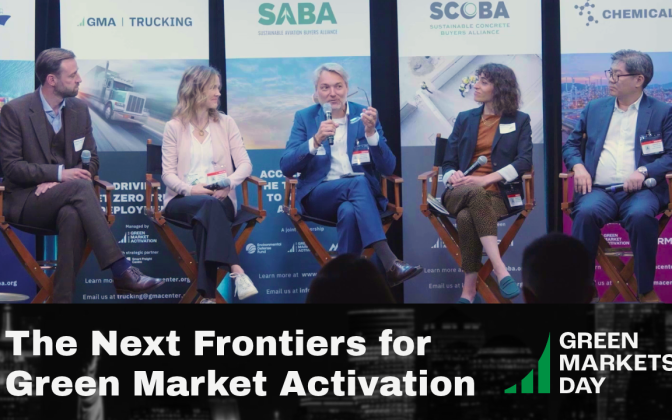
Green Markets Day 2026 | Panel: The Next Frontiers for Green Market Activation: New Technologies, New Sectors, New Regions
Moderated by Andrew Alcorta, Senior Director at GMA, this panel featured Philippe Vedrenne, CEO of 3Degrees; Frederick Teo, CEO of GenZero; Rachel Lichte, Interim CEO of the Good Food Institute; and Devon Lake, Head of Net Zero Strategy at Meta. The panelists explored where demand aggregation and market mechanisms should go next, from new sectors such as metals, plastics, low-carbon fertilizer, green ammonia and alternative proteins to new regions, especially the Asia Pacific. They also discussed the standards and market infrastructure needed to work across geographies, and shared what success could look like five years from now.
See below for a full transcript.
TRANSCRIPT
ANDREW ALCORTA:
So, first of all, thank you to the panelists and we’ll do introductions in just a moment. But I just want to start with some reflections and perhaps some framing for this conversation about new frontiers for demand aggregation and market mechanisms.
Every Green Markets Day, I find myself kind of looking around the room and seeing all the various folks that I know from past lives and that I know from some of the work that we’re doing within various GMA initiatives. And it is hard not to be blown away by the amount of good work that is happening in this space, even in spite of some real headwinds that I know many of us are feeling at the moment.
And so I think it’s important to start by recognizing that there is real progress happening here and that deploying things like demand aggregation, deploying market mechanisms and book and claim is allowing us to really create wins in a number of sectors that have been very challenging to move forward for quite some time.
And if I think back to the deals that move markets panel earlier in the day, I think it is a reflection of the fact that we are seeing real projects move forward that either would have taken much longer or might not have been able to move forward absent these mechanisms.
And it’s a good opportunity to step back and really take stock of the fact that we have something that is working, right? And we need more of it and we need more of it faster, but we have found something that really is moving the needle and not only allowing projects to move forward to FID, but ultimately is going to put steel in the ground for low-carbon projects that we can point to as a demonstration that this is possible.
And so I think it’s against that backdrop that it’s important to really ask the question, where else can and should we be applying these mechanisms? And that’s what we’re going to explore on the panel today and we want to take that from two lenses.
The first is what other sectors might be ripe for demand aggregation, for market mechanisms to really be applied and to accelerate progress beyond what we’re seeing? And the second is what new geographies can we bring these mechanisms to or scale these mechanisms in more aggressively and how can we do that effectively?
On the first one, as we think about additional sectors, there are two places that I just want to pause on and frame out. I think it’s important to step back and look at the entire emissions stack that we’re trying to solve for.
25% of emissions come from industrial production. Cement and concrete, steel, copper, aluminum, a lot of things that we take for granted and don’t think about, but that are responsible for this structure that we’re in today, are responsible for the phones and laptops that we are doing business on every day. And it is a sector where, despite the fact that we all know there is a huge impact and a huge challenge that we need to tackle, very little progress has been made to date in many of these sectors. And we have seen some announcements here and there about low-carbon production, but they are still the exception and not the norm. And I think understanding how we can be applying some of these mechanisms to industrial commodities and to industrial production is a question that we really need to seriously ask here, particularly when a lot of the market failures that we have successfully addressed in some of the transportation sectors are also present in industrial commodities. And I think we could bring some of the same solutions to bear.
Another sector that we need to look at here is agriculture, which is another 20 to 25 percent of emissions and is another place where there are some really challenging problems. And we are beginning to move forward and get traction on some of those, but we have a very long way to go. And so thinking about how can we accelerate some of that progress is really, really critical.
If I switch and think about the geographic side for a moment, many of us live in this world and we’re trying to figure out how to get these projects across the line. But I think it’s really important to step back and remember that while many of the interactions we may be having on a day-to-day basis or with colleagues in the U.S. or North America or sometimes Europe, the projects that can really deliver here can happen all over the world. And particularly when you look at the global south, some of the energy cost fundamentals are incredibly compelling in terms of being able to bring new technologies to the market at effective costs if we can solve for the capital stack.
And at the same time, there is demand all over the world. I was looking up some stats as I was preparing for this, and it is remarkable to think, I think for many of us, that only 10% of the validated SBTi targets come from companies headquartered in North America. 35% of the targets come from companies headquartered in Asia. And so there is an enormous amount of opportunity. And if we are going to make the voluntary markets drive the change that we need to see and live up to their potential, we need not just the first wave of demand that some of the folks, including people here on the stage, are delivering, but we need to figure out who is going to follow that demand. And part of that is recruiting the next set of buyers in the markets that we’re operating in today, but part of that is also expanding the aperture and looking at new markets. And so that’s what we get to explore over the next 35 minutes or so, and I’m really excited to get into the conversation. And we’ll talk about the sector element of this, the geographic element of this, and– and I want us to really pause and talk for a few minutes about, okay, well, if we execute on that and if we do it right, what does the world look like? I think it’s easy for many of us to get caught up in the day-to-day of the work, and it’s important to step back and say, what is the vision here and what can we actually achieve if we are effective in rolling these mechanisms out? So with that, I will pause.
I would love to turn to the panel here and ask everyone on the panel to provide a very quick introduction, name, organization, perhaps a little bit of context. And I can start here briefly. My name is Andrew Alcorta. I’m a senior director at the Center for Green Market Activation. I lead our low-emissions materials work, which includes both cement and concrete, ammonia, and other high-value chemicals. And I’m very excited to be here with you all today. Devon.
DEVON LAKE:
Hi. Devon Lake. I’m the head of net zero strategy at Meta. And I think this is my third Green Markets Day. And it’s just a thrill to be here and see how many different sectors are represented. I’m really excited to talk about the new sectors that are coming. And my team leads basically all of our work, investing in market mechanisms across many of the commodities and technologies that we’re talking about here.
PHILIPPE VEDRENNE:
Hi, everyone. I’m Philippe Vedrenne, CEO of 3Degrees. 3Degrees is a global climate solutions provider. We help companies to reduce emissions on Scope 1, 2 and 3. We have been in the business now for more than 20 years. We are a B Corp. We’ve just reached the $1 billion turnover. Joined this company one year ago. I spent 25 years before in the energy space. Still new in this space, but very excited about what we try to do all together. Thank you for having me here.
RACHEL LICHTE:
Hello. Wonderful. Hi, I’m Rachel Lichte. I’m the interim CEO of the Good Food Institute, or GFI. We are a nonprofit think tank, and we focus on unlocking the resources and the knowledge to change how meat is made in order to create our vision of a thriving world fed sustainably. We just celebrated our 10-year anniversary. We have a presence here in the United States, and we have affiliates around the globe, so we’re a global network. And I’m absolutely thrilled to be talking about new opportunities for aggregating market demand.
FREDERICK TEO:
Very good. Hi, my name is Fred again. I’m CEO of GenZero. I think GenZero is probably the baby on the block here. So we are just slightly over four years old. We are a climate investment company headquartered in Singapore, wholly owned by Temasek Holdings. We invest into nature, technology, as well as climate ecosystem solutions. And we have been focusing on delivering both sustainable financial returns from our investments, as well as to deliver climate impact from our investments. Thank you.
ANDREW ALCORTA:
Wonderful. And thank you all for joining us today. Devon, I want to start with you. And, you know, as I think about the challenge that Meta is tackling here with the net zero goal, the supply chain that you all have to manage is incredibly complex, right? And it spans power, cement and concrete, steel, all sorts of metals, from products to data centers, and even food, right? And so as you are thinking about the next set of opportunities, what are you all focused on as the sectors that you really want to try to deploy market activation techniques in and move the needle in?
DEVON LAKE:
Yeah, no, that’s a great question, and it’s one that my team really loves kind of digging into. So the sectors that you mentioned, cement and concrete, steel, iron, we’re now on our third, fourth, fifth transactions in each of those sectors. And it gets easier. The AIM Platform is our bible. I say this all the time. We now have guidance, which we didn’t three years ago, in terms of what makes a quality investment of this kind. The book and claim systems are out there. We’re getting the sector guidance that docs in. So the whole process from an investment point of view is really becoming much easier. And the counterparties, the folks bringing us the projects, whether it’s through buyers alliances or directly, are also much more mature. So all that to say, you know, I have a lot of hope for where this can get to.
It’s been interesting to start to work, for example, on the trucking sector. That was one of the things that I have to do is to get my leadership excited about every new sector we go to. It’s not enough to say that deep in the bowels of my Scope 3 EEIO factors, like this emissions is there. That doesn’t, you know, that doesn’t, it’s not going to get the money moving. So instead, what we do is we really help communicate what are the sectors that we drive through our business and that our suppliers operate in, what are the solutions that those sectors need to decarbonize, how can we do investments now so that in five or ten years our suppliers can be using these solutions directly, or we can be using these solutions directly.
So one of the sectors that we’ve been spending more time in is plastics, which is what we’ve named chemicals, because chemicals didn’t capture the imagination, but plastics people can touch and feel from a data center perspective. So we actually just did our first plastics project, which was announced today with Macrocycle this morning, and we’re learning in that sector. And so I think another sector that we’re really interested in continuing to explore is, what are the other metals that we can be doing work in? Copper, aluminum, we know that these metals are relevant to us and our suppliers, and we’re still very early in terms of figuring that out.
ANDREW ALCORTA:
Wonderful. Thank you, Devon. Philippe, I want to turn to you. And I would ask that maybe you share a little bit about what 3Degrees is currently doing in regards to low-emissions fertilizer, low-emissions ammonia. And if you can say a little bit about why book and claim might be particularly important in this sector, it would be wonderful.
PHILIPPE VEDRENNE:
Yeah, this is actually one of our core topics. I mean, when we are talking about low-carbon fertilizers or fertilizers, generally speaking, what are we talking about in terms of emissions? This is a really hard spot. I mean, fertilizer industry emits roughly 1.3 gigaton of emissions on a yearly basis. I think it’s nearly a quarter of total U.S. emissions on a yearly basis, or equivalent of 300 million of vehicles powered with gasoline. So it’s really a very, very important sector in terms of emissions. And 40% of these emissions resides in the production of these fertilizers.
So end of 2023, 2024, 2025, we decided to launch the Low-Carbon Fertilizer Alliance, bringing together actually consumer brands, forward-looking companies who wanted to accelerate the decarbonization of this space. And technologies exist, actually. You can use catalytic technologies to abate nitrous oxides in nitric acid plants. You can install CCS, carbon capture and storage when you produce ammonia. And you can in the future even produce green ammonia with green power, water and air.
Now, you need investments to deploy these technologies. And these emissions happen very upstream in the value chains of these big brands. And so there is a huge and very complex supply chain that sits in between. I mean, these potential investments and this ultimate consumer brands company.
Now, that’s where actually collective action and market-based instrument comes into play. With market-based instrument, as long as you can associate your intervention or investment to, let’s say, a geographic boundary which makes sense towards your value chain, then you can overcome this problem of not being able to do direct procurement from your fertilizer industry. And so you can deploy market-based instruments collectively. And that was the other element which was important.
When you need to invest in these assets, and we mentioned that earlier in the day, I mean, no one can afford investing in a single asset. So having a collective approach, a pool of investors that can fill their actual capital through these technologies, make these technologies accessible, lower the initial ticket for each of them, and building a coalition of buyers as well, resolve a risk management issue, which is, in general, these budgets are only yearly budgets, and you want to have a steady flow of money over the years to finance not only the capex but the opex of these technologies.
So one of our first interventions was with CF Industries, which is a large fertilizer producer in the United States. We finance a catalytic-based technology to reduce emissions by 600,000 tons per annum, so that’s a significant one. We have currently 25 members in this LCFA alliance. We are going to add new projects, and the next step now is what you see on the left side, the Green Ammonia Buyers Alliance. We want to replicate what we have done with the Low-Carbon Fertilizer Alliance in the green ammonia sector. We will have exactly the same concept.
Coming from the renewable energy certificate business, actually we experienced today what we experienced 20-25 years ago, when actually through RECs we were allowing end consumers to have access to renewable power without having to manage the complexity of the supply chain and the logistics of power. So that’s where we are today, and we are still at the beginning with a lot to come, but with a good start.
ANDREW ALCORTA:
Wonderful. Thank you, Philippe. And we have been incredibly excited about the collaboration and the ability to move the Green Ammonia Buyers Alliance forward here. Rachel, let me go down to you, and I mentioned briefly in my opening that as we think about new sectors, industrial commodities is one space we need to think about, the agricultural sector is another. And there are some real tricky challenges when you start breaking down emissions from food and beverage and the agricultural supply chain more broadly, and animal proteins are at the heart of a lot of that. And so we’d love for you to share a little bit about, maybe just some context on the challenge as you see it, but also the solutions that you all are working on at the Good Food Institute.
RACHEL LICHTE:
Absolutely. So, you did speak to the overall global emissions of agriculture, but if we look at animal agriculture in particular, it’s 12% of global greenhouse gas emissions. So there is a huge percentage that we can focus on, just from animal agriculture. Animal agriculture is also incredibly inefficient. 80% of farmland is used for just 17% of the calories that are produced. And the demand is increasing. Right now, the projection is that it’s going to increase 50% by 2050. And animal agriculture is connected to some of the biggest issues that we face as a globe. So in addition to greenhouse gas emissions, we’re also looking at biodiversity loss, land use issues, water pollution, a whole slew of human health issues as well, zoonotic disease, antibiotic use resistance. There are a lot of issues that are connected to livestock and to animal agriculture.
So at GFI, we really focus on not trying to get people to change what they eat, but rather to look at how meat is made, how our protein is developed. And if we can produce those foods differently, then we have an opportunity to drastically reduce some of the negative side effects of it.
So at GFI, we focus primarily on three different types of proteins. So one of them is plant-based. Perhaps you have had it before down the street. You can get products like a Beyond Burger or Impossible that is primarily a plant-based protein. So meats that are made from plants. But we consume them, and they perform, and we experience them just like a conventional animal product. Another technology is fermentation-derived. So those are foods that are made. If you were to, you could walk in, at industrial scale, you could walk in and see huge tanks. They’re like three floors tall. They even go multiple floors through, and it looks like a big brewery. But rather than producing beer or yogurt, they’re producing proteins. And these proteins are used in really small amounts, but they provide critical functionality or performance or taste benefits to products. And then the third technology that we use or that we focus on is called cultivated meat. So these are meats made from animal cells rather than whole animals.
And across the board, we see that there is the emissions reductions are absolutely incredible. So through this and as we think about a buyer’s alliance here, we’re really focused on precision fermentation and in particular whey, so a dairy protein and eggs. And the emissions reductions potential there is significant. So with whey, we’d be reducing emissions by 77% land use. It’s less than 99% more efficient from a land use standpoint. And with egg, it’s 55%. And it continues on as we look at plant-based and cultivated as well. So huge, huge potential as far as more environmental benefits and in addition to others.
Over the past 10 years that GFI has been around, we’ve seen incredible development in this space. So 10 years ago, alternative proteins and protein diversification wasn’t really talked about a whole lot. But we have seen tremendous scientific advancement around the globe. There are three countries that have already approved cultivated meats. So in the United States, there are different restaurants and states you can go into and purchase cultivated meat right now. We have seen precision fermentation products, plant-based products make tremendous strides.
And we’ve also seen some headwinds. Over the past few years, we have seen that products were too expensive. Products did not meet the performance expectations. They didn’t taste quite right. They didn’t feel quite right. So we did not see them perform as businesses would have expected. But there is a whole set of technology that has continued to develop but is now really kind of caught in this middle where they have, there is technology that is ready to scale. There are businesses that see, that have invested in these technologies that have seen some benefit but there is a real need to scale them up more. So we’re in this kind of stalemate situation with technology that is ready to scale. Businesses that see some benefit, that see a value proposition primarily around the sustainability benefits or the price stability benefits, particularly as there is price volatility with dairy and eggs. But there is a big risk in investing.
And so as we think about opportunities to support and address this market failure, we’re very excited about what we’ve learned with GMA about the opportunity for something like a Buyers Alliance that would allow us to aggregate some of that demand and really signal that there is demand for these products in order to unlock that financing that can help scale up these technologies. So there is demand for these technologies. We’ve seen some from some of the large companies around the world, like JBS and Novonesis. There is technology that is ready to scale. There is tremendous greenhouse gas emission savings. And so we’re really excited about the potential for precision fermentation technology in particular.
ANDREW ALCORTA:
Wonderful. So, I mean, it’s really exciting to hear both the appetite to look up in upstream and supply chain and really understand what are those remaining hotspots. And a lot of what I’m hearing here is industrial commodities, right? Metals, materials, as well as ammonia into fertilizer is key opportunities in places where action is already taking place. And then, Rachel, I am hearing, you know, perhaps kind of the new frontier here as being how can we start applying demand aggregation to some of the other big problems that we know we have ahead of us in the transition.
I want to switch gears here and start moving to the second lens that we teed up at the beginning of geography. And Fred, I will start with you. And, you know, I think it’s important to start with the incredible work that GenZero is already doing on applying this model. And at least part of how I think about it is, you know, ultimately so much of what needs to happen to deploy these models is building understanding and building trust. And I think having folks that are operating in market and know the key players and can do that translation work is critical as we think about building those things. And so would love to hear how you are thinking about opportunities to apply demand aggregation and market mechanisms within the Asian context more broadly, both on the supply side, but also looking at the demand generation side of this.
FREDERICK TEO:
Sure. I think when we think about market activation, and that’s true in Asia, that will be true anywhere else. I think that I’ve got a couple of things that you probably need, especially when we’re talking about green solutions. The first is that you’ve got to be very clear about the policy and regulatory framework and environment. Whether it is about standards on what kind of new foods you will need to have, and Singapore went through that process as well, right? Or setting a sufficiently ambitious carbon price to be able to incentivize change and transformation. You’ve got to have the enabling regulatory and policy environment. Otherwise, it is also going to be very difficult for many corporates to make the case to often pay more, right, for some of these solutions. That’s one.
Two, given the current macro environment especially, it is important for us, when we’re talking about activation, to be able to connect to the audience. In other words, can we speak the language that people will understand? For many of us in this space, right, I mean, we are sometimes lost in our own alphabet soups and our own technical jargons, which only we understand. But the point of it is that when you are talking to others, you’ve got to be able to relate to them and explain things to them and have these solutions become appealing.
So, for example, all the good stuff that Rachel is talking about will not work if it doesn’t taste great, right, because food is experiential. We’ve got to find a way to tell people, look, you know, all of us love to travel, we want to see new cultures, new places, we’ve got to fly. Now, how do we do this in a way that doesn’t also make you feel bad about the impact that you are, you know, having on the planet, right? So, we’ve got to think about changing the narrative. So, both of these things actually require us to develop a little bit of an innovative framework and I will relate to some examples out in Asia on what we are trying to do.
Let’s talk about the narrative around climate and maybe shifting it from clean energy to a question around energy security and resilience. This issue around biofuels that we spoke about has actually come to the fore more recently, not because we all want to have like SAF for aviation but because you don’t want to be vulnerable to a single choke point somewhere in the Middle East. And that means that you’ve got to diversify your feedstock, you’ve got to diversify the way that you have access to fuels and that means in the near term biofuels or renewables or many other kinds of things. So, where we see an intersection between climate impact and energy resilience, that is a good place to activate.
Now, even on the food question, we work on carbon projects that are nature-based around the world. One very interesting project is in India where we talk about sustainable rice farming and that involves teaching some of the smallholder farmers practices around alternate wetting and drying. Now, why do we do it? When I visited some of the farmers in India, I asked them, you know, this practice has been around for a long, long time, why are you doing it now? And they said that that’s because over the past few years, the average rainfall in that part of India dropped by 50%. And as you know, rice farming involves continuous flooding of the rice fields. And so if you don’t have enough water, you’re going to have a real problem. So teaching them how to save water is important for their ability to continue to grow rice. But for us, it results in lower anaerobic decomposition, less methane emissions, and we can then credit it, right, and draw additional revenues. Now, so there is actually an adaptation concern here as well, right, because you are teaching them how to deal with agriculture in a much more water-constrained environment. And then there is a food resilience component to it.
But I belatedly also realized that there’s something else happening. With climate change, farmers need to adapt to very new conditions. So that means that they are sometimes switching out from food crops to cash crops. Take, for example, oil palm that uses about a third of the amount of water to produce the same amount of product. And each ton of that product, crude palm oil versus rice, is probably three times more valuable. If you are the smallholder farmer facing some of these challenges, it’s kind of like a no-brainer. But carbon revenues, for example, can then channel additional economics to the smallholder farmers to perhaps alleviate some of these negative disincentives. So this is important for us.
So in other words, change the narrative. We don’t need to always talk about climate impact. We don’t always have to talk about doing clean energy, low-impact food. Sometimes it’s about food resilience, energy resilience. We can talk about it in a language that others can understand. Secondly, we’ve got to corral each other or support each other to be able to get the correct policy frameworks to encourage action. And finally, I will also say that we’ve got to find the correct economic incentives because we have got to make sustainability sustainable. Great. Thanks.
ANDREW ALCORTA:
Thank you, Fred. Philippe, I want to turn back to you. And I know 3Degrees has operated across a range of markets and has sold market mechanisms ranging from RECs to other EACs in a number of markets. And, you know, I think as we are thinking about applying and scaling this model in new places, one of the questions is how do we need to adjust this model? Or to what extent should we be prioritizing consistency and standardization? So I’d be curious what lessons you have learned about, you know, where and how these models might need to be flexed in different policy or infrastructure or demand environments as you have operated in various geographies.
PHILIPPE VEDRENNE:
Yeah, I will share, I mean, our experience more on the REC side. I mean, we are operating nearly in 65 different EAC markets globally. And some of them are very mature. REC markets are very greeny markets. Here are very, I mean, standard liquid. Some others are much less. So we face a huge diversity in terms of market infrastructures. And when we look at these market infrastructures, four dimensions are important for us. The registries, I think we mentioned that in a previous session. The chain of custody, how we track actually the commodity. The local regulation. And I put that last, but I think it’s the most important, the accounting standard and target setting standard. And I will come back to that.
Of course, when we are talking about registries, there’s a question of cost to trade. There’s a question. I mean, registries are super important to, I mean, validate the eligible environmental assets that are registered. The claim and the environmental certificates you can issue from them and avoiding the double counting. So that’s super important. It’s important as well to make sure that, I mean, you have easy access to them. You can lower your cost to operate with them. And we’re not necessarily at the same level of, I would say, sophistication across the world. So that’s something that might be an impediment to development of a market-based mechanism.
Chain of custody. In the renewable energy certificates, we talk about book and claim, where you can completely separate the flow of the environmental certificates with a physical power. In other commodities, you talk about mass balance, which is probably a more precise system to track the environmental attributes across the value chain within blended systems. I mean, both of them are valid. I mean, one is probably easier to manage and create more fungibility. So it helps. So the book and claim system helps actually to create more scale in terms of tradability. Mass balance is probably a more challenge from that perspective. That’s the one we have typically in the biomethane sector globally. But nothing that you can’t overcome.
Then you come with the regulation. I mean, the regulation has two sides of the coin. Positive signals in terms of price and value that actually give incentives to the demand to be there and to actually buy for these environmental attributes. The other side of the coin is a regulatory uncertainty. As long as we can complain about voluntary markets because actually the demand is difficult to trigger and that’s come back to what is the correct narrative to have company making actions. We like sometimes having more regulatory, I mean, strong frameworks to incentivize these interventions. But actually on the other side, you take the risk of change of regulation and that might be as well a difficulty.
Last point I think which is important is accounting and target setting framework. I think we had a great discussion earlier with David from SBTi. Where are the markets we operate? I mean, we’re going to manage the structures of this market differently. The storytelling might be different depending on the commodity we are addressing. But we need to be consistent across geographies in terms of the way we measure and we report our interventions. And because we are still in this flux of evolving guidance, evolving regulatory frameworks in some areas in the world, it’s an impediment actually to scale up what we currently try to do.
For example, the fertilizer industry. We expect to expand that in many other geographies. In Asia, it’s probably the right place where we could have a lot of demand and a lot of projects. But applying what we did on Scope 2 and Scope 3 is not necessarily easy. And we need to take care about issues we face as well on Scope 2. I mean, it was mentioned earlier today. Additionality. When we are discussing about GO markets in Europe, there is no more additionality. The question of double counting emission factors that take into account the market-based instruments which are traded or not. The question of regional matching. I mean, how close you are between your operations and the source of your EACs. That are issues we’re going to face in the Scope 3 market developments.
We are at the beginning where we actually want to trigger these markets. So we want this investment coming from actually these high-end firms that are committed. But moving forward, we’ll see some challenges we will have to address in terms of precision, in terms of accounting, precision in terms of locationality. That we need to address with wide open eyes.
ANDREW ALCORTA:
No, it’s very helpful. And I think we want to make sure that we are learning lessons from prior market experiences and the reactions that have come there. And perhaps you can file this one under shameless plug. But I think this is where the AIM standard work can be really helpful to navigate some of those tradeoffs in the early days. And what we’re seeing is more convergence and ensuring that these nascent markets we are helping to get off the ground. But we’re doing it with a glide path that addresses all of these things is the balance that we have to strike here. Devon, I want to go to you and understand from the buyer’s perspective, what does it take to engage across markets? And what do you need to see in terms of rules and standards or from a project perspective to be able to really take a meaningful position in projects across a range of geographies?
DEVON LAKE:
Yeah, it’s a great question. And just to confirm, we’ve got three minutes. Yeah, we’re going to shorten the next bit of this. All right, I’m going to be real fast. So I would say at the highest level, it is certainly easier for us to transact in the U.S. And we’re going after solutions that don’t all exist in the U.S., right? Either because the emissions aren’t happening here, right? This is not where the copper smelting, as far as I understand it, is happening. I’m learning a lot about where the processes are and thus where the technologies are going to need to be deployed. So that’s one.
Two, this is Scope 3. We’ve got a huge portion of our Scope 3 that is based out of this country, mostly in APAC, right? So there are a number of different reasons to go beyond the U.S. market, and it gets progressively trickier because it gets less familiar, right? And so the more that we have the book and claim frameworks, the registries, the more we’re able to say, yeah, this looks familiar. We know how to go and transact here because a lot of the other pieces, to your point on the standards, we’ve got those parts, you know, figured out. We’ve got a playbook to follow.
So I would just say standardization, whether that’s the contracts, the, you know, systems that we’re using, is going to help our team because my guess is our team at Meta is probably larger than most of the teams that people in these buyers alliances is maybe paying attention to, maybe working on, and our team will struggle to go internationally if there isn’t some replicability and familiarity in the way that the markets work.
ANDREW ALCORTA:
Incredibly helpful. So being conscious of time, I want to maybe condense this last section and just go down the line and ask each of you, you know, if we were sitting here five years from now and your wildest dreams have been realized for kind of your priority in the sector, what does the world look like? And Fred, perhaps I’ll start with you.
FREDERICK TEO:
Oh, I usually think that if I’m extremely successful with my work, I don’t need to exist. So if we are highly successful at what we are doing, you won’t need to have a dedicated market activation capability because it would just be the norm. I think that it would take a lot to be able to get there. Clearly, there will need to be political will. We will need to be able to bring some of the costs down. But if I can just summarize in one thing, I think we do need to work with each other a lot more closely and be a lot more open-minded about the kind of coordination, understanding of what is actually happening out here. You know, America is a continental country. It is a big, huge country. But it is extremely important, like just what Devon was saying, to be aware of what is actually happening outside the US, what is happening in Europe, innovation that is happening in APAC, developments that are happening in Africa and South America because, you know, really a lot of the action and what needs to take place to be able to get us to net zero will be happening outside this country.
ANDREW ALCORTA:
Thank you, Fred. Rachel?
RACHEL LICHTE:
Yeah, so in thinking about the near-term future, I’m kind of wondering where we would have room on this stage for a buyer’s alliance that speaks to the precision fermentation opportunities. So another shameless plug there. And if there are any people interested, please do come and speak with us.
But I think that it’s very much aligned with what you shared, Fred, that ideally there wouldn’t be a need for an organization that is going out of its way, that we have greater protein diversification, that this is fairly unremarkable, that the way that we source proteins, the way that we are eating is much more sustainable, so is not emitting and is far more efficient. That is a longer-term future, so we are doing what we can along the way.
Near-term, looking at a buyers alliance opportunity to help aggregate that demand and scale up supply. Medium-term, diversifying even the types of proteins that can fit within that sort of aggregated demand. And then longer-term, just an unremarkable commodity market that is much more sustainable.
ANDREW ALCORTA:
Thank you. Philippe?
PHILIPPE VEDRENNE:
Yeah, I hope in five years we will be here with GMA and RMI to celebrate what we have done on the low-carbon fertilizer industry and ammonia industry. Hope that we will have more than 200 members by then, that we will have a lot of demand, not only coming from the U.S., but from Europe and from Asia, with a lot of projects everywhere in the world, meaning that will become brighter and better.
And hope as well that we will be able to stimulate demand over 10 years and 15 years, long-term commitments. Really the things which are critical. And that they will consider some as normal things to do when you want to manage your supply chain risk, when you use it as a hedge. Because actually, as you mentioned, at the end it’s a question of resilience and forward-looking. So I hope that we will be there in five years’ time.
ANDREW ALCORTA:
Wonderful. And Devon?
DEVON LAKE:
I’m going to go back to, I think someone mentioned shovel-ready projects and ribbon cuttings. I would love to see just a huge map of all of the ribbon cuttings from the plants that are actually built from these transactions because I’m learning a lot about what it takes to move from idea in the lab or startup concept, you know, shopping an idea around to investors to actually getting the project built. And I’m hopeful that the demand that we and others represent accelerates that process. And I really just am excited to see actual materials that we can consider putting in our own data centers, that we can say we help those get deployed in this other facility. That to me is where, you know, I can’t touch the carbon, so I want to touch the concrete and the cement and just know that this is actually changing things in the real world.
ANDREW ALCORTA:
Incredible. So we will check back in five years. We’ll probably do one-year checks between now and then. But thank you all so much for the time, for sharing your thoughts here. And this is where we’ll break and actually hand over to our colleagues at RMI to share some of the work that they are doing on one of the industrial commodities that we started the session talking about. So thank you all.
Related News & Resources
05.07.26
GMA Insights | Harnessing Green Demand to Drive Sustainable Chemicals Production
Our latest GMA Insights installment is a co-authored article by GMA’s Andrew Alcorta and RMI’s Brianne Cangelose.
Chemicals play a critical, though often overlooked, role in modern society. They provide many of the key building blocks for the construction industry, support agriculture by increasing crop yields, and offer novel materials for a range of products from automobiles to new energy technologies. In fact, chemicals are everywhere, present in 96% of manufactured goods, including 75% of the energy technologies that will be needed to navigate the energy transition.
While chemicals are deeply embedded in modern society, it is equally important to acknowledge the challenges they pose. Among these are the need to reduce reliance on fossil inputs, develop better end-of-life management for chemical products, and lower emissions even as production is projected to grow up to 43% by 2050. More effort is needed across all these fronts, but addressing the 2 billion metric tons — or roughly 5% of global greenhouse gas emissions — from chemical production annually requires particularly urgent action given the long timelines to commercialize new production methods.
Despite these challenges, technologies are emerging to enable low-emissions chemicals production. While many of these technologies show technical promise, few have moved beyond the pilot or early demonstration phase. Scale-up of these technologies is often not held back by technical feasibility so much as by commercial barriers, including uncertainty about demand for low-emissions products and risk-aversion among participants spread across long and complex chemicals value chains.
Clear demand signals from companies that use chemicals in their products and novel mechanisms to bridge chemicals value chains are critical to overcoming these roadblocks and unlocking investment. The Center for Green Market Activation (GMA) and RMI are actively working to establish demand signals by aggregating buyers of low-emissions chemicals and by developing a book and claim system to enable chemical producers to transact directly with downstream companies that have committed to lowering supply chain emissions and are willing to pay a premium to do so.
The Challenge of Decarbonizing Chemicals Production
Scaling low-emission technologies in the chemicals sector is uniquely challenging. Chemical production assets are highly capital-intensive, with investment horizons that span decades. Existing plants, many of which are fully depreciated and can produce at a low marginal cost, leverage processes that have been optimized over many years and produce at enormous scale. The result is constant cost pressure that reinforces the competitiveness of conventional production methods. As a result, even when low-emission alternatives exist, buyers and suppliers alike often default to the legacy status quo.
The diversity of chemical products — and the resulting complexity of value chains required to produce them — results in an additional challenge. Unlike other industries with relatively standardized products, the chemical sector encompasses thousands of molecules, intermediates, and derivatives. This often results in long value chains with multiple layers of intermediaries separating a primary chemicals producer, generally responsible for the majority of emissions, from the better-known companies at the end of the value chain that have made net-zero commitments and are closer to consumer demand. In the middle are specialized producers of intermediate chemicals or products that often operate with thin margins and limited visibility.
In this environment, intermediate producers operating with thin margins have few incentives to source lower-emissions, higher-cost inputs unless they have certainty that their customers are willing to pay an equivalent price premium. The result is an enormous coordination challenge. Multiple parties within a value chain must simultaneously close both procurement and offtake contracts at a material premium to market prices. And all of this needs to occur at a volume that gives the primary chemical producers certainty that customers will pay a premium for most of their output over an extended time horizon. While this may be possible in rare cases where large buyers directly purchase from primary chemical producers, it will be all but impossible in most chemical value chains.
Leveraging Novel Mechanisms to Catalyze Investment
Breaking the deadlock requires both credible demand for low-emissions chemical products and mechanisms to bridge companies across long, complex value chains. GMA and RMI believe that two critical interventions, pursued in tandem, have the potential to address these challenges and unlock investment in low-emissions chemical production: demand aggregation and book and claim.
Demand aggregation is the first necessary intervention. As in many industrial sectors, low-emissions production will come at a price premium, particularly given that novel technologies often operate at small scale and with less historical process optimization than their fossil-intensive counterparts. While new technologies have the potential to decrease costs as they scale, the ability to achieve initial traction in highly price-sensitive markets is often a challenge for these production methods. The presence of buyers willing to purchase at a premium is a critical proof point for projects seeking capital to invest in low-emissions production.
But why is it necessary for multiple buyers to act together in order to provide this proof point? Because chemical assets operate at such a significant scale and because their lifetimes are so long, the purchasing volume required to unlock investment in a new facility can be enormous. By pooling demand, multiple buyers can provide the necessary volume to support an investment decision, thereby decreasing the cost and risk that any individual company would otherwise have to take on.
In cases where physical offtake of low-emission chemicals is constrained, book and claim systems provide a mechanism to aggregate larger demand volumes through the use of Environmental Attribute Certificates (EACs). Under this chain of custody approach, chemical producers generate an EAC for each unit of low-emission product, such as a ton of ethylene, that reflects the reduced emissions intensity associated with production. This certificate is then sold separately from the physical product, which continues through the value chain as a traditional commodity with a baseline emissions intensity. This separation enables chemical producers to receive revenue from EAC sales to cover the premium associated with low-emission production, providing the financial certainty needed to finance capital-intensive projects. At the same time, buyers gain verifiable, traceable progress toward climate commitments through certificates that are independently verified and tracked through a registry system.
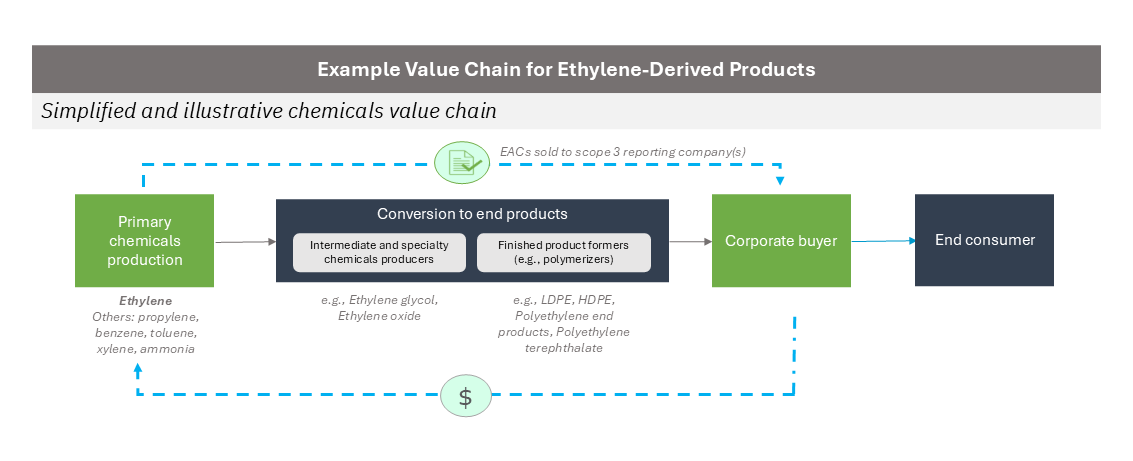
The result is three benefits that can dramatically alter the viability of low-emissions production:
- 1: Value Chain Bridging: Perhaps the most significant impact of book and claim systems is the ability for interested parties to transact efficiently. By enabling standardized transactions between downstream brands willing to pay for value chain decarbonization and upstream producers that most heavily influence emissions, the challenge of aligning multiple intermediaries around price and volume in complex value chains can be avoided.
- 2: Geographic Aggregation: Book and claim provides an additional benefit, particularly in the early innings of the net-zero transition when access to low-emissions products remain limited. Creating an EAC distinct from the physical product means that a producer is no longer constrained to finding customers willing to pay a premium for a low-emissions product near its production plant. Instead, they can sell the physical product locally at commodity prices and cover the green premium by selling an EAC to any downstream user of the product, regardless of geography.
- 3: Product Aggregation: By focusing a book and claim system on high value chemicals, a third benefit can be realized. A traditional demand aggregation approach would need to find buyers procuring identical products. However, book and claim enables demand aggregation across any product that contains a particular molecule. For example, demand for low-emissions ethylene can be aggregated across apparel companies using polyester for textiles, pharmaceutical companies sourcing polyethylene for syringes, and personal care companies using multiple types of plastic for everyday household goods. By focusing on a common and consistent upstream input, substantially more demand can be aggregated and transacted in a single procurement.
Given the immense challenges associated with decarbonizing chemical production, leveraging novel mechanisms to catalyze investment in low-emissions production will be essential. Combining demand aggregation with book and claim in the form of a buyers alliance for EACs offers a unique opportunity to reduce risk for both buyers and suppliers, while driving real investment decisions.
GMA and RMI’s Low-Emissions Chemicals Initiative
An emerging initiative from GMA and RMI to procure low-emissions high value chemicals leverages these approaches to tackle emissions in the chemicals sector. Multiple downstream brands that use chemicals in their products have come together to procure environmental attributes for low-emissions ethylene, with plans to expand this approach to other molecules in the future. In the process, they will provide demand certainty for low-emissions projects while simultaneously finding a pathway to address upstream Scope 3 emissions that had previously been out of reach due to complex, multi-tiered value chains.
Prior efforts from GMA and RMI to pool advanced commitments for low-emissions products in heavy industry sectors have demonstrated how aggregated demand can generate confidence for suppliers and investors. Sectoral buyers alliances such as the Sustainable Aviation Buyers Alliance (SABA), managed by Environmental Defense Fund, GMA, and RMI, have shown how standardized frameworks and collective purchasing can accelerate the deployment of next-generation technologies. Launched in 2021, this effort has evolved from one-year advanced commitments to purchase bio-based sustainable aviation fuel (SAF) to a scaled marketplace and targeted 5+ year offtakes at scale for next generation fuels.
Without credible demand signals and effective mechanisms to translate that demand into firm offtake agreements, the transition will stall. GMA and RMI are working to bring these pieces together—aggregating demand and developing mechanisms to more efficiently enable offtake—to ensure that novel pathways to produce low-emission chemicals are developed. Together with active engagement from buyers and support from the broader ecosystem, these actions can provide the demand certainty needed to unlock investment and enable the chemical sector to accelerate its transition to a net-zero future.
If you are interested in learning more about the GMA-RMI low-emissions chemical procurement that was spotlighted in this article please reach out to chemicals@gmacenter.org.
Related News & Resources
- Deadline for Respondents to Submit Written Clarification Questions: May 14, 2026
- Responses shared: May 21, 2026 - Read the full document here
- Suppliers Letters of Intent (LOI) Due: May 29, 2026
- Proposals Due: July 16, 2026
- Proposal Shortlist and Notification of Respondents: August 2026
- Winner(s) Announced: October 2026
04.29.26
Pilot Procurement Uses Collective Demand to Unlock Investment In Low-Emissions Chemicals
The Center for Green Market Activation and RMI launch first-of-its-kind request for proposals on behalf of corporates to scale low-emissions ethylene production.
The Center for Green Market Activation (GMA) and RMI today announced a first-of-its-kind pilot procurement for low-emissions chemicals, bringing together leading, early-adopter companies across industries, including technology, consumer goods, apparel, and food and beverage. Through a collective procurement, participating companies are sending a strong, coordinated market signal to address emissions embedded deep within the chemicals value chain, targeting approximately 3,000-10,000 mtCO2e per year in emissions reductions from low-emissions ethylene — a key building block used in many everyday plastic products ranging from packaging and medical supplies to construction materials and textiles.
GMA and RMI are now seeking responses from chemical producers capable of supplying verified low-emissions ethylene using eligible production pathways, with transparent emissions accounting and the ability to transact environmental attributes through a book and claim system. The procurement is designed to provide producers with an opportunity to monetize low-emissions production, helping to support the business case for scaling emerging and differentiated production pathways. The inaugural request for proposals (RFP) will also act as a proof of concept for future aggregated procurements of low-emissions chemical attributes.
“With this innovative pilot procurement for low-emissions ethylene, we’re excited to demonstrate the power of collective, corporate demand in the chemicals sector,” said Kim Carnahan, GMA CEO. “Through this pilot, we will have the opportunity to field test and refine our approach with an ambitious group of first movers and lay the groundwork for bigger buys and different molecules in future.”
Chemicals are crucial to modern society, yet little progress has been made toward decarbonizing chemical production. Historically, substantial barriers have constrained investment in low-emissions production pathways. These barriers include capital-intensive facilities, long asset lifetimes, thin operating margins, and complex supply chains that, together, have limited the ability of new technologies to secure the long-term demand needed to justify investment at scale.
As a result, companies that use chemicals in their products have struggled to address value chain emissions. While many are working to reduce or replace emissions-intensive inputs like ethylene, unavoidable residual demand remains, and companies are often several steps removed from primary production with limited visibility into the most emissions-intensive stages of their supply chains. Even where willingness to act exists, traditional procurement structures have made it difficult to translate that intent into meaningful emissions reductions.
This pilot procurement applies a novel approach to break that gridlock and enable action. By combining demand aggregation with a book and claim system, the procurement enables chemical producers to generate environmental attribute certificates (EACs) associated with low-emissions ethylene production and sell them separately from the physical product. This allows producers to receive revenue reflecting the lower emissions intensity of their production, while downstream companies gain a flexible, credible pathway to support low-emissions production and report associated claims in their climate disclosures.
“Voluntary demand has already proven to be a powerful catalyst for investment and innovation in sectors like renewable electricity and sustainable fuels,” said Thomas Koch Blank, managing director at RMI. “We’ve seen how established, forward-looking buyers can grow emerging markets, de-risk investment, and send strong demand signals that unlock capital at scale. We’re excited to explore how this pilot procurement for low-emissions ethylene can bring that same momentum to the chemicals sector.”
Versions of this approach have already been used successfully to jumpstart markets for low-emissions production in other hard to abate transport and heavy industry sectors, including the Sustainable Aviation Buyers Alliance, the Sustainable Steel Buyers Platform, and others. This pilot represents the first known application of a collective procurement and book and claim model to the chemicals sector.
The RFP is available for download here on the GMA website, and responses are due by July 3, 2026. For additional information about the procurement, please contact chemicals@gmacenter.org.
Media inquiries please contact:
Alison Greene, Communications Manager, GMA: alison.greene@gmacenter.org
About the Center for Green Market Activation:
The Center for Green Market Activation (GMA) is a US-based, globally focused non-profit. Through innovative procurement approaches and sector-specific buyers alliances, GMA catalyzes and scales the uptake of low-carbon goods and services within carbon-intensive industries including aviation, maritime, trucking, cement and concrete, and chemicals. With collective decades of experience in environmental markets and alternative fuels and materials, the GMA team works to standardize new, green markets and forges mutually beneficial partnerships between climate-focused companies, suppliers, and mission-aligned non-profit organizations to channel funding to critical climate technologies in pursuit of accelerated sectoral decarbonization. Learn more at gmacenter.org
About RMI:
Rocky Mountain Institute (RMI) is an independent, nonpartisan nonprofit founded in 1982 that transforms global energy systems through market-driven solutions to secure a prosperous, resilient, clean energy future for all. In collaboration with businesses, policymakers, funders, communities, and other partners, RMI drives investment to scale clean energy solutions, reduce energy waste, and boost access to affordable clean energy in ways that enhance security, strengthen the economy, and improve people’s livelihoods. RMI is active in over 50 countries.
Related News & Resources
Chemicals
GMA Chemicals focuses on accelerating deep decarbonization of the chemicals sector, while supporting efforts to address chemicals’ non-climate impacts.
Outputs from the chemicals sector play an important role in our lives. Our food, healthcare, transport, housing, and many other things rely on products from the chemicals sector. However, chemicals production is also the largest industrial energy consumer and the third largest source of industrial CO2 emissions. Not only are the sector’s greenhouse gas emissions significant, they are projected to rise if no action is taken to decarbonize the sector – and the sector is not currently on track to remain within carbon budgets consistent with global climate goals.
While decarbonizing the chemicals sector is critical for the achievement of these climate goals, the complex, distributed nature of the sector, and its heavy reliance on fossil fuels both as energy and as product feedstocks, contribute to making the chemicals sector particularly hard to abate. In addition to emissions abatement, many products from the chemicals sector are also contributors to the global plastics waste crisis.
GMA Chemicals, in partnership with RMI, is facilitating collective procurement of low-emission chemical products through a book and claim system. The initiative aggregates demand from companies across consumer goods, technology, packaging, apparel, and healthcare sectors to enable direct transactions between corporate buyers and chemical producers. Through Environmental Attribute Certificates (EACs), member companies can financially support decarbonization at chemicals manufacturing facilities and address upstream Scope 3 emissions—without requiring restructuring of complex supply chains. Email chemicals@gmacenter.org to learn more.
RFP for Low-Emissions Ethylene
GMA and RMI have launched a Request for Proposal (RFP) for low-emissions ethylene—the backbone of most common plastics and the single largest contributor to petrochemical emissions. Building on supplier responses to a Request for Information that closed in December 2025, this pilot procurement connects chemical producers deploying decarbonization technologies with an assembled buyer group across consumer goods, packaging, apparel, and healthcare sectors. Through Environmental Attribute Certificates (EACs), participating companies can support low-carbon chemical production while claiming verified emissions reductions toward their Scope 3 targets. Find more information here.
Chemicals production generates over 6% of global GHG emissions

Chemicals production is the largest industrial energy consumer

The chemicals sector is not on track to meet climate goals
Member benefits
Clear guidance and expert support on the identification of high integrity decarbonization opportunities
Access to joint procurement opportunities with potentially lower prices via group RFPs
Educational support to inform your stakeholders how purchasing environmental attributes can support credible emissions reductions and how to account for them in your inventory.
Related News + Resources
10.29.25
Green Markets Day 2025 – Concrete Steps, Steel Resolve, and Clean Chemistry: Heavy Industry’s Next Moves
During Green Markets Day 2025, moderator Bryan Fisher, Managing Director at RMI, was joined by Chris Atkins, Director, Worldwide Operations Sustainability with Amazon, Leah Ellis, CEO and Co-Founder with Sublime, Johan Mandarić Reunanen, Climate Impact Lead with Stegra, and Hans Olav Raen, CEO with Yara Clean Ammonia.
See below for a full transcript.
BRYAN FISHER:
We’ve got four great innovative companies on the panel here. One buyer of low emissions commodities and three suppliers of low emissions commodities, all innovators in their own right. So that would be Amazon, Yara, Stegra, and Sublime.
So why don’t, just a couple of plugs before we start. One is I just want to announce the official launch of SCoBA, which is the Sustainable Concrete Buyers Alliance. We’re super excited about it. Thank you.
Could I actually get a show of hands for RMI and GMA folks that have been integrally involved in it? Please raise your hand. So if you want to know more, thank them for their hard work, first of all. And if you want to know more about it, please find them kind of after this session.
But we’re excited. It’s going to link, obviously, buyers that desire low emissions goods with suppliers that are creating innovative low emissions goods, backed by a high integrity book and claim system. So that’s what we’re all about. We’ve been working at it for quite a while, but our official announcement is actually today live. We issued a press release last Friday on it. So again, super excited about that.
And just a sneak preview, because we’re not quite ready to announce it, but we’ve made a lot of progress in the chemical space as well. And so we have had a number of active discussions. So please, in the next few months, we’re hopefully, with GMA and RMI partnership, launching something in that space.
So enough for the plugs. Let me get on to the panel here. And I’m going to have our esteemed panelists introduce themselves and their companies.
First, Chris of Amazon. You might want to explain who Amazon is, but maybe not. But you’ve been immensely supportive of RMI and GMA’s work in concrete. What does Amazon need from a group like the Sustainable Concrete Buyers Alliance? And what work do you see the alliance doing that Amazon can’t do on it, frankly, on its own?
CHRIS ATKINS:
Great question. And thanks, everybody, for being here. Thanks to RMI and GMA for putting this on and for launching the Buyers Alliance, which we think is integral to what we’re trying to do to bring scalability up to low carbon concrete.
So first of all, Chris Adkins, I’m the Director of Worldwide Operations Sustainability at Amazon. So our focus is on, how do we take our e-commerce division of our business and meet our sustainability targets? So my team works internal to the business units with them to be able to develop new solutions, but then also engaging with our external partners and our NGO partners to figure out how do we accelerate and kind of catalyze the pace of change to meet the climate ambitions that we all know are urgent right now.
And so when we look at that, you know, our fundamental belief is that there’s a mismatch of supply and demand. Over the last five, six years, we’ve seen tremendous reaction in industry to the climate crisis and commitment reaction in industry to the climate crisis and commitment to reach net zero emissions by many, many companies.
We co-founded the Climate Pledge in 2019 as our commitment to reach net zero by 2040, so 10 years ahead of the Paris Agreement, because we believe that we’re going to need leaders on the front edge of that to be able to transition the entire economy to meet the ambitions of the Paris Agreement.
Since that announcement, we’re really excited because we have over 600 co-signatories globally that are companies that see this as something that needs to happen. And we believe the power is not only one company. There’s no one company on Earth who can do the things that are necessary in order to usher in this change. And so the power is in these partnerships. And so we believe that’s really strong.
And with that, the demand is there. The supply for the low carbon solutions that we need is not yet at the production level that we need. And we all know, use the renewable energy example of where we were 15, 20 years ago in the renewable energy markets. When we are able to best match supply and demand, particularly through market-based mechanisms, we see how fast production capacity can grow. And with that, we accelerate learning curves and cost curves in a way that then catalyzes more and more adoption.
Buyers alliances are really critical. I assume I’m not really trying to sell too many people on that. If you’re at Green Markets Day and you have not been already sold to that, come find us afterwards. We’ll try to close you on this idea. But we really believe that what a buyers alliance can do can signal confidence that there are buyers ready to purchase the low carbon solutions that are needed to scale. And that gives confidence to the producers to go out and raise capital and build facilities and sell their products.
And so obviously you’ve got the examples behind us. You’ve got Zero Emission Maritime Buyers Alliance, Sustainable Aviation Buyers Alliance, Sustainable Steel Buyers Alliance. You look at all of these sectors and what we’ve been able to do collectively with the partnerships of so many, many of who are in the room today, we’ve seen this work in other areas. And so it only makes sense for us to move towards doing this in the concrete space. And so we’re super excited about that.
BRYAN FISHER:
Great. Can you touch on why– what’s the value of the partnership writ large and why Amazon just isn’t doing this bilaterally?
CHRIS ATKINS:
Yeah, I mean, look, we have a very large global presence. Everybody’s aware of that. We know that we have a big responsibility as an individual actor when we can to commit to large, long-term commitments to be able to scale up production. And we’re doing that.
But we’re not content to decarbonize Amazon alone. That’s not going to solve the problem that we’re all facing with climate change. And so what we’re trying to do is really catalyze the broader industry. And the way you do that is you bring partners together and you build confidence that supply is there. And so that the producers can now go out and do what they do so well, and they do it at scale.
BRYAN FISHER:
Great. Well, thank you. Let’s switch to Sublime. Leah, first, I’d love for you to introduce yourself and the company and what Sublime does, and talk about the role of like a SCoBA in your ecosystem and how important it is.
LEAH ELLIS:
Good afternoon, everyone. I’m Leah, CEO and co-founder of Sublime Systems. We’re developing technology to make low carbon cement.
So, as you know, cement is very carbon intensive, it’s high in fossil fuel and it’s also made from limestone which is 50% by weight CO2. We avoid both those CO2 emissions from cement making while making a same or better hardened concrete product at the end of the day.
Recently, we announced a large binding offtake commitment from Microsoft, and that was a bilateral agreement, but what matters so much is that… one company can’t make this massive change that we’re all trying to make. So Sublime alone can’t do anything. I think it really takes a village to make these changes happen.
And on Sublime’s side, we’re working with a lot of the incumbents from the industry. So Holcim, Amrize, and CRH, three of the largest cement producers in the Western world, partnered with us about a year ago. And so we’re working with them on a retrofit strategy. How can we move quickly to market using the existing logistics and distribution, mining, grinding infrastructure that’s already there? How can we turn those over and build these plants as quickly as possible?
And then on the other side, they need to see big demand signals that this isn’t a bridge to nowhere, that we’re not exhausting ourselves for naught. And so seeing this big buyers alliance come together, we’re really just building the bridge from both ends. And I couldn’t be more excited by what you’re putting together.
BRYAN FISHER:
Great, thank you. So turning to the next commodity, Johan, Stegra. First, again, could you explain for those who don’t in the room, hopefully everybody knows who Stegra is and formerly H2 Green Steel. But how do you think about the role specifically around book and claim in kind of the European context and where that regulatory framework is? So over to you.
JOHAN MANDARIĆ REUNANEN:
Yeah, hi. I’m Johan Mandarić Reunanen, I’m from Stegra. I’m a climate impact lead. And that means that I lead all the work on EAC and book and claim from Stegra. And Stegra used to be called H2 Green Steel.
We are in the works of producing green hydrogen, green iron, and green steel at scale in the northern part of Sweden. And we sell both green iron and green steel into the market. And by the end of next year, we’ll be at 2.5 million ton capacity of green steel and 2.1 million ton capacity of green iron.
And on the question on what role does book and claim play, so I guess it ties back to the role of offtakes, I would say. Why are off-takes so important to the industry, right? I mean, when Stegra was founded, and it was only four and a half years ago, there was like five people and a PowerPoint, right? And you need roughly $8 billion to construct the site that we’re building now. So how do you do that?
Well, for those of you who listened to the last panel, or the previous panel, you saw that the banks, they’re not going to do anything unless you have offtake agreements. So we had to have offtake agreements, we had to have bold partners, you know, being ready to sign long-term agreements, something that you didn’t do at all in the steel industry, you only buy like one year, year by year. No one pays a premium for anything. Very, very commodity market. But that wouldn’t work as offtake.
So that was one of the things that we had to change from a sector perspective to actually get this project, you know, off the ground and about two years ago, we concluded the financing, and with that, we had the offtake agreements that we needed for roughly 60% of the volume, and five to seven-year contracts, and not 10 years, that’s in SAF, but five to seven-year contracts.
And so the book and claim, that will unlock markets outside of Europe, because the offtake customers that we have now, they’re all within Europe, right? And so, with the agreements of the agreements that we have announced with Microsoft that we’re super happy and proud about, we have a first of a kind shot at what does this mechanism look like for the steel industry? What are the learnings that we can take from SAF and from the cement and from renewable energy? And how do we apply that to steel to unlock even more production sites globally? Where if you don’t have to be in the same geography as your customers, you could establish a steel plant anywhere in the world. As long as you have access to the green electricity, you know, at a reasonable price and some other things, right?
BRYAN FISHER:
Great. So last sector, Hans, Yara, you are selling products into two primary end uses, right? Both shipping and for agriculture. And again, how do you think about, first, we’d love to talk about what Yara’s doing kind of broadly in the space, and then also talk about the role of book and claim and how it might be similar or different than some of the other, in the intricacies, some of the other commodities we just talked about.
HANS OLAV RAEN:
Hey, great to see you. Great to be here.
Let me quick glance, who is Yara Clean Ammonia? So we are a 100% subsidiary of Yara. And our role is to provide Yara with all the ammonia that Yara needs. But we also have other customers. And actually, Yara Clean Ammonia, we are transporting and storing transporting 20% of all ammonia in the world today. We have the largest fleet transporting ammonia, and we actually have 18 terminals. We come back to the challenges or how to scale this up a bit later.
So what we want to do is we want to decarbonize. Of course, today, 98% of what we produce is grey ammonia and grey hydrogen. But in the future, we want to, of course, move into blue and green hydrogen. Actually, today, I think we’re the only producer in Europe today who’s actually producing green ammonia. So we are on that path.
And also very exciting when it comes to our ships, just to show that we’re making steps. We have ordered three new ships mid-sized gas carriers, which will run on ammonia and transport ammonia. And these ships will be running in, first one is coming in two years, and the two others in three years. So it’s really coming.
And also another thing, walking the talk, we are the first shipper, we will have the first container ship running from Norway to Germany end of next year which will run on ammonia. Actually, the ammonia we’re producing today will be put on that vessel, and it’s going to be zero CO2. And we’re going to be the first of its kind starting end of next year. So that’s what we’re working on.
BRYAN FISHER:
Great. And how are you using and working with a book and claim system like this in the context of both?
HANS OLAV RAEN:
Let me, first, before we go to book and claim, I think what is really the challenge for us all here is really how do we scale up demand, right?
Let’s look, there are two markets for me. There is the voluntary market and there’s the regulatory market. The voluntary market, well, it’s a niche market, it’s a small market. We are doing, we are with the food companies, for example, to really produce low carbon fertilizer or green fertilizers, we have we signed actually two weeks ago a big off-take agreement for CEN, which is going to be produced in Latin America, 300,000 tons, which is a small part of what we’re doing. So that’s the voluntary market.
And then when it comes to the regulatory market, that’s where your question about book and claim comes in, mass balance. Yes, it can be, it definitely can help in the beginning as we build the market. Again, the problem we’re facing today is the demand. How do we scale up demand? Where do we scale up demand?
For the low carbon ammonia, you know, we have sectors like the fertilizer, which we, but we also use ammonia for fuel, which tomorrow, and for power. When we burn ammonia for the power, there’s hardly any CO2 coming out. But again, that is more expensive. Today, it’s more expensive. So how do we get mechanisms in place for that? And that’s where book and claim can play a role in the beginning.
But we have to be careful. So it has to be transparent. It has to be controllable. And for us as first mover, it’s important that we keep that. So when we produce it, I think mass balance it has to be the rule. But as you go into the value chain and as you advance in time, then you can go towards book and claim.
BRYAN FISHER:
Great. So let me– and thank you for articulating that. I think it’s debating the merits of obviously kind of these both safety in numbers in terms of having a bunch of buyers that are looking and providing that match for buyers that are looking for low emissions products and suppliers, but also then backed by a high integrity system, right, that we can actually monitor, measure that emissions reduction.
So I want to ask you each of you the same question from your industries. Maybe, Chris, you can answer this as a buyer, but how fast and how big can this market grow? And maybe we’ll start with steel. How does this movie look like in the next one year, two years, three years? I’d love to kind of see baseline, kind of given what today’s environment looks like, and then maybe what could help speed it up.
JOHAN MANDARIĆ REUNANEN:
So the green steel market in general?
BRYAN FISHER:
In general, yeah.
JOHAN MANDARIĆ REUNANEN:
I mean, first and foremost, I mean, we need more green steel production coming online, right? What we’ve seen is a lot of the incumbents they have even gotten huge grants and they still do not go to production, right? So we need more production. Otherwise, Stegra’s production is going to be a very, very niche market. It’s not going to reach the volumes needed. I mean, the European market alone is like 70, 80, up to 100 million and that could be like 20, 25 million green steel, and we produce 2.5 and then 5 million tons. So we need to have more projects coming online.
And from a European standpoint, we need a price on carbon. So we need the European Commission to really kind of keep that course. We need to phase out the free allowances and phasing CBAM.
But from our point of view, if we can, sell the greenness of the production to a global market, then of course it would be a lot easier for us to reach the offtakes that we need for a second site, for a third site. So that will for sure open up.
But what we need to do is really prioritize getting Boden factory built. Because if there’s no factories, we’re not going to produce the green steel anyway, and then we don’t need to talk about book and claim at all. So we really need to double down on getting the thing built.
BRYAN FISHER:
So are you saying it’s more of a supply-ish than a demand issue?
JOHAN MANDARIĆ REUNANEN:
At least in our experience, it is. There’s a lot of willing buyers out there. I mean, we’ve seen a great demand from, for example, the European automotive industry. They are willing to pay the green premium, or today I learned a new word, transition premium. I really like that word.
But yes, they have signed the agreements. And I think depending on how ambitious are you when it comes to addressing the climate issues in your company, and are you willing to put your money where your mouth is, really. Otherwise, you’re not really taking it seriously. And we see that there’s enough buyers out there.
BRYAN FISHER:
Great. What about cement?
LEAH ELLIS:
The question is how fast can it go?
BRYAN FISHER:
What path are we on and what’s it look like in a few years and what can make it speed up or slow down, frankly?
LEAH ELLIS:
Yeah, we’re on a really exciting path. And I think there’s a lot of demand for low carbon cement. I think one of the really special things about cement is that it is so cheap. And that’s really a double-edged sword because it’s both so cheap and so carbon intensive, which means that even if there is a green premium, an innovation premium, or a transition premium, like you say, it actually is such a big lever because it’s so much CO2 for such small amount of dollars. And I think a lot of people recognize that.
And in the building world with general contractors, also time is money. And so knowing that they can just pay for something and then that solves all of their embodied carbon issues with their building. And they don’t have to go around and find energy efficient light bulbs and low carbon rugs or something like that. And they’re just like, boom, low carbon cement, like all of that is gone. I think that’s a really compelling value proposition to a lot of people that we’re seeing.
And so I’m seeing a lot of continued demand for cement, and I think it’s disingenuous to not acknowledge the political landscape and how much that’s changed in the US, and it has had a lot of ricochets around the community. But I think the one thing with cement is that it is an industry with a lot of inertia, and that is a good thing. It takes a long time for things to change in cement, but when they do change, they change pretty decisively, and I don’t think they swing back and forth in the same way that, let’s say, the venture capital community is known to be very skittish.
So it’s just a different game they’re playing. So I’m not seeing any pullback or any loss of momentum. I think that it’s going and it’s going to keep going, and everything you’re doing just helps it make it go faster.
BRYAN FISHER:
Great.
HANS OLAV RAEN:
For low carbon ammonia, it’s definitely demand we are missing, or it’s… We need to scale up demand. Supply is not a problem. We know how to make it.
And then there’s the cost position. As I said earlier, it costs two or three times or two times more to produce clean ammonia. So again, how do we, for the fuel, I mean, we have a real solution here to really decarbonize almost 100%, but that has a cost, and then we’re back to the cost of CO2.
And then the question is also for us as a producer, how do we lower our cost position? Today, it’s more expensive, but when you look at the renewable energy, in the future, we believe that there’s going to be more of that and also cheaper. So then the cost will go down of clean ammonia.
But we need to bridge the gap. And how do you bridge that? What kind of mechanisms do you put in place there? And that’s where I’m really positive. And when you look at ammonia as a fuel, I’m not sure if you follow, but IMO is going to have a meeting soon in London. And the net zero frame is going to hopefully be voted. And if we manage that step in London, it’s going to be a great step forward, a great signal to the ship owners, to the shipbuilder, and the cargo for us. And we’re really taking that step, as I said earlier, by already now chartering vessels for the future. So in the fuel, we have that.
As a power, same we have in Japan and Korea, the governments are subsidizing. In the beginning, again, it’s the CFD, Contract for Difference. So again, for us, it’s really how do you scale up demand.
And then the other challenge we have is, of course, infrastructure. How do we– I mean, when you need an infrastructure to bunker all of this ammonia. And again, there, I think we have to have a step-by-step approach. We, as I said, we have terminals all around the world. There is an infrastructure already existing. We need to scale it up. So today we’re discussing with partners, how can we together scale it up with the financial partners? How can, like Brookfield or BlackRock or whatever.
But the other thing is how– we need the whole value chain here. We need the port authorities, we need the financier, we need the cargo owners, we need the bunkering companies. So everybody needs to take some kind of risk here. And even the financier, they need to take also their part of the risk to get this going.
BRYAN FISHER:
Yeah, well, I think too, One amazing thing is what we could see coming out of the IMO, which is it effectively sets a price for carbon and a kind of a compliance and non-compliance, which would then help create some economic rent for some of those low emissions technologies and leaders in those as well.
And I think the second thing, one, just because we have a buyer that wants to buy a low emissions good, in this case ammonia for a fuel or maybe for fertilizer, there’s a lot more complication in particular shipping where we have to build an alternate infrastructure around the world and make sure that’s consistent in doing that.
So Chris, let me turn it over to you. In terms of a buyer, how do you see this playing out? Is it going kind of as fast as you would like as a buyer? Should it go faster? And what’s going to make it do that?
CHRIS ATKINS:
It’s never going fast enough for what we would like. And at the end of the day, we’re looking at this, I mean, I guess the benefit of where I sit in my role is we’ve already made a commitment. So it’s a math problem at the end of the day. We know kind of where our business is going from a growth standpoint. And so with all those inputs, we take a look at 2040 is our date, net zero. We’re going to make it one way or another. So what are all the inputs that must be true in order to make that happen?
And then you look at it and say, okay, well, we’ve got a time problem. So this is a 15 years, it’s 202, we’ve committed to achieving this by 2040. You look at the development timeline of how long it takes to go raise capital, get permitting, lease or buy land, you’re not talking about a whole lot of leeway there.
And then you’re looking at, well, no business is going to accept a fundamental cost driver that’s going to raise their cost of doing business by 2 or 3x, which some of these premiums are right now, which we understand.
I love the transition, I’ve heard this a couple of times today, I think the transition premium is the right way of framing it. But we know that the solutions are going to have to become competitive with conventional over time, or else they’re not going to scale.
So if you take all those factors together, then you put yourself in some real hard constraints, which allows us, which I love about this, is it allows us to really focus in on what are the problems we have to solve, and then we solve it together with our partners.
And that’s why market-based mechanisms all of a sudden become so important, book and claim become so important. It’s not enough for me when I’m looking at a 15-year timeline to decarbonize a massive global operation to say, well, okay, this is a facility going in, and you name the place, North Dakota, it’d be great as soon as we get a building that’s gonna be proximal to where that is, then we could use those general contractors. Like, we don’t have time for all of that. We have to build scale as fast as possible, and that’s why book and claim and other mechanisms are so critical.
And I guess I’ll leave you, my thought is, we have this phrase internally that we use called Attack the MAC. And the MAC is the marginal abatement cost, the cost to avoid one ton of carbon. So we look at all of our different segments of the industry and we look at what are the inputs that go into that cost? They’re real inputs. It’s not like anybody’s out there, Sublime’s not, I think I’m gonna charge this much. There’s obviously all these inputs that drive the bottom line cost to the buyer.
How do we work with industry to figure out what are the ways we can bring that down over time? What do we need to see? What are the things that the buyers can bring? What are the things that potentially good policy that makes sense can bring? There’s all these components, and I think when we get to really thinking about that, and if we think about it as a systems problem, you were talking about, you’ve got the infrastructure, and you’ve got, how do you get that from the port to where you actually have the bunker, the fuel for the vessels? We start thinking of this as a holistic system rather than isolated problems to solve, then that’s when we make this massive progress, which is, again, why coalitions like this are so important.
HANS OLAV RAEN:
I just want to, I mean, I’m probably preaching for the choir here, but that’s exactly my message to you out there. We all believe in decarbonizing this world and the energy transition. And we have a unique possibility in the next weeks to really make a big step. So I’m coming back to the IMO so that your products can be transported by containers and with almost zero CO2. We can really make that happen.
So each one of you, we represent a lot of nationalities here, I’m sure. And what you can do in the next weeks, go and influence your representative in IMO. That’s really, really a request. If you really want to participate, if you do it personally, then you can make a change in the next weeks. That’s important.
BRYAN FISHER:
This is a really, really big deal, and it could happen imminently.
So I learned a lot today, thanks to our esteemed panelists, talking about all of the wonderful opportunities, some of the risks that we face.
But I think the takeaway I get is, this is complicated. But if we work together, if we work across and redefine supply chains, as we work in a group of buyers, as we work across buyers and sellers, we can get this done, and we can get this done with a transition price, which will then help it be a parity in the next few years.
So again, thank you to our panelists for today.
Related News & Resources
10.29.25
Green Markets Day 2025 – Founders at the Frontier: Scaling Climate Tech in Hard to Abate Sectors
In the final panel discussion of Green Markets Day 2025, moderator Lauren Faber O’Connor, Partner at Lowercarbon Capital, led a conversation featuring Gregory Constantine, CEO and Founder of AirCo, Sarah Lamaison, Co-Founder and CEO of Diocycle, Sandeep Nijhawan, CEO of Electra, and Hiro Iwanaga, CEO of TalugAg.
See below for a full transcript.
LAUREN FABER O’CONNOR:
I’m not kidding when I say this is the most exciting panel of the day. This is like the discussion of how we are realizing all the net zero goals and commitments that are represented across this room, across GMA. So I’m really excited to get us going.
Very quickly, I’m Lauren Faber O’Connor. I’m a partner at Lowercarbon Capital. You heard from Clay, our GP, earlier today. So I don’t have to explain what Lowercarbon is and what we do and who we invest in.
But I will say that for the buyers in the room, one note is I feel you. I understand your world and I empathize with you. I’m a former CSO myself, not of a large company, but of a large city. The next largest city to the city that we are in right now, just due west of here.
And I really do understand the feeling of charting out your net zero goals, understanding your scope one, two, three emissions, and then figuring out what to do. And I will tell you that 20 years in climate in my career, I have never been more optimistic about our ability to meet those commitments and meet a net zero future than I have just in the last couple of years at Lowercarbon being immersed with the entrepreneurs that are solving our problems for us. And we have to show up for them.
And so who we have represented on the panel today are honestly some of the most exciting and important entrepreneurs on the planet right now as it relates to decarbonizing these hard to decarbonize sectors.
They’re hard to decarbonize not just because of the technology, but these are very intricate supply chains and markets that we’re infiltrating. So in order to do that, we have to be really smart and savvy and develop technologies that are truly, as Clay was talking about earlier in the Lowercarbon way, better, faster, cheaper, on a path to commercialization, and what can we do to make them go faster.
And so we’re going to get going. And I’m going to start by first letting everyone kind of go across the board and tell us who you are. Tell us about your innovation, the problem that you’re solving as it relates to climate, but you’re also solving other problems too. And so feel free to talk about that in terms of why you’re so attractive to buyers. And then we’ll get into specifics of how you all are engaging in the market.
So Sarah, I’ll start with you.
SARAH LAMAISON:
Great. Well, I’m happy to be here. Thank you, GMA, for today and for everything behind today and that you’re doing. It’s super important.
I’m the CEO and co-founder of Dioxycle. And so what we are doing at Dioxycle is that we are developing a novel technology to convert carbon emissions into key chemicals, key-based chemicals that go into, for example, footwear, apparel, plastics, medical device, PVC pipes, a number of things that we touch.
And so these small primary carbon-based chemicals are like ethylene, propylene, acetic acid, formic acid. And together, they represent over 2% of the world’s emission and a $350 billion combined market.
And so just to give a bit of background, we started in January 2021, and before that, with my co-founder, while in grad school, we came across a technology that, instead of using fossil fuels to make these chemicals, could make them just using water, electricity, and captured carbon.
And you know, skeptical at first, we did start investigating. And so we stayed for five years really working on that technology. And so in the last 10 years, really this carbon electrolysis technology, which is a field, it’s not something we invented, has really got a tremendous amount of academic momentum.
But it was facing really like three big hurdles, which were, I mean, still are in some version of the technology: energy efficiency, durability, and of course, scalability.
And so what we’ve done since we started, we developed an actual new pathway that go through carbon monoxide electrolysis for like the techie of the room. And that actually can cut by nearly half the amount of energy you need to make ethylene from carbon from CO2 if you were to do the full pathway.
And then we also got the system stable by advanced engineering on the catalyst for thousands of hours versus the hundreds of hours reported in the literature, which has been very important.
And finally, we’ve scaled from an electrolyzer of a postage stamp to a car-sized electrolyzer. And you need very modular technology. And so once you have one module, you’re just stacking the same module and then paralyzing the same stack.
And so moving forward now, we are ready to do our commercial demo, which will be our next step in the next two years.
Yeah, and so with this, we’ve been super, super lucky to attract in fact, very, very ambitious clients and sign like binding off take in the, example, like cosmetics industry or consumer goods industry.
And the reason behind that is because these people really value our unique value proposition, which is like virgin-like quality, which is very important. No downgrading, like in certain recycling, because we are making the same molecule from emissions.
Of course, sustainability. You can reach the lowest carbon footprint, of course, when you’re using just electricity to convert carbon oxide into the chemical. And finally, the past parity, which is very rare, as you know, in a carbon utilization field. So yeah, that’s us.
GREGORY CONSTANTINE:
Impressive.
LAUREN FABER O’CONNOR:
Right, exactly. So carbon free, recycled carbon, fossil fuel free, plastics, no big deal. So Greg, let’s talk about SAF.
GREGORY CONSTANTINE:
Greg Constantine, co-founder and CEO of AIRCO. AIRCO’s been on a mission for the last seven or eight years to commercialize an array of carbon dioxide to chemicals and fuels technologies.
Over the course of the last seven years, we’ve commercialized a CO2 to ethanol technology, a CO2 to methanol technology. We’re on the commercial pathway towards a CO2 to aviation fuel and rocket fuel technology.
And in those sectors, we work with a bunch of different customers across both the public and the private sector as well. So I know there’s a lot of potential customers in the audience tonight. So excited to talk through a little bit about that.
I think the reason in which we’ve gone after a lot of the sectors that we have is it’s where the impact is the greatest, but also it’s some of the largest chem industries in the world, obviously similar to some of the chemicals you’ve done.
We’re very much focused on the, almost a Daft Punk saying there, we’ve harder, better, faster, stronger. I think you said faster, better, and cheaper.
I think that’s just the core of what we do is how fast can you continue to move in a rapidly changing environment? How can you continue to build a business that generates near-term revenues and long-term revenues as well? And how can you continue to wade through all the ups and downs and the changes that happen throughout, obviously, the US, but also globally as well?
So we’ve got an incredibly bright team that’s underpinning all the work that’s being done as well. But yeah, happy to dig into a lot of the work that’s happening.
LAUREN FABER O’CONNOR:
Awesome, which we will. All right, Sandeep.
SANDEEP NIJHAWAN:
Thanks. Sandeep Nijhawan. I am the co-founder and CEO of Electra. We are a clean iron company.
Iron is, believe it or not, everywhere. We live on the planet made out of iron. But it’s a key element of steel. And 98% of steel is actually iron. And steel is an industry, as we’re all aware, that’s massive carbon footprint, roughly 3.6 gigaton. And if that industry was a country, it would be ranked third in its emissions globally. And 90% of those emissions actually come from refining iron, from the ore that we dig out of the ground.
So from the problem statement perspective, of course, it’s an emission-related thing. But there is a second part of this problem statement that we don’t talk about, which is the sustainability of the entire value chain, which starts with mining. And we actually leave a lot of mined, but resources like the ores that cannot be used in any of the iron making process today or what we are thinking of in future.
So roughly for every ton of iron that gets iron ore that gets shipped to go mix steel, some of the mines can leave a two ton behind that has already been dug out of the ground, and it’s just baking in the sun.
So as a company, we took that head on as a challenge, that how we can solve for this two-headed or two-faceted problem. And what we have is a solution that’s an electrified process combines chemistry, specifically electrochemistry and electrolysis, with hydrometallurgy, which is how every metal has been made in the world except iron to date.
And bringing that for iron making in a way that not only abates that emission, so as long as your electron is renewable, there is that emission-free product. And the end product is pure metallic iron, so we don’t feed forward any impurities.
And in fact, anything that is in the ore, and our ability to use a wide, broad range of ores because we use hydrometallurgy, allows us to refine those, what’s in the impurities as byproducts and co-products as well, and which by their very nature, hence, are also green minerals, that can feed into adjacent markets and industry.
And I would say, I mean, we are in the same situation as some of the folks on the panel said that the other problem we are all trying to solve for is how do you take what we have and scale that? And it’s like, feels like moving a mountain. Everything from contracted offtakes to how do you build together a financial model that allows these technologies to scale as rapidly as possible.
LAUREN FABER O’CONNOR:
We’re going to attack that mountain in a moment. So Hiro, over to you.
HIRO IWANAGA:
Oh, thank you. So ammonia is the second most produced chemical in the world, 80% of which is used as fertilizer. Half of the nitrogen in your body started as ammonia. And so it is this raw material that’s critical for global food security.
But there are two problems. One is it is 1.5%, 2% of global carbon emissions by itself. The more immediate problem, really the one that we started addressing from the beginning, is that we produce it in giant centralized plants. China, Russia, the United States are the largest producers, and ship it all over the world.
And that works for places with well-developed and reliable supply chains, although over the last few years I think we’ve realized that those supply chains are more brittle than we thought. It doesn’t work in many parts of the world.
And so at Talus, we build modular green ammonia systems. We are a green infrastructure company. We deploy these systems on our balance sheet, sign 10-year fixed price offtake agreements, and lower the cost of fertilizer by 20% to 50% in different markets. We guarantee availability of supply, sign long-term fixed price contracts, so guarantee price of that supply. And our systems are– a nice side effect of being green is that our systems are fully carbon free.
So we are working with a couple global food companies that are off-takers for our agricultural projects, for our environmental attributes, and then with large agricultural distributors and large commercial farms and large mining companies to deliver green ammonia to them now.
I think what differentiates us is we are, yeah, we’re deploying now and scaling now versus years from now.
LAUREN FABER O’CONNOR:
Well, let’s talk about partnerships then. And so I want to throw it back to you and maybe Greg as well. We’re going to pop around. So maybe here on then, Greg, can you talk through one of those partnerships, what it kind of took to get there? And then, Greg, I’m going to ask you the same.
HIRO IWANAGA:
Yeah, absolutely. So we have $1.3 billion in LOIs and offtake agreements in the US alone. We are working with PepsiCo on environmental attributes and a couple other global food companies.
What it takes– I think there are two things. One, our attributes are priced competitively. Our fertilizer is 20% to 50% cheaper than market incumbents. And so we don’t need to charge a lot for our environmental attributes. So we use a standard market benchmark and price it off of that.
And as a result of that, I think some people ask us, why is it hard to sign long-term offtake? And I would argue it’s way easier for– most of our customers, whether it’s the product itself or the environmental attribute, are attracted to a 10-year fixed price offtake that’s 20% to 40%, 20% to 50% cheaper, depending on where you are, and so in those cases, I actually think the long-term offtake is one of our– is a feature, not a bug. And so they’re difficult agreements to sign. They just take a long time to work through large companies.
But we’ve been really grateful for the support that we’ve had from our large agricultural partners, large consumer food companies that have been instrumental in our early scaling and hopefully continue scaling.
LAUREN FABER O’CONNOR:
Good. We’ll create some FOMO for others in the room that are hearing about the great deal and then they’ll want to come and do more.
HIRO IWANAGA:
Yeah.
LAUREN FABER O’CONNOR:
Greg, over to you.
GREGORY CONSTANTINE:
Yeah, I think, you know, so we’ve done, we’ve had commercial arrangements across the gamut of our business. I think there’s a couple, there’s a couple of key throughputs that sit within them all.
And one of the examples I’ll give is that we do a lot of work with the US Department of Defense for our aviation fuel. And some of the things that rang true in that technology along with the others are transparency. So whether you’re doing well or not, well, always being upfront with a partner, especially in the developmental stage of a contract, even in the actual commercial stage of a contract as well.
And then at the end of the day, results, right? If you’re saying you’re going to deliver something, you do everything in your power to deliver that. And then that will, at least for us, have led to subsequent contracts there on after. We’ve won multiple contracts with the USDOD through different vehicles.
But it’s all come down to saying we’re going to do something, delivering on that something, and then doing that again the next time. And then that continues to grow and develop trust with those partners as well. And being transparent along that whole journey is really, really important, has led to some of the contracts that we’re continually winning as well.
LAUREN FABER O’CONNOR:
And it’s an interesting point, because, as we know, the U.S. government isn’t doing, and particularly when it comes to anything that the defense sector is doing, they’re not doing it to be green they’re doing it because this is a key part of their defense strategy, so… there’s a lot of reasons to commercialize these technologies and being able to move faster through the larger buyers agreements, advanced market alliances make a big difference.
So I want to turn to Sarah and to Sandeep because while this is true of, in some ways, everybody– I feel like on the plastics, the chemicals, and the steel side, you are deep in a supply chain. This can be true of everyone, but let’s pick on you guys. You’re deep in a supply chain. You’re in some cases like an input to an input to the product, and then you’re trying to work with the downstream brand, or maybe it’s the upstream, you know, chemical provider, and so what does it look like to engage with those different upstream and downstream partners and what can they be doing to facilitate that engagement?
SARAH LAMAISON:
To downstream and upstream partners?
LAUREN FABER O’CONNOR:
Yeah, how like the partners that you’re working with how can they make it easier for you to help them? Like, help me help you.
SARAH LAMAISON:
Okay yeah. I have a great advisor who always tell me it’s easier to pull a string than to push a rope. So based on this, I was like, okay, we have to start downstream and really working with partners who are facing consumers. They have taken, they have committed to do things for, whether it’s like reducing their amount of virgin fossil plastics in the final product.
So yeah, our strategy has been to go downstream initially, and so really find these customers who value the features of our offering, which, as I said, was really on the virgin-like drop-in quality, while also having the sustainability and the cost competitive of it. So that has been a big work.
But of course, you also need to make sure you assemble the value chain there, because they are, I mean, the next question they have is how are you gonna make that happen? And so, I mean, when you look at how we’ve structured our business team, actually, there is one person in charge of downstream, one person in charge of upstream polymerization partners.
And so the idea for us is really to go downstream, get these offtakes agreements, and then have a, whether it’s soft tolling agreement or things like this, to make sure we also retain the value and don’t get completely crushed. I mean, our value doesn’t get shrinked in the transaction. So that has been a first thing.
One specific example I can cite where we see really the complexity of the value chain is, for example, footwear. So, you know, ethylene, acetic acid, these are things that are used in footwear, for example, in shoe soles and things like this. And that’s a very, very complex supply chain because a lot of the production, I mean, the production of the base chemical, of course, happens in the US, in Europe, in a number, in Asia, pretty much everywhere. But then when it comes to actually making the, I mean, the intermediate to the final product, like the shoe sole, then everything is happening in Asia.
So that’s where I think, typically, environmental attributes would be an amazing thing. So hopefully, GMA is going to continue pushing that effort because you now have a disruption between the final customer, so the footwear brand, and the supply chain. You’re not going to make ethylene in the US and polymerize that and then ship the pellets somewhere else and then ship back the meat sole of your shoe to the US. It doesn’t make sense from an environmental standpoint, from an economic standpoint.
So that has been the difficulty we have seen on implementing, once you have the contract, on implementing the thing.
LAUREN FABER O’CONNOR:
Interesting. So in some ways, can the EAC, the book and claim work decouple some of that so that you can overcome some of those supply chain issues?
SARAH LAMAISON:
Yep.
LAUREN FABER O’CONNOR:
Sandeep.
SANDEEP NIJHAWAN:
So in steel industry, I mean, the supply chain, first of all, is as entrenched as it can be. Today, the way it exists is that it is four miners in the world that produce 90% of the ore that the world uses. And 70% of that actually goes to China. So highly entrenched on the ore side.
And then it goes into what’s called integrated iron and steelmaking. That part of the value chain is not broken. It is together. They make first what’s called pig iron, then they go make steel. And then it goes to the end users, whether it’s going into automotive, let’s say, part or in this building. So that’s what is existing today.
And the way we think about it and the way we have built the company from the day number one is you have to really lift the value chain from what you’re trying to do from end to end. And one of the key things that is going to happen through this transition is that steel is going to break into iron as a separate aspect of the value chain, and then steel that converts iron into steelmaking for a various number of reasons. And what we have been trying to do is align our value proposition from what we believe is an end-to-end solution across the value chain.
So let’s just take that and unpack it. So when we have a discussion with the ore companies, because we also need the ore to convert that, the discussion there is that, look, our value proposition is we can take the ore that is sitting in the mine, baking in sun, that you cannot sell today. That means that your mine life, without digging more and developing more mines, can be extended for another 20 years, 30 years, 50 years. There’s a value to be harnessed there. Let’s work together to capture that value.
When we go having this discussion, we are the iron supplier, so we are in the next, and then we go to the steel guy. Our value proposition to them is like, look, we do not feed forward any impurity to you. Okay? We will refine it. We’ll give you pure metal that you need. And hence, that simplifies your steel making step. And so there’s value being created in terms of a better product. That creates more efficiency in your system, productivity, yield. And we quantify that to the nth degree to say, how do we capture with you that part of the value and price that product.
When we go and talk to the end user of steel, and this could be a car company, let’s say, the discussion is, well, our product will help enable the environmental attribute you’ve been wanting for. They don’t care as such. Steel is steel is steel. At the end of the day, they are looking for that environmental attribute. There is a sustainability story to be harnessed there at that point, but it is really about not just the carbon, which we focus a lot, but also the overall sustainability of the value chain. So there the discussion could be book and claims, EACs, to either bundled or unbundled physical product that provides that premium.
And last but not least is that in this whole ecosystem, there is again circularity in this whole thing as the world is transitioning towards things that should be recycled more. So that means you can also recycle more of the extended steel. So how can a scrap and the end product that comes back into the cycle of the value chain, how we can enable that as well to make it more circular at the end of the day.
So it’s really about aligning that value chain and the supply chain. And in fact, crafting different parts of the story to the audience that is sitting across from you.
LAUREN FABER O’CONNOR:
And to your point, when you said, at the end of the day, the car companies just want steel, steel is steel is steel. They want the environmental attributes, but steel. And we’ve had a bit of this over the course of the day, which is, the EAC market is seeming to provide a level of stability in terms of these long-term off-takes, bankable off-takes, but you all are developing physical products that live in the physical world that also have to make it into a market physically as a commodity.
What about that part of the equation? Is there a role for the EAC buyers to facilitate that through their supplier network, through co-development, through– how do we square that whole piece together? And anyone can jump in on that.
SANDEEP NIJHAWAN:
I can jump into it. Look, I mean, no doubt the book and claim and what the hyperscalers are trying to do is a very important piece of the puzzle. At the end of the day, that physical good has to create and get embedded into the physical world we live in, which is where we are today.
So the way we see it is this is one of the few ways we have to go about doing it. And what we find is that, let’s say we have a discussion with a book and claim type of methodology with a hyperscaler, and they’re happy to take that attribute, and then you’re selling a gray commodity back into the market.
But the minute we have the discussion with the automotive company, they said, hold on, hold on, hold on, we also want that attribute. And it creates that healthy tension in the negotiation that, look, somebody has to pay for this. And it has to be bankable.
So a car company, the procurement process, if any of you are familiar with it, it doesn’t get more difficult than that. It does not. And they are fighting for every cent, every penny, a tenth of a penny on the pricing contract with you. And it is really about putting that tension and fear of missing out, like FOMO, in the equation, that is a very important tool to make this all come together, as well as bring new parties into the equation that are willing to off-take the physical good, because it is still, in our case, even if it’s a gray iron, it is still pure metallic iron with no impurities. So there’s still value to be harnessed without that green iron attribute that they’re willing to go take.
But we take the tension out of the room that, all right, who’s going to pay for that environmental attribute? And if a hyperscaler is willing to do that, then we can connect that back into the value chain. So a hyperscaler can go into the data center, or somebody can, if it’s a logistic company, can be putting trucks and moving goods. And the trucks need steel, and the steel needs iron, and iron comes from us.
So it absolutely has to be physically connected back together. It’s a harder thing across the value chain from an accounting perspective, no doubt about it. If I could, I would just sell a bundle product any day of the week if I can.
LAUREN FABER O’CONNOR:
Well, and then we’ve talked about this is– book and claim systems are maybe a means to an end and not the end itself per se. But do others have a perspective on getting the physical product into the ecosystem and if there’s a role for the EAC buyers to participate in that?
HIRO IWANAGA:
Yeah, so we think about the world differently. We sell a commodity. It needs to be price competitive or cheaper, that’s it. And it needs to be reliable.
And so when we go to an off-taker, whether that’s in Kenya, Del Monte, or Kenya Nut Company, whether that’s Ilovo or Zambia Sugar or the big US co-ops that we serve now, they only care that we can deliver a ton of ammonia reliably and cheaper than the long-term average. And so we only deploy systems where we can be cost competitive or cheaper.
And the environmental attributes represent 5% of our revenue, 7% of our revenue. So it doesn’t really drive our revenues. And so it’s helpful because we have a captive supporter. But fundamentally, if you have a commodity that’s half the price of the existing commodity, demand’s not the problem.
LAUREN FABER O’CONNOR:
We’ll be coming on to audience Q&A in just a moment. So be thinking about your question. I don’t know if there’s someone running around. Okay, so thinking about your question.
In the meantime, I would love to hear, you know, if you have kind of an anecdote of talking to a potential customer, a potential buyer about your technology, about your solution, and is there anything that sort of surprised them or kind of gotten over the hump to be talking from, going from like, tell me about this, this sounds really interesting, to let’s do something, let’s make something real happen.
GREGORY CONSTANTINE:
I’m happy to jump in. I think there’s a couple things, at least for us specifically, that have really kind of gotten us over that hump or hurdle, I would say, is the level, the time frame in which we actually have the ability to get there. I think that for at least if we just talk about the aviation fuel as an industry specifically and kind of SAF and then PTL within there, I think the perception is that the time horizons are really far out, which they are for a lot of organizations as well.
I think for us specifically, we’ve had the ability to really collapse those time frames. And I think that, as with anything, faster and speed is the core to everything. And we’ve able to come up with a lot of those solutions through just innovative business model thinking as well and finding kind of, I would say, gaps in the way that you get to there.
But also just continually pushing teams to meet those goals, meet those deadlines, essentially. But I think speed is just so integral for any new innovative technology and delivering as well, and making sure that you’re delivering is kind of quintessential or has been for our kind of moderate level of success, I would say.
LAUREN FABER O’CONNOR:
Yes, we all live on these tight timelines. Agreed. Sarah?
SARAH LAMAISON:
Yeah, I think in our case, I think it’s, I mean, this time, it’s more for the intermediate players, so the source of carbon emissions, and who are very often the polymerization partner as well. I think the fact that it’s a retrofit is interesting to them, because they see this as a way to learn how to use a new technology to produce the chemicals they know how to produce, but also as a way to extend the lifetime of their asset, which is already amortized, and so just add more production, while also having this dual decarbonization, the existing emission by capturing them, converting them, and also producing this good for electricity.
So I think that has been important because then they see that because of the modularity as well of that technology, if you can piggyback all the back end of their processes, for example, separation, it’s really just adding electrolyzer, which are modular. And in that case, they see this opportunity as a way to kind of de-risk the scale up and just see first on a few modules and then have the possibility to grow.
LAUREN FABER O’CONNOR:
Okay. Fantastic. Do we have any questions from the audience?
ANDREW ALCORTA:
Hi, Andrew Alcorta. So one question that I have here is, how are you all thinking about capital scarcity and availability as you scale up, and in particular I’ve already had several conversations today about the missing middle. And as a former DOEer, we were trying to step into the missing middle, and we are clearly not now. And so I’m just curious how you really think about bridging that gap as you’re getting to folk demonstration in particular. And are there particular needs that this audience or the investor community more broadly that you would highlight in that space?
GREGORY CONSTANTINE:
I’m happy to go again. No, I think we would do it as capital availability. I think there’s plenty of dry powder out there for businesses that are actually delivering on what it is they are saying they’re doing. I think it’s definitely a challenging environment for a lot of organizations. But if you have a clear strategy and you’re executing on that, and you have a clear pathway forward to not just revenue, but even potential profitability in the future, there will be funders out there for that.
I think the last point I would make is, you’ve got to get creative with it as well, right? It’s not just going to, it may not just all come from one source of capital.
And so from our business perspective, we obviously do a lot of work with the US government that is bringing in not only sources of non-dilutive capital across grants, but also revenue as well. And then working in the commercial sector, bringing in revenues as well as contractual obligations with large organizations as well.
Bankable off-take agreements is obviously like an underpinning for a lot of the customers that you have. So I think that we view it as availability, but it’s just being creative with what’s out there as well.
Yeah, go ahead.
SANDEEP NIJHAWAN:
I’ll add one more color to this discussion. So I think the challenge, I think a lot of what we do sort of fits into the first of the kind risk that is underlying to a lot of stuff we do. And what happens at the end of the way the math works is against you is that given the capital intensity, you need to put in the capital stack together and the risk that remains, you try to size the project smaller and smaller in some way, which goes against the economics, unit economics that you’re trying to drive. And very soon, as your unit economics goes up, to be then financeable, you’re trying to drive price higher and to get back the IRR that you need to match the capital.
So it’s just a difficult math that you’re trying– that’s what you’re up against. So there is one source of capital that I just want to put it out there that we have been very successful is that does not look at IRR as a metric for financing. It’s called the strategics.
LAUREN FABER O’CONNOR:
Strategics.
SANDEEP NIJHAWAN:
Strategics are there for a strategy. They’re here for a reason. And as long as that value proposition exists, they can come in and they can help you take that risk and sort of help you go through that piece where the typical financial sources of money, whether, of course, equity always takes more risk, but other parts of the capital stack, like debt, and that you need to lower the cost of the capital, it doesn’t take a risk.
And the name of the game is how are you de-risking this? So in that sense, having a solution in today’s world that is highly modular makes a lot of, helps you a lot, because in our case, we want to build, let’s say, 100x plant, like let’s call 100 units it wants to produce, but we can roll out the first train of 10 units, okay? And let that be equity financed predominantly. And then the next 10 and the 20 and the 30th, you’re basically now sliding down on that capital stack and helping drive your unit economics down. You are reducing the risk down and hence you’re able to build that capital stack.
So there is, I mean, obviously, it’s a very hard math that you are trying to attack. So I don’t want to, by any means, say it’s easy. But that’s what we have been using.
LAUREN FABER O’CONNOR:
It’s a little bit like what we were hearing on the two panels ago, the finance panel, with what Jigar was saying about the role of strategics, and with Brandon at Microsoft talking about the multiple roles that they have played in terms of investment and off-take and direct purchases. Yeah, so see here.
I know we’re coming to time. I do in the spirit of action, I want to take a chance for everyone to go down the line and just tell us, coming out of today, people have spent the day here, you’re spending your lives developing these solutions that we all need and want to see in the market, what can we do here today? What do you here today want to have happen before, while we go off and have drinks shortly?
SARAH LAMAISON:
Well, there was like some Lego executive who was supposed to attend, and I think he’s not here. So if someone knows him, I’d love to talk to that.
LAUREN FABER O’CONNOR:
They use a lot of plastic.
SARAH LAMAISON:
Because toys are great!
LAUREN FABER O’CONNOR:
Toys!
SARAH LAMAISON:
They make life more fun.
LAUREN FABER O’CONNOR:
I have a seven-year-old, and it’s like stressful the amount of plastic in my household. I get it. OK. All right. Plastics.
GREGORY CONSTANTINE:
I think getting in early is really important. You mentioned strategics, I think, crucial to the success of probably all of us up here on stage and many, many more. You’re not going to win them all. You might not win any, but you may take a winner or two along the way.
But I think it’s very, very important for people to try to come along that journey and place some of those bets, whether strategics or otherwise, on companies that are out there trying to do this sort of stuff because it’s not easy stuff, but there will be companies that persevere and prevail. So I’d say get in early and be involved.
LAUREN FABER O’CONNOR:
Get in the game. All right.
SANDEEP NIJHAWAN:
Lauren, it’s late. Can you repeat the question? I’m spacing out.
LAUREN FABER O’CONNOR:
Before you go, what do you want to have happen in this room to help scale?
SANDEEP NIJHAWAN:
Oh, yeah. Thank you. Thank you. Oh, very easy. Buy, buy, buy. If you can buy the product, everything will come together. If people can off-take the product, that is what creates the pull. And every piece of the puzzle will fall into place, in my opinion.
LAUREN FABER O’CONNOR:
All right, Hiro. Close us out.
HIRO IWANAGA:
I think I will go back to the question I was asking from the audience. We’re raising our $200 million project finance facility, which we aim to close early next year. I think it’ll be fine. But–
LAUREN FABER O’CONNOR:
Off-take helps. Off-take helps.
HIRO IWANAGA:
Yeah, and we have 150 of it secured now. So I think we’ll get there. But it’s not there until it hits your bank. So it is fundamentally, we have the off-takes. We have our demonstration systems in place. As we look forward over the next six, twelve months, we still have incredible capital and execution risk. So the good thing is a lot of that’s on us. And so it’s less about what we need from the world, more—
LAUREN FABER O’CONNOR:
Things in your control.
HIRO IWANAGA:
Yeah, I mean, we’re probably 10 months behind schedule of our original plan, but at least now—
LAUREN FABER O’CONNOR:
Transparency as we were talking about there, Greg.
HIRO IWANAGA:
Most of it is within our control going forward.
SANDEEP NIJHAWAN:
Well, if you’re not, there’s something wrong.
HIRO IWANAGA:
Yeah.
LAUREN FABER O’CONNOR:
Well, this is fantastic. Thank you guys so much. Please give all of them a round of applause.
Just hang on here for a quick second. I’m going to take a second just to close us out. And thank you so much to Kim and Kari and the GMA team for an amazing day today.
My kind of conclusion that I want to leave you all with is that as we were just discussing up here, we have all of those important, key, crucial ecosystem partners literally here today. And so GMA has done that. We have together brought in the entire piece of the how to make all systems go between the buyers, the sellers, the investors, and other pieces of the supply chain. So please use this moment.
For buyers, you, and I know in a lot of cases, tons of people who are in this room probably speaking to the choir, but not necessarily across the board, you really are the master of your destiny here. Being part of these alliances does help you reach scale so much faster. And so just implore you to take these opportunities seriously.
And to the entrepreneurs, the innovators, the investors, this event is a testament to the fact that there is a market. There is a market for these products, and we know that we can get there if we all step in. We heard JP Morgan say, we all were a little bit outside of our comfort zone, and that’s what made it go. And that’s what we have to continue to do. Everyone has to just move a little bit outside of, doesn’t have to be a comfort zone, just things we haven’t done before. It’s only discomfort because we are just getting started. But we’re all here to do that, and that’s the ecosystem that we’re building.
And so thank you to GMA. Lowercarbon is really proud to be a part of this as well. And let’s go make things happen over drinks and small bites in the other room. Thank you all.
Related News & Resources
10.01.24
GMA Announces Official Launch of New Chemicals Program
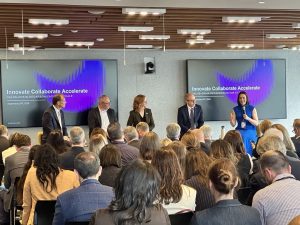
On Tuesday, September 24, the Center for Green Market Activation (GMA) released details related to its work in chemicals, as part of a Climate Week NYC session hosted by the Center for Climate and Energy Solutions and Boston Consulting Group. In what marked the official GMA Chemicals program launch, Kim Carnahan, GMA CEO, described the chemicals decarbonization challenge and the approach GMA and its stakeholders are taking to address a sector that contributes more than 6% of global greenhouse gas emissions.
Products from the chemicals sector are found throughout our daily lives, and chemicals emissions are a sizable and growing issue. Decarbonization efforts are being impeded, at least in part, by structural barriers that will require coordinated efforts to overcome. GMA believes that chain of custody and demand aggregation approaches have an important role to play in this work and is excited to embark on a program to gather critical insights to inform subsequent phases of this endeavor – with the ultimate goal of accelerating decarbonization of the chemicals sector while supporting efforts to address the global plastics waste crisis.
GMA Chemicals has been designed to deliver a range of benefits to its participants drawing from the model GMA has already applied successfully in other hard to abate sectors like aviation, maritime, and heavy-duty trucking. More specifically, GMA aims to do the following, in sequence:
- First, build a chain of custody system that enables the transfer of attributes from high integrity decarbonized chemicals to customers willing to pay a premium for a decarbonized product
- Second, develop a buyers alliance for such customers, aggregating their demand and managing joint procurement on their behalf
GMA will also provide education to buyers alliance members and the broader chemicals stakeholder community on GHG accounting and sustainability certification.
To kick off the system development process, GMA is convening a working group of stakeholders from across the chemicals sector – from producers to buyers, standard setters and NGOs – to ensure that diverse views input into our chemicals system design. Our approach is inclusive, working with both legacy chemicals producers as well as start-ups focused on game-changing decarbonized chemicals technologies.
Program design will continue through the remainder of 2024 and into the first part of 2025, after which GMA will shift our efforts from program design to activating the market through our buyers alliance.
Companies who are interested in getting involved should contact chemicals@gmacenter.org.
Related News & Resources