
02.25.26
GMA Insights | Key Takeaways from GMA Trucking’s New White Paper
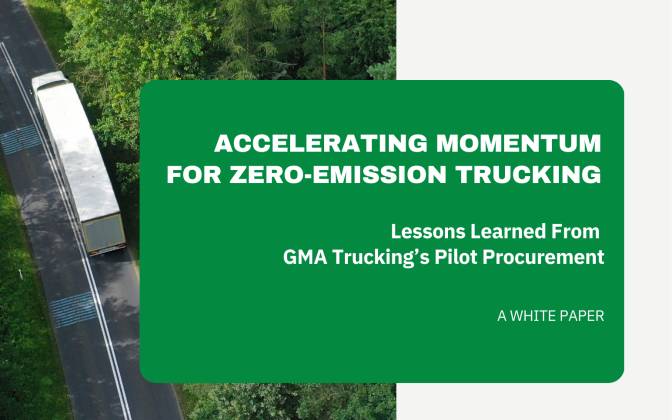
For the latest edition of GMA Insights, we’re taking a look at a new white paper released just this week, “Accelerating Momentum for Zero-Emission Trucking: Lessons Learned from GMA Trucking’s Pilot Procurement.” Assembled by the GMA Trucking program team, it offers a detailed examination of the market challenges GMA Trucking seeks to address, the critical role of demand aggregation and book and claim in addressing those challenges, and key findings from GMA Trucking’s recently concluded pilot procurement that will deploy 40 new battery electric trucks in the state of Texas.
The white paper, available for download here, includes an exploration of lessons learned that can be applied to future efforts, describing the pilot procurement as “an invaluable opportunity to explore the real-world dynamics of the zero-emission trucking market” and “a test case to identify friction points, gather actionable data, and understand the values, priorities, and constraints of different stakeholders.” A summary of insights follows.
Lessons Learned on the Benefits of Book and Claim and Demand Aggregation for the Zero Emission Trucking Market
- 1. Book and claim incentivizes and enables increased truck utilization above typical, current battery electric vehicle (BEV) usage, significantly reducing costs per mile.
- 2. Increased demand, aided by the flexibility of book and claim, can enable charger maximization and optimization, spreading CAPEX across more trucks and decreasing service costs.
- 3. Book and claim allows longer contract periods and the ability to spread costs over an extended time horizon with increased assurance of charger and truck utilization, leading to a reduction in overall project costs and increased bankability.
- 4. Innovative contract structures with tiered pricing of attributes reduces risk exposure, ensures high-integrity outcomes, and aligns incentives across parties.
- 5. A single entity facilitating alignment on key terms such as the criteria for high-integrity zero emission trucking certificates (ZETC), minimizes administrative burden when multiple parties are signing contracts.
Additional resources:
- Press release: First Ever GMA Trucking Procurement Brings Together Leading Companies to Enable Largest Known Deployment of Class 8 Battery Electric Trucks in Texas
- Webinar and Q&A: Webinar Q&A | GMA Trucking’s Pilot Procurement: Lessons Learned and the Road Ahead
- Frequently Asked Questions, including definitions of often-used terms like book and claim and demand aggregation
Interested in getting involved with GMA Trucking? Email trucking@gmacenter.org to get started.
Related News & Resources







02.05.26
Webinar Q&A | GMA Trucking’s Pilot Procurement: Lessons Learned and the Road Ahead
In January 2026, GMA Trucking announced the results of its pilot procurement that will enable the largest known deployment of Class 8 zero-emission trucks in Texas, and which showed the effectiveness of a market-based approach to accelerate deep decarbonization within the heavy-duty trucking industry. Shortly following the announcement, GMA hosted a webinar featuring GMA Trucking team members, the winning carrier Nevoya, and representatives of two corporate buyers discussing the procurement, lessons learned, and the road ahead. A recording and transcript can be found here. The compiled Q&A from that webinar is shared below. This includes questions that were answered live during the webinar, as well as those left unaddressed during the session because of time constraints. Please reach out to trucking@gmacenter.org with any further questions.
| Question | GMA Trucking Answer |
| How are the environmental attribute certificates (EACs) certified/verified? | The ZETc will be verified by an ISO 17029 accredited verifier for the application of ISO 14065, and in alignment with the requirements of ISO 14083 to calculate the emissions intensity of the transport activity (gCO2e/tonne-km). |
| Will the environmental attributes be sold and transferred via a registry? | Yes. Third-party registries are a critical part of the EAC market to ensure transparency and credibility. GMA Trucking is currently finalizing the registry provider but expects to have a functioning registry in time for the first generation of attributes to ensure accurate tracking and transparency. |
| Approximately how many years does it take for the lower operating costs to reach breakeven with the purchase cost of a battery electric vehicle? | There is no uniform answer, as both capital and operating costs will vary significantly across deployment opportunities. It depends on many factors, such as, but not limited to: vehicle mileage, diesel price, electricity price, demand charges, charging ownership model, charging infrastructure costs, and others. This leads to a wide range of payback periods, from only a few years[1][2], to many years, or possibly never. |
| How do zero-emission truck sales compare to overall truck sales? | While global sales of zero-emission medium- and heavy-duty trucks are slowly increasing (on pace for upwards of 4% of all new sales in 2025), that increase is driven almost entirely by China, where sales approach 15%[3]. In contrast, the U.S. market has stalled. Bloomberg NEF and Smart Freight Centre’s Accelerating the Transition report notes that zero-emission truck sales peaked at under 0.5% in Q2 2024 and dropped below 0.1% in the first half of 2025, with fewer than 200 zero-emission medium- and heavy-duty trucks sold nationwide[4]. This is in contrast to the over 200,000 diesel class 8 trucks sold in the same year. |
| Are 45V tax credits for clean hydrogen production still up under the new administration? | Yes, though the deadline for projects to begin construction has shortened. Projects must now start construction prior to January 1, 2028. |
| What is the energy source powering the winning carriers’ electric vehicles, and is GMA Trucking basing its analysis on Well-to-Wheel calculation? | Yes – ZETc are based on well-to-wheel (WTW) emissions intensity. As part of the RFP, GMA Trucking specified that the charging infrastructure used must be backed by renewable electricity. This could be accomplished either by using behind the meter on-site renewables or by purchasing a renewable energy product (e.g., Green-e eligible REC) equal to the volume of electricity utilized to charge the vehicles.
The energy used for trucking services will align with GLEC Framework and ISO 14083, which provides the methodology to measure the WTW emissions intensity per transport activity (tonne-km). This includes an approach to account for losses in the charging infrastructure while considering the data sources available. Per the standard, both location-based (using grid intensity) and market-based (using any contractual electricity certificates) emissions intensities will be calculated. |
| At what point in the process are vehicles purchased by the winning carrier? | The pilot RFP was open to bids for existing and/or net-new vehicles, though there was a preference for net-new.
For existing vehicles, GMA Trucking only considered vehicles that were already deployed but underutilized, or deployed but operating at a loss. |
| When will the trucks be deployed? | GMA Trucking expects the trucks generating the EACs to be deployed and in operation by the end of 2026 or early 2027. |
| Was the winning carrier able to fully satisfy the demands of the GMA Trucking members? | Yes, Nevoya is able to satisfy the final demand of GMA Trucking members. |
| What incentivizes shippers to buy EACs? | Shippers purchase EACs to meet their climate goals when decarbonized trucking services are not available on the routes used to physically move their goods. In these instances, shippers use EACs as a tool to complement their ongoing efforts to push their direct logistics providers to decarbonize their operations. |
| Is GMA Trucking’s model structured so that the EACs are only sold with the Scope 3 attribute, or also Scope 1? | The GMA Trucking program is set up for corporates to buy scope 3 EACs only – the carrier driving the zero-emission trucks claims any impact on scope 1 or 2 emissions. |
| Has GMA Trucking considered sharing lessons learned or releasing recommendations for these types of agreements? | Lessons learned from GMA Trucking’s pilot procurement will be shared in an upcoming White Paper. We are excited to connect with the market to share what we can about EAC offtake agreements. |
| How do you see GMA Trucking’s program scaling? | A key focus for GMA is to grow and scale programs past the pilot stages. The results from the GMA Trucking pilot will drive momentum and interest to scale up future efforts for larger impacts. It will also provide us, and the members, with the information and supporting infrastructure to transact more efficiently, including base contracting language and registry issuances. The standards landscape is also positioning to bolster demand for the program, as SBTi, GHGP, and AIM plan to release updates on the inclusion of market-based mechanisms like ZETc in coming months.
GMA Trucking is currently considering how to structure its next RFP and is considering how it may pair book and claim with physical procurement. |
| Will a recording of the webinar be shared publicly? | Yes. The recording, slides, and a transcript can be found here. |
[1] https://theicct.org/cost-electric-semi-feb22/
[2] https://www.terawattinfrastructure.com/blog/how-to-better-predict-your-ev-fleets-total-cost-of-ownership
[3] https://assets.bbhub.io/professional/sites/24/Zero-Emission-Commercial-Vehicles-Factbook-2025.pdf
Related News & Resources
01.15.26
First Ever GMA Trucking Procurement Brings Together Leading Companies to Enable Largest Known Deployment of Class 8 Battery Electric Trucks in Texas
Results from the first-of-its-kind pilot procurement show that a market-based approach can effectively accelerate deep decarbonization in heavy-duty trucking.
Washington, D.C. – January 15, 2026
In a major milestone for electric freight, the Center for Green Market Activation (GMA), in collaboration with strategic partner Smart Freight Centre (SFC), announced the results of its groundbreaking pilot procurement that will enable the largest known deployment of Class 8 zero-emission trucks1 and associated charging infrastructure in Texas. Leveraging corporate demand for decarbonized on-road shipping from first mover companies like Amazon, eBay, Etsy, Green Worldwide Shipping, and Meta, the program will support carrier Nevoya in deploying roughly 40 Class 8 battery electric trucks on a new all-electric Houston-Dallas route.
The trucks are expected to travel up to 7 million miles annually, reducing an estimated 60,000 metric tonnes of CO₂e, improving local air quality, and decreasing noise pollution. Through multiyear offtake agreements, participating companies will receive verified zero-emission trucking service attribute certificates as early as 2026, accelerating Nevoya’s fleet expansion and advancing decarbonization within heavy-duty transport.
“With this pilot procurement, GMA Trucking has shown how to translate market demand for zero-emission trucking services into scalable deployments,” said Kim Carnahan, CEO at GMA. “Through a competitive procurement process and advance purchase commitments from leading corporations, we’ve proven a replicable model to get urgently needed zero-emission trucks on the road. With contracts signed, we’re already planning for our next, even bigger procurement.”
While many shippers are committed to decarbonization, less than 1% of new heavy-duty vehicles in the United States are electric2 and companies struggle to find available zero-emission services on their routes. As the first large-scale application of book and claim to zero-emission trucking, the GMA pilot procurement tackles current EV access barriers and will enable Nevoya to deploy new trucks where they deliver the strongest commercial and operational value.
Similar to programs like the Sustainable Aviation Buyers Alliance (SABA) and the Zero Emission Maritime Buyers Alliance (ZEMBA), the GMA approach decouples the environmental benefit of the zero-emission trucking service from its physical delivery, allowing the environmental attributes to be sold and tracked separately. GMA Trucking members who purchase the attributes can claim the associated greenhouse gas reductions while helping grow the market for decarbonized trucking services.
“We’re thrilled to partner with GMA and Nevoya on this procurement,” said Sam Brundrett, Environmental Lead at Etsy, Inc. “This is an opportunity for an all-electric carrier to scale in a new location at a faster rate than otherwise possible. With millions of Etsy items moving through Texas each year, strengthening shipping reliability while cutting emissions and improving air quality for local sellers and buyers is essential.”
GMA Trucking’s book and claim system is built to promote accuracy, transparency, and credibility across the zero-emission trucking ecosystem. As Nevoya operates its vehicles between Dallas and Houston, an independent, accredited auditor will verify the environmental attributes being generated. These verified attributes will then be recorded in a registry, where they can be transferred to and retired by participating GMA Trucking members.
Charging will be fully backed by renewable electricity in the form of Green-e Renewable Energy Certificates (RECs).
“The advanced market commitments from GMA Trucking members represent a transformative moment—they’re not just supporting this deployment; they’re catalyzing a new model for how zero-emission trucking can scale,” said Sami Khan, CEO at Nevoya. “Book and claim helps unlock the capital and operational certainty to deploy electric capacity where it makes the most commercial sense, while our AI-native platform ensures we’re maximizing both utilization and emissions impact. Launching the Dallas to Houston lane is proof that the next era of trucking—combining zero-emission capacity, intelligent orchestration, and relentless efficiency—is already here.”
The GMA Trucking buyers alliance, launched in 2023 to accelerate the decarbonization of heavy-duty trucking, has grown to include nearly a dozen pioneering companies across technology, consumer goods, food and beverage, and other sectors who are ready to support action to address road freight emissions. This pilot establishes a model for future collective procurement efforts, helping to expand the deployment of Class 8 zero-emission vehicles into new regions while creating economically viable pathways for companies to invest directly in heavy-duty freight decarbonization. GMA Trucking is developing a second procurement, in partnership with SFC, that will combine book and claim with direct procurement of physical low-carbon trucking services for even greater scale and impact.
“Combining book and claim with direct procurement connects corporate climate commitments to real-world action, real trucks, real infrastructure, and real emissions reductions,” said Christoph Wolff, CEO of Smart Freight Centre. “This approach creates a scalable, credible pathway for decarbonizing freight.”
Companies interested in participating in future procurements or exploring membership in GMA Trucking can email trucking@gmacenter.org to learn more. GMA will also host a webinar at noon ET on Thursday, January 15 to provide an overview of the pilot procurement, share lessons learned, and discuss the road ahead – find out more and register here.
1 “Zero-emission trucks” refers to tailpipe emissions.
2 BloombergNEF & Smart Freight Centre. (2025). Zero-Emission Commercial Vehicles Accelerating the Transition. https://assets.bbhub.io/professional/sites/24/Zero-Emission-Commercial-Vehicles-Factbook-2025.pdf
Media inquiries please contact: Alison Greene, Communications Manager, alison.greene@gmacenter.org.
About the Center for Green Market Activation
The Center for Green Market Activation (GMA) is a US-based, globally focused non-profit. Through innovative procurement approaches and collaborative alliances, GMA catalyzes and scales the uptake of low-carbon goods and services within carbon-intensive industries such as aviation, maritime, trucking, cement and concrete, and chemicals. With collective decades of experience in environmental markets and alternative fuels and materials, the GMA team works to standardize new, green markets and forges mutually beneficial partnerships between climate-focused companies, suppliers, and mission-aligned non-profit organizations to channel funding to critical climate technologies in pursuit of accelerated sectoral decarbonization.
About Nevoya
Nevoya is the next-generation electric trucking carrier transforming American logistics through AI-native operations and customer-centric excellence. The company’s proprietary TMS platform optimizes vehicle utilization, routes, and energy consumption—proving that zero-emissions trucking delivers superior economics and service reliability compared to traditional diesel operations. By prioritizing efficiency, innovation, and deep customer understanding, Nevoya is establishing the new standard for freight excellence while accelerating America’s transition to sustainable logistics. Learn more at nevoya.com.
About Smart Freight Centre
Smart Freight Centre (SFC) is a globally active non-profit organization driving climate action in the freight sector. Its mission is to mobilize the global logistics ecosystem — particularly its members and partners — to track and reduce greenhouse gas emissions. SFC works to accelerate emissions reductions in line with 1.5°C pathways, aiming for a zero-emission global logistics sector by 2050 or earlier. Along the I-10 corridor, SFC has convened a shipper–carrier consortium to test and accelerate battery-electric truck adoption. For more information visit www.smartfreightcentre.org
Related News & Resources